




Read this article in 中文 Français Deutsch Italiano Português Español
How cranes support demolition projects

28 August 2026
Cranes can be integral to demolition and deconstruction projects, providing the lifting capacity needed to take down heavy structural elements.
Whether deployed on large-scale industrial sites, in ports or tight urban projects, these towering giants facilitate safe and measured dismantling for contractors across the globe.
While in the past, the role of the crane was more often associated with swinging a wrecking ball towards buildings, today they are used in much more sophisticated operations.
From helping to remove parts of large-scale industrial facilities to dismantling large road or port infrastructure or lifting equipment on and off urban sites, even holding up protective curtains during explosive demolitions, cranes are very much part of modern demolition.
On the harbour front
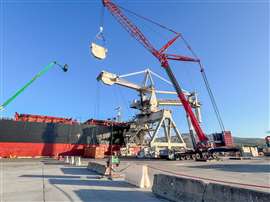 North American Dismantling Corp used a carefully engineered crane dismantling sequence in Hawai’i (Image: NADC)
In Hawai’I, North American Dismantling Corp. (NADC) used a carefully engineered crane dismantling sequence to remove a 128 ft (39 m) high Continuous Ship Unloader (CSU) at Kalaeloa Barber’s Point Harbor.
The unusual rail-mounted structure incorporated a counterbalancing system around a single pivot point, meaning weight had to be removed in a controlled sequence to maintain stability.
Working with Applied Science International, NADC developed engineering calculations and 3D models to plan each stage. A 700-tonne capacity Demag AC700 was the principal lifting crane, supported by 150-tonne and 90-tonne Grove cranes.
The largest lift was the CSU’s upper A-frame, weighing approximately 140,000 lb (63.5 tonne). Its movement was complicated by a large hydraulic cylinder of unknown strength and reliability, prompting NADC to fabricate a blocking system around the cylinder rod and install lifting chains around its pins to prevent unexpected movement during the pick.
Six 80,000 lb (36 tonne) concrete counterweights, positioned 90 ft (27 m) above ground, presented another lifting challenge. With their original rigging points corroded or missing, new lifting points were engineered and cored into each counterweight before they could be removed by crane.
Crane operations were carried out while the harbour remained fully operational, with fuel deliveries and vessel movements taking place close to the work zone and the CSU standing just four feet from the water.
Custom tie-down assemblies, incorporating 2 in wire cables, 35 t turnbuckles and four 55 t dynamometers, stabilised the structure while crews alternately removed weight from either side of the pivot and continuously monitored loads.
Using this controlled approach, NADC dismantled approximately 704,520 lb (320 t) of steel and 480,000 lb (218 t) of concrete, completing the four-week project two weeks ahead of the anticipated dismantling schedule.
Complex power station demolition
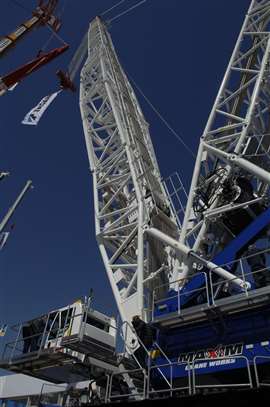 The Tadano CC 78.1250-1 1,250 tonne capacity crawler crane seen here at Bauma (Image: Alex Dahm/KHL Group)
In its first outing in the US, a Tadano CC 78.1250-1 crawler crane played an important role in the demolition of an old coal-fired power plant in the Ohio Valley.
Cleveland-based B&B Wrecking & Excavating enlisted the help of Maxim Crane Works to tackle the highly complex industrial demolition, the deconstruction of the W.H. Sammis coal power plant in Stratton, Ohio.
The plant was in operation from 1960 to 2023 when it was decommissioned as part of a transition to cleaner energy. A huge project expected to take between 2.5 and 3 years to complete, the plant will deliver over 100,00 of ferrous metal taken out using excavators equipped with ShearCore Fortress demolition shears.
While parts of the demolition were carried out using explosives, various other building components needed the lifting power of a crane due to the proximity of roads and other infrastructure.
Bryan Donatelli, project manager, B&B Wrecking, said, “We felt that bringing in this massive crane was exactly what we needed to maintain the schedule and do the work safely. It gives us the reach, the lifting capacity and the safety we need to get the job done.”
The Tadano CC 78.1250-1 is a 1.250-tonne lattice boom crawler built for heavy infrastructure and wind energy projects. It features a maximum load moment of 17,900 tm, main boom length up to 209.5 metres, and maximum tip height of 229 metres.
It was supplied in by Maxim Crane Works, one of the largest crane rental companies in North America and the first to take delivery of this model following its debut at Bauma 2025.
“Dismantling at this scale isn’t just about horsepower; it’s about precision. We’ve spent months engineering the lifts, coordinating the crew and prepping the Tadano 78.1250 to ensure every movement is calculated down to the inch,” commented Nikolaus Filippi, technical operations manager at B&B Wrecking.
Bridge dismantling over live railway
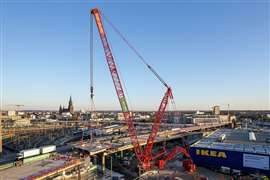 A Liebherr LR 11000 crawler crane dismantling a bridge in Germany (Image: Liebherr)
The dismantling of a major road bridge in Ulm, Germany, is another example of how heavy lifting can provide an alternative where conventional demolition methods are impractical.
With more than 100 m of railway tracks and overhead lines beneath the structure, explosive demolition and conventional excavation were ruled out. Instead, Swiss crane and logistics specialist Emil Egger AG (ETE), working with demolition and construction company Max Wild, developed a method based around a Liebherr LR 11000 crawler crane.
The bridge was divided into 56 individual sections, with the heaviest weighing up to 510 tonnes. Each section was first connected to the crane before concrete saws separated it from the remaining structure, making accurate calculation of the individual weights critical.
For the heavier lifts over shorter distances, the LR 11000 operated with an 84 m lattice main boom, which was subsequently extended to 128 m to reach more distant sections. The crane worked with up to 750 tonnes of ballast, including 450 tonnes of derrick ballast that could be extended to a radius of 30 m for certain lifts.
A Liebherr LTM 1650-8.1 mobile crane provided additional support, initially assisting with assembly of the LR 11000 before moving to the opposite side of the railway to dismantle an access ramp. Sections weighing up to 110 tonnes were similarly supported by the crane, sawn from the structure and lifted away individually. This approach allowed the bridge to be dismantled within tightly controlled railway closures while avoiding the risks associated with dropping demolition material onto the tracks below.
As demolition projects become increasingly complex and constrained, cranes are there to provide the reach, capacity and control needed to dismantle structures safely.


CONNECT WITH THE TEAM