




Read this article in 中文 Français Deutsch Italiano Português Español
Interview: NFDC President on tackling demolition’s problems head on

18 November 2025
Adrian Corrigan tells Demolition & Recycling International (D&RI) about his plans to tackle the skills shortage, improve safety standards, and strengthen the family-focused culture of the demolition industry.
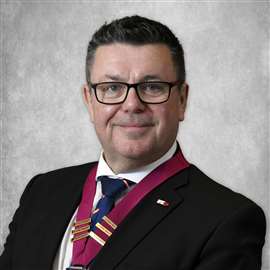 National Federation of Demolition Contractors (NFDC) President Adrian Corrigan. (Photo: NFDC)
With more than 27 years of hands-on experience in both construction and demolition, it’s fair to say that National Federation of Demolition Contractors (NFDC) President Adrian Corrigan is a safe pair of hands.
Now some months into the role, some would have viewed the timing of his appointment as somewhat of a baptism of fire, especially as the industry faces challenges ranging from the skills shortage, compliance and the energy transition.
But Corrigan, who has spent his entire career around the construction and civil engineering sector having started out at his father’s civil engineering firm, is enthused that the industry and its members are well placed to tackle key issues head-on.
Corrigan tells Demolition & Recycling International (D&RI) that his remit as President of the NFDC is to bring contractors together, with collaboration, skills, and strengthening the Federation’s ties across the industry high on the agenda during his tenure.
The challenges ahead
He does, however, acknowledge the scale of the challenges that lie ahead: “The biggest challenges right now are skill shortages and compliance. Compliance is vital, and I fully support it, but we’re at risk of being over-regulated.
“Contractors lose days and weeks making compliant bids when we’re already fully audited through NFDC and SSIP accreditations. It adds cost and distracts from what matters.”
To meet these challenges head-on, digital innovation is a priority, he says: “One big focus is on digital tools – especially developing a carbon calculator. It’s been discussed for a while, but we’re now close to putting real substance behind it.
“It’s the Holy Grail for sustainability in demolition, and we want to get it right rather than rush it.”
The skills shortage is also proving problematic for the industry. A report this year from Places for People in partnership with the University of Cambridge estimates that a gap of 140,000 job vacancies is stalling essential housing and infrastructure projects.
It’s not an easy fix, and the same report states that over one-third of construction workers will retire by 2035.
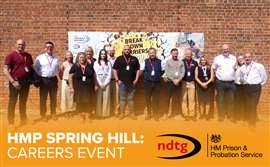 The NFDC supported a careers event at HMP Spring Hill in August as part of the Breaking Down Barriers programme. (Photo: NFDC)
The government has made pledges to tackle the shortfall, but Corrigan and the NFDC are already doing their bit.
He reveals: “We continually update our library of documents and codes of practice to reflect the latest technology and regulations. AI is now being looked at to see how it can benefit the Federation and our members.
“Our strategic membership officer, Brian Carroll, has been strengthening member focus and ensuring the Federation truly serves them. We’re keeping members informed about developments like BIM and the Building Safety Act 2022 – which, for the first time, considers how buildings will come down at the end of their life.”
Corrigan also stresses the scale of the work being done behind the scenes. “Our website and members’ area now provide more resources than ever. We’re also using regional meetings to share technical insights from ISPs and other experts – short presentations that spread knowledge and innovation.
“It’s not about sales pitches; it’s about education and staying ahead. My predecessor John Lynch did great work on this, and I’m building on that foundation. The Federation is nimble, up to date, and committed to making sure our members get maximum value and support.”
Despite the skills shortage, Corrigan argues that demolition, unlike construction, has a strong family focus and culture that helps attract and retain talent.
“Tier 1 and Tier 2 contracting is a bit more faceless — and that’s not a criticism — whereas demolition companies, even the biggest, are generally family-based and try to create that sense of family for new employees,” he explains.
“There’s more of a family feel, more time-served people, and I’ve always found it a nicer way of going on. That sense of belonging is key as we work to address skill shortages and keep talent in the industry.”
He adds that the NFDC mirrors this ethos. “It’s a very inclusive, friendly environment – we’re all competitors and desperate to win the next contract, but there’s real camaraderie and a good feel around the room when we meet up, because we all share the same gains and pains.”
Outlook for the UK demolition market
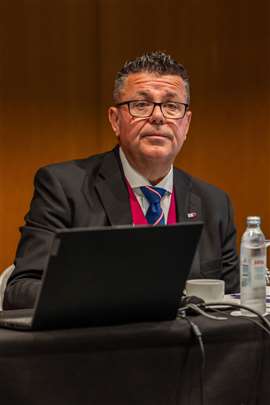 Corrigan speaking at the NFDC Annual Convention 2025 in Dubrovnik. (Photo: NFDC)
Taking a broader view of the market in the UK, Corrigan admits that it is “spotty” in the present and explains that many members, himself included, are finding start dates slow.
“We’ve got projects on the board waiting to go. There are bursts of activity followed by quieter spells – feast and famine,” he says.
London, he adds, is busy but with significant capacity, while regions such as Wales are seeing stronger demand. “On the whole, things could be better, but we’re still pushing for excellence and maintaining standards,” Corrigan notes.
He stresses the importance of upholding quality and safety, even when the market is competitive. “NFDC members are committed to using CCDO-qualified operatives, which comes at a cost, but it’s essential. When non-federation members undercut with cheaper, less qualified labour, it risks lowering standards.”
This commitment to professional standards is part of why Corrigan is keen to keep growing the Federation. “That’s why I’m keen to keep bringing new members into the Federation – good, professional firms that meet the benchmark.
“Around 85% of UK demolition work is done by NFDC members, which is strong, but there’s always room to grow,” he explains.
Improving the image of demolition
Of course, maintaining high standards isn’t just about training and qualifications, it’s also about protecting the industry’s reputation. Many, at least outside the sector, have commented on the issue of “cowboy contractors.”
Corrigan is measured on the topic when it is mentioned. “I don’t think it’s as big a problem as it’s sometimes made out to be. You tend to see the big failures in the press – the negatives get attention.
“When I talk about cowboy contractors, I mean those lacking competence. NFDC contractors have to demonstrate competence – that’s what sets them apart. Unfortunately, we do still see images on social media of unsafe or poor practice from non-federation firms.
“But nationally, it’s not a huge issue. There are still occasional cases where a less reputable firm wins a job by undercutting costs unrealistically, and that’s frustrating.
“All we can do is keep educating clients – inviting them to our talks and promoting competence, sustainability, safety, and training. Cowboy contracting isn’t widespread anymore, but we must stay vigilant and continue promoting professionalism.”
Collaboration beyond the NFDC
Looking ahead, collaboration will be key for the NFDC, but also for the future of the sector, and Corrigan places importance on wider industry collaboration.
He tells D&RI: “The Federation is working closely with the HSE, and that relationship is really positive. NFDC members don’t see the HSE as the big bad wolf – we’re collaborating constructively, and they’re involved in our NFDC Talks.”
He is also keen to strengthen ties with the Institute of Demolition Engineers (IDE), noting the value of working together.
“The IDE is a personal membership body, while the NFDC is corporate, but there’s huge crossover. Many of us, like myself, are members of both. I’ve got great respect for the IDE President, and we’ve agreed to work closely together. There’s no need for separation – by collaborating, both organisations and our members benefit.”
Perhaps there is a lesson in that quote. With the industry facing so many challenges, collaboration is more important than ever.
Lessons from 27 years
Corrigan draws on nearly three decades in construction and demolition to guide his leadership of the NFDC.
He says his approach is simple: “For me, it’s about being straight and fair with people, and appreciating those around you who work hard. I take the same approach to the Federation as I do to my business – it’s about personal relationships and appreciating the people who pull with you.”
Listening is also key, he adds: “At National Council meetings, there are lots of strong characters and differing views. I’m not the bang-the-table type – I listen to everything, make a decision, and stand by it. That comes from years in contracting, where you must be decisive, fair, and accountable. That’s the approach I bring to the Federation.”
He stresses that the Federation’s success depends on a strong team. “The Federation wouldn’t be anything without Leslie Ranson and her team – Silvia, Fran, Angela – all brilliant. Running the Federation requires a slightly different management style, but the principle is the same: if people are appreciated, you’ll get the best outcome.”

CONNECT WITH THE TEAM