




Read this article in 中文 Français Deutsch Italiano Português Español
WDS 2026: the highlights in pictures

12 November 2026
With 440 delegates attending across the three-day event in Madrid, the World Demolition Summit 2026 gathered contractors, equipment manufacturers and industry specialists, who came to share project experience, discuss common challenges and explore developments in recycling, safety and innovation.

Under the theme “World Class Demolition & Recycling: Driving Growth Through Innovation, Safety & Sustainability”, speakers examined challenging projects from around the world, explaining the planning, engineering and working methods behind their delivery.
From detailed project presentations to discussions on the future of demolition and recycling, the programme gave delegates an opportunity to learn from colleagues across the global industry.
Meanwhile, networking breaks provided time to renew friendships, make new contacts and continue conversations sparked by the conference sessions.
The event concluded with the World Demolition Awards and gala dinner, hosted by rugby legend Matt Dawson MBE. Now in their 18th year, the awards recognised outstanding projects, technical achievements and innovation across the sector.
Below, we revisit the conference presentations and share some of the highlights in pictures.* More detailed reports on key presentations will be published in due course.
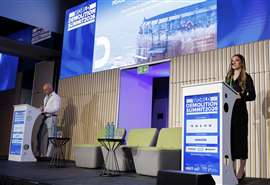 ICC-Commonwealth
Opening the conference, Andy Fournier and Sierra Boyuk (R) told the story of how ICC-Commonwealth in Canada tackled the enormous task of removing a deteriorated, 2,000-tonne steel flue liner from the Sudbury Superstack, a structure as tall as the Empire State Building.
Managing access, rescue and material handling at extreme heights, the team devised a radical new demolition method, the Rapid Descent Plan, that allowed them to safely drop huge plates of steel within the chimney. The impressive project ran from May 2020 to August 2024 and required around 157,000 labour hours.
 Urban Reuse
In his talk, Are Strøm, CEO of Urban Reuse, which is part of NG Nordic Group in Scandinavia, described how the contractor helped transform the former US embassy in Oslo. Focused on circular deconstruction and reuse, the project preserved the listed building and its original features while excavating beneath it to increase usable space by about 50%.
Strøm explained how the team supported the building on temporary steel piles, monitored settlement and transferred the load to a permanent basement structure. He argued that demolition contractors can apply their experience of complex, confined work to renovation by getting involved early in design and planning the sequence of work in detail.
 Recycling panel discussion
Jim Graham (L) (Winter Environmental) moderated a panel discussion on how demolition contractors could recover more products for direct reuse and produce higher-value recycled materials.
Marianne Hedberg (MH Miljöbygge) emphasised the importance of planning before demolition begins, while Kasper Sørensen (R) (Tscherning) explained the role of material mapping and finding buyers for recovered components. Eunan Kelly (CDE Group) called for clear end-of-waste criteria and specifications that will enable recycled aggregates to compete in suitable applications.
Questions from the floor explored market demand, rules governing on-site recycling and the potential to retain embodied carbon through reuse.
 TU Delft
Under the heading ‘Using robotics and AI for sustainable material recovery,’ Dr Mohanad Abukmeil presented TU Delft’s work on an autonomous drilling and material recognition module developed through the European DISCOVER project.
The concept uses one robot to scan buildings and identify sampling locations, and another to drill and analyse materials using cameras, near-infrared sensing and X-ray fluorescence. The aim is to identify materials before demolition mixes them together, helping contractors plan recovery and document the quality of recovered products.
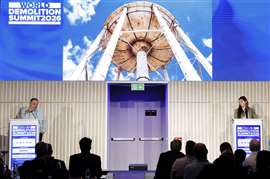 Tri-Phase Group
During a very visual presentation, Rachelle and Camille Atrache (L) described how their Canadian demolition company Tri-Phase Group dismantled the Snell Grove elevated water tank in Brampton, Ontario.
The structure stood at 43 metres (142 ft) tall and the tank itself measured 23 metres in diameter, with a capacity of 5,000 cubic metres, next to a playground that remained open throughout the work. Lead paint on the exterior required continuous air monitoring and paint removal at planned cut and anchor points. The team cut the tank into sections, lowered them by crane and restored the site for community use.
 DDM
Winners of the Best of the Best World Demolition Awards 2025, John Patist and Jorn Vermeer (L) explained how DDM dismantled a 780-metre bridge over the Rhine while keeping the shipping channel open and preventing debris from entering the river.
Working in reverse order of construction, the team used movable protective scaffolds, split the bridge at midspan and installed temporary supports and auxiliary cables to allow the original stays to be de-stressed and cut.
The project was completed within 20 months with no accidents, and 99% of the materials were recycled or upcycled. The pair stressed the importance of involving demolition contractors from the outset so that practical experience can inform design, planning and sequence of work.
 Jackson Demolition
Mark Ramun from Jackson Demolition Service discussed how squat risk was managed during the blowdown of a 650 ft concrete stack at a former coal-fired power station, when core tests revealed wide variations in concrete strength.
Finite element modelling indicated that the hinges might fail before the stack had rotated far enough to fall in the intended direction. This prompted the team to reinforce the hinges with steel plates and protect nearby assets, thereby ensuring that the stack would fall as planned.
 (L–R) Megan Vansant (NASA), Ron Gilbert (DetX), Austin Hays and James “JJ” Martin (Target Contractors) and Justin Taylor (NASA)
During the conference keynote, delegates were given a close look at the explosive demolition of two historic rocket test stands at NASA’s Marshall Space Flight Center in Alabama. The team took the audience from NASA’s decisions about retiring facilities through to the preparation and implosion of structures built to withstand rocket testing.
A project video combined footage of space rocket launches with scenes of the test stands’ demolition, giving delegates a sense of their history and scale. It showed the work and the blasts, including the fall of the Dynamic Test Stand, which stood more than 475 ft tall.
The speakers explained how planning involved five federal agencies and more than 100 NASA stakeholders, while accommodating active test schedules and restricted site access. They described trial blasts, structural modifications and measures to control blast overpressure before the implosions on 10 January 2026.
 C&D Engineering Consultants
Mike Kehoe explained how C&D Engineering Consultants successfully carried out the explosive demolition of a 107-metre chimney on Anglesey, in Wales, where the surrounding activity made timing particularly demanding. The team had to coordinate the blowdown around ferry and rail services, road access, air operations and an active industrial site, while managing public interest in watching the blast.
Road restrictions covered about 4.5 miles, and the team worked with local councils, emergency services and Network Rail to establish a suitable blast window. Drones checked the exclusion zone before firing, while contingency plans covered communications failures, extended closures and an alternative blast plan.
 Grupo Mitre
Miguel Ippolito described how attending the World Demolition Summit in 2013 helped inspire Grupo Mitre to develop its demolition and recycling business in Argentina. He recalled feeling like the Flintstones visiting the Jetsons: the same industry, but seemingly a different century.
The experience encouraged the company to invest in recycling and build demand for recovered materials despite economic instability and limited regulatory support. Projects at a port, racetrack and airport demonstrated its approach, while documenting environmental performance helped secure sustainable finance.
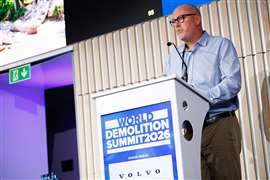 Erri Berri
Closing out the conference, Jose Carlos Juan Muñoz from Erri Berri outlined the company’s approach to complex demolition projects, combining skilled teams, investment in machinery and digital waste tracking. The Spanish contractor reported a 98.56% waste recovery rate in 2025, managing almost 360,000 tonnes.
The presentation highlighted work at the Málaga Nostrum shopping centre, where demolition involved night operations within a fully operational retail park, and the former La Fe Hospital in Valencia, covering ten buildings up to 56 metres high. The projects achieved reported recovery rates of 98.22% and 99.54%, respectively.
* All images (C) Demolition & Recycling International / KHL Group

CONNECT WITH THE TEAM