




Read this article in 中文 Français Deutsch Italiano Português Español
Engineering demolition in a live industrial environment: The Matosinhos Refinery
Partner Content produced by KHL Content Studio
19 October 2026
How a ‘One Project, One Team’ approach is helping GALP and Hughes & Salvidge tackle the complex decommissioning of Portugal’s former Matosinhos Refinery.
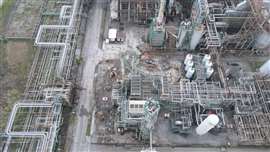 Large-scale excavators at work within the former Matosinhos Refinery, dismantling redundant industrial structures as part of this complex, multi-phase demolition project
Good communication, collaboration and a shared commitment to safety are hardly radical approaches to delivering a major demolition project. Far harder is creating a team in which that collaboration becomes something more ingrained, with people genuinely caring about one another and successful delivery becomes a consequence of that shared commitment, rather than its sole purpose.
That distinction sits at the heart of the ‘One Project, One Team’ approach adopted by Portuguese energy company GALP and UK demolition contractor Hughes & Salvidge. Their work together centres on the former Matosinhos Refinery in Porto, Portugal, a 2.37 million sq m Seveso-regulated site divided into 18 demolition areas.
Hughes & Salvidge is dismantling former process infrastructure while part of the site remains operational as GALP’s logistics park. For GALP, that has meant convincing others that the two activities can be carried out safely side by side.
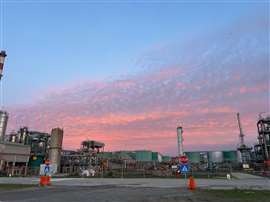 Against a spectacular Portuguese sunset, the scale of the Matosinhos Refinery project comes into focus
“We needed the Portuguese authorities to trust us,” says Carlos Fagundes, Project Manager at GALP. “We needed to demonstrate that we could operate the logistics park alongside the demolition areas, and do it safely.”
Decommissioning the Matosinhos Refinery
GALP decided to close the refinery in December 2020, beginning a lengthy period of permitting, regulatory approvals and preparation.
The company cleaned and isolated the redundant plant from the continuing logistics operation, while a complex tender process, supported by engineering consultancy RVA Group, led to the appointment of Hughes & Salvidge.
When mobilisation began in July 2024, client and contractor had already spent months preparing.
Planning for each of the 18 demolition areas required more than determining how individual assets would be brought down.
The sequence was shaped by the conditions surrounding them: a substantial interconnected pipe network over waterlogged ground was deliberately left until the dry summer months, while structures surrounding distillation columns were cleared to create sufficient felling space, with other assets set to remain permanently as part of a heritage scheme.
That preparation was supported by people who knew the refinery from its operational life. Fagundes says: “We had the opportunity to keep former operators and former maintenance supervisors with us. It was the best way to make sure that, between the decision to close and the start of demolition, everything was cleaned and prepared.”
When conventional demolition methods fall short
As demolition moved forward, the ‘One Project, One Team’ approach shaped how the team responded to challenges on site, including when conventional industry solutions proved not to be the safest.
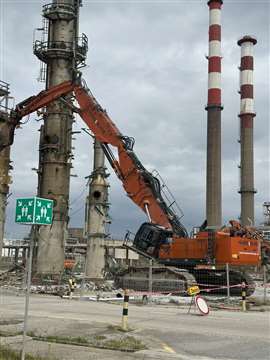 Excavator working across the refinery’s extensive process areas, removing redundant plant and infrastructure within a highly controlled industrial environment
“We entered this project knowing there would be challenges, but we would not settle for anything less than delivering it safely,” says Martyn Burnett, Chief Executive Officer at Hughes & Salvidge. “With every challenge we came across, the question wasn’t commercial. It was whether what we were doing was safe.”
That principle was tested when Hughes & Salvidge began assessing how to remove approximately 280 tonnes of asbestos-cement packing from one of the refinery’s cooling towers. On cooling towers the contractor had previously encountered, the equivalent packing had generally been plastic.
At Matosinhos, corrugated asbestos-cement sheets were packed so densely that Joe Parnell, Contract Manager at Hughes & Salvidge, describes the interior as “basically a solid cuboid of asbestos-cement”.
Removing the material manually was considered first. But reaching it would have required extensive work at height – itself a primary risk – and a complicated scaffold arrangement, potentially including a working deck suspended from openings at the top of the tower.
The scaffold also had to leave enough space to physically extract the densely packed sheets, without the risk of damaging them and exposing the asbestos fibres.
“Whichever way you tried to do it, you could not eliminate all of the risks,” says Parnell. “No matter where you put the scaffold, it would have physically restricted the removal.”
Mechanical demolition of an asbestos cooling tower
Hughes & Salvidge therefore developed a comparative risk assessment for manual removal and mechanical demolition.
“Whilst obviously we like to remove asbestos by hand wherever possible, sometimes the immediate risks in doing so outweigh the potential fibre release in doing it mechanically,” Parnell says.
The comparative risk assessment led Hughes & Salvidge to propose mechanically demolishing the tower with the asbestos-cement packing still inside. But adopting that methodology required more than agreement between contractor and client.
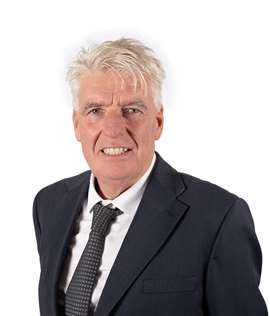 Hughes and Salvidge CEO, Martyn Burnett
The team had to demonstrate to Portugal’s ACT regulator that mechanical demolition presented the safer option.
“They’d never come across it before,” says Parnell. “We were concerned that they would immediately shut down the idea of a mechanical demolition.”
Instead, ACT accepted the conclusions of the comparative risk assessment, allowing the methodology to be developed with the regulator’s involvement. According to Parnell, “It really did take a lot of time and many minds to come together to develop a suitable safe system of work.”
The approved methodology relied on layers of control around the demolition and subsequent handling of the asbestos-cement material. A high-reach excavator brought down the tower, with a second machine processing the material at ground level.
No fewer than 12 monitoring pumps operated continuously at three radii around the perimeter, while the machines were fitted with filtration systems and the operators used respiratory protection and personal monitors, with water suppression used throughout.
The tower’s existing basin provided containment as the structure came down, collecting suppression water and demolished material. The water was pumped through HEPA filters into the refinery’s drainage system before passing through GALP’s water-treatment process and being reused through the site’s fire-hydrant system.
Processing the material presented another logistical challenge. The asbestos-cement had to be loaded into specialist skip bags before being sealed for disposal. When a shipment of the bags was held in customs for around four weeks and failed to arrive, Hughes & Salvidge collected another pallet from Birmingham, UK, and drove it to Portugal.
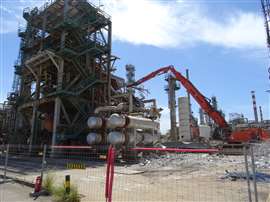 Heavy excavator carrying out controlled mechanical demolition among existing industrial structures, with careful planning essential to managing the site’s operational and environmental challenges
Demolition and processing took around five weeks, during which none of the 12 continuously operating monitoring pumps recorded asbestos fibre levels above the permitted threshold.
For a methodology considered sufficiently unusual that Parnell feared the regulator might reject it, the result was significant.
The safe demolition of the cooling tower contributed to a project-wide total of more than 100,000 working hours without a reportable safety or environmental incident, while recovered material across Matosinhos has passed 23,600 tonnes.
Making ‘One Project, One Team’ work in practice
Behind that outcome was a way of working that had begun taking shape long before the cooling tower came down.
‘One Project, One Team’ had been the intention from the outset, but Fagundes acknowledges that turning it into day-to-day behaviour took time. “It’s not easy to set this spirit inside a day-by-day approach,” he says.
Burnett can pinpoint the moment when he felt that changed. Hughes & Salvidge had mobilised in July 2024 and, around four months later, he was standing on site watching the teams at work.
The interaction between them no longer felt divided along the lines of client, contractor and consultant. Watching them work together, Burnett turned to Fagundes and said: “We’re there now. Your people are my people, and my people are your people.”
Being part of that team also meant everyone being able to speak and be listened to.
Fagundes explains that, “During the project’s weekly safe-hands meetings, everybody was able to raise their hand and say, ‘I want to clarify this topic. I want to understand this. I do not agree with that’.”
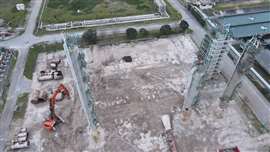 Specialist demolition excavator tackling heavy industrial structures, combining experienced operators, carefully planned methods and the right equipment for the task
In these situations, the management teams of GALP and Hughes & Salvidge were keen to understand people’s positions.
Sometimes, says Fagundes, “that meant taking a step back, waiting a day or two if necessary, and only proceeding when everybody’s concerns had been understood and addressed”.
The scale of the refinery means demolition is progressing across multiple work fronts.
Work expanded from the north and south of the site, with the teams progressively moving towards the centre and Hughes & Salvidge increasing people and machines as required.
Some of the demolition areas have effectively become projects of their own, with dedicated supervisors responsible for them.
The project’s complexity meant ‘One Project, One Team’ was necessary from the outset. No single party could deliver it in isolation. As Burnett puts it: “Hughes & Salvidge have needed GALP and GALP have needed Hughes & Salvidge. We’ve needed RVA, RVA have needed us.”
Preparing for explosive demolition
The team is now preparing for some of the most technically demanding operations ahead. Eight structures are planned for explosive demolition, including four chimneys approximately 100 m high, with extensive planning and risk management required to protect live assets around them.
Planning has taken around eight months. “It’s almost been a project in itself,” says Parnell. Around the drilled sections, chain link, wire rope and geotextile will be reinforced with steel plates, while 4 m-high crushed-material bunds will contain debris when the structures fall.
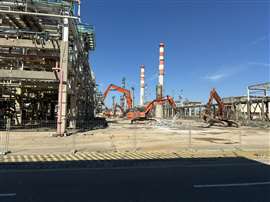 A fleet of demolition excavators works across the Matosinhos Refinery, demonstrating the specialist plant, technical expertise and coordinated delivery required for a project of this scale
Protecting the refinery’s remaining infrastructure requires further measures. Vessels will shield fire hydrants and shipping containers will protect pumps, while concrete mats will cover the underground drainage network.
Beyond the site itself, the explosive works must also account for the refinery’s proximity to residential areas, a hospital, a beach and the airport.
Ahead of the blowdowns, the team is coordinating with civil protection and arranging access for dilapidation surveys of neighbouring assets to establish a baseline for assessing any effects from air overpressure or vibration.
The explosive demolitions will add another complex operation to a project that remains without a reported injury or environmental incident. “It’s not easy to achieve,” says Fagundes. “We need to recognise these moments.”
That recognition included stopping work to mark the milestone. “We forgot about commercial,” says Burnett. “We stopped the job and made sure the team was recognised for the achievement.”
With some of the project’s most demanding operations still ahead, the priority at Matosinhos remains unchanged: completing the demolition safely while protecting the people, infrastructure and surroundings that remain.
--------
This article was produced by KHL Content Studio, in collaboration with experts from Hughes & Salvidge and GALP
--------
All images courtesy of Hughes & Salvidge and GALP
--------