




Read this article in 中文 Français Deutsch Italiano Português Español
Construction must make reuse the default, says Holcim

08 June 2026
The latest episode of Holcim UK’s podcast The Material Mix examines how circular thinking is beginning to influence decisions across design, policy and construction.
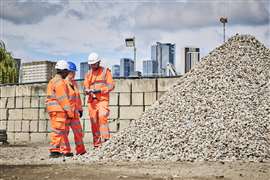 Construction and demolition generate ~32% of total UK waste by volume according to DEFRA (Image: Holcim)
Holcim UK has previously backed mandatory verification and third-party certification and is calling for reuse to become the industry default.
The company says that construction industry must move towards treating the reuse of materials as a standard part of development rather than an exception, as pressure grows to reduce both costs and carbon, according to a leading expert in materials innovation.
This issue was discussed in the company’s podcast series The Material Mix, in the latest episode entitled “Building it Twice”.
Danielle Dawson, innovation manager at Holcim UK, said the continued loss of valuable materials through demolition reflects a wider misalignment between how value is defined and how it is captured in practice.
Speaking on the podcast, she said, “We are still discarding materials that have already been processed, transported and built into place. That points to a gap between how value is defined and how it is captured in practice.”
“If reuse is to become standard, the construction industry will need to look beyond individual materials and consider how value is retained across the lifecycle of a building.”
The podcast highlighted how construction and demolition continue to generate approximately 32% of total UK waste by volume, according to official figures from DEFRA, the government department for environment, food and rural affairs.
Dr Helen Fairclough, lecturer in structural engineering at the University of Sheffield, and panellist on the podcast, said the value embedded within existing buildings is often under-recognised in decision-making.
“There is significant value in the materials within our buildings, and that value can be maintained over the lifecycle of those assets,” she said, adding, “The question is how we design and manage buildings so that materials retain their usefulness beyond a single use.”
Also on the panel was Kim Gault, principal sustainability consultant at Cundall, who said the shift towards circularity was already well understood, but progress remained uneven.
“The urgency is not new, but it is still not fully reflected in how the industry operates. Policy is not always as responsive as it needs to be, and updates can lag behind where the market is moving. In practice, much of the change is being driven by clients, particularly through ESG requirements.”
Dawson stated that concerns around performance of recycled aggregates and reclaimed materials were no longer the primary barrier.
“Questions around quality have largely been addressed. Technology has moved on, and we are producing materials from recycled sources that meet the same standards as traditional products. In many cases, we can make a high-quality product from what was previously treated as waste,” she said.
“The challenge is that it does not always align neatly with carbon. Recycled materials can involve additional processing and transport, which can increase embodied emissions in the short term.
“That is where a broader shift in mindset is needed, so decisions are taken on a whole-life basis rather than at a single point in time.”
Dawson said progress would depend on aligning how the industry approaches materials across the supply chain: “We have to make this happen. The capability is already there, but the system has not yet caught up. Education is a big part of that. This is not a niche issue; it is becoming central to how the industry operates.
“Once that understanding is more widely shared, reuse and recovery will not sit alongside construction as an alternative. They will increasingly define how projects are delivered,” she said.
Dr Fairclough added that delivery remains complex in practice: “The challenge is often at project level. What materials are already on site, what is available nearby, and how do we make that work as a system. That requires better information, and greater confidence among those making decisions who are not necessarily specialists.”
Where these constraints are addressed, the benefits are beginning to emerge. Across the UK, existing structures are being repurposed for new uses, retaining material value while responding to changing demands.
Dawson said: “The most net zero building is the one that is still standing. The priority has to be extending the life of what we already have. Where demolition does happen, the question is how we embed reuse as a standard part of the process.”
She concluded, “This will continue to improve. The technology is developing, the quality is there, and the opportunity is clear. The issue now is how quickly the industry chooses to act on it.”

CONNECT WITH THE TEAM