




Read this article in 中文 Français Deutsch Italiano Português Español
Why material recovery is becoming a competitive advantage for demolition contractors
Partner Content produced by KHL Content Studio
19 October 2026
Demolition contractors around the world are under pressure to recover more from the waste streams their projects generate.
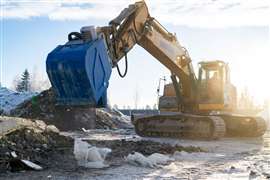 A large excavator using a Dynaset HRVB heavy-duty vacuum bucket
What drives that pressure differs from market to market. Waste regulations and recycling requirements vary considerably between regions and countries, with some imposing far greater demands on contractors than others.
At the same time, growing public awareness of the environmental damage caused by human activity is changing what people expect from businesses and the projects they deliver.
Those expectations are increasingly reflected in client demands, sustainability targets and contractual requirements for greater recovery, reuse and recycling of materials.
For contractors, meeting those expectations presents a practical challenge. Recovering and separating materials takes time, labour and equipment.
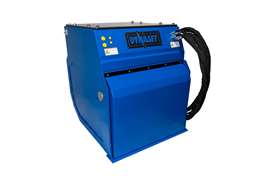 A close look at Dynaset’s hydraulic recycling vacuum bucket
The commercial question is therefore not simply how much material can be recovered, but how efficiently recovery can be integrated into the demolition process.
That challenge becomes particularly apparent with lightweight waste.
Steel and other heavy materials can be handled mechanically, but lightweight fractions such as plastics, insulation, textiles, small pieces of wood and light expanded clay aggregate (LECA) can be more difficult to separate from the heavier demolition stream.
Collection typically involves site workers using bags, rakes, shovels and brushes to gather these materials by hand.
The method is straightforward. The problem is that it takes time.
Every hour spent manually collecting lightweight waste represents not just paid labour, but industry expertise that cannot be used elsewhere.
As the amount of material or area being cleared increases, so do the man-hours required to recover it.
In markets where skilled labour is particularly expensive, that can turn a simple sorting task into a costly use of a contractor’s workforce.
For Esa Kannisto, Key Account Manager at Finnish hydraulic equipment manufacturer Dynaset, the challenge is not simply the time spent collecting lightweight waste, but the wider labour, safety and waste-handling costs associated with doing so.
 Esa Kannisto, Key Account Manager with Dynaset
While particularly relevant to demolition, the same considerations apply wherever lightweight materials need to be recovered from active industrial or infrastructure sites.
“In practice, this could mean needing extra people to pick up this light material,” says Kannisto.
“It’s not appealing work and it is not safe – having people walking around active work areas presents additional safety risks. And if a contractor cannot adequately separate those light materials in different boxes, then they must pay a lot more in associated mixed-waste costs, compared with situations where everything is separated.”
Separating waste materials
Keeping lightweight waste separate from the rest of the demolition stream can reduce the amount of mixed waste that requires treatment or disposal.
Separating materials at source also creates cleaner individual waste streams, making it easier for those materials to be directed towards appropriate recycling or recovery routes.
Where mixed waste attracts higher transport, treatment or disposal costs than separated waste streams, reducing that volume can therefore produce a further saving for the contractor.
Exactly what must be separated varies between markets and projects. Requirements may be set by regulation, client specifications or sustainability targets, while the costs of treatment and disposal, and the recycling infrastructure available, also differ by location.
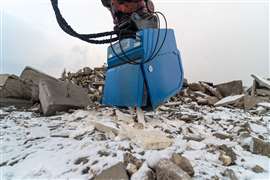 Dynaset’s HRVB is used to lift light material from frozen ground
As a result, both the requirements for material separation and the commercial value of carrying it out efficiently will depend on the project.
Client requirements, in particular, reflect a much broader shift in public expectations.
Concern is growing about the extent to which human activity is destroying and degrading the natural systems and habitats on which we depend.
Businesses themselves are therefore placing greater importance on reducing their environmental impact, with many choosing to go beyond minimum regulatory requirements.
For contractors, these changing priorities can ultimately translate into more demanding contractual requirements for the recovery, reuse and recycling of materials.
Kannisto has seen how specific those requirements can become. He says: “On a recent harbour project in Denmark, for example, the contractor was required to prevent lightweight material from being blown beyond the work area. It was a particularly windy location, so effective collection and containment of that material became an important part of meeting the project requirements.”
Taking manual work out of recovery
For contractors, the challenge is therefore not simply to recover more material, but to do so without making the process increasingly dependent on manual labour.
Mechanising the collection of lightweight waste offers one way to address that problem.
That was the solution a Finnish contractor was looking for when it approached Dynaset about developing a way to collect lightweight materials, including mineral wool insulation, polystyrene and plastics, from worksites.
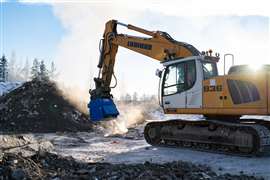 lightweight materials can be difficult to separate from the heavier demolition stream
The request led to a development process lasting around two years and involving several prototypes, ultimately resulting in Dynaset’s hydraulic recycling vacuum bucket, or HRVB.
The HRVB attachment works on a principle similar to a large industrial vacuum.
Powered by the carrier’s hydraulic system, a turbine creates high-volume airflow that draws lightweight material into the bucket while leaving heavier material behind.
Building on the original HRVB design, Dynaset has also developed the HRVB-HD, which incorporates more durable materials and a reinforced structure that can withstand particularly demanding demolition site conditions.
Designed for use on hydraulic carrier machines, including excavators, material handlers and backhoe loaders, the attachment can be incorporated into quick-coupler arrangements, allowing the operator to change attachments from the cab.
The commercial significance for contractors lies in what that process changes on site.
A task traditionally carried out by workers using bags and hand tools can instead be performed by the machine operator, allowing lightweight material to be collected as part of the machine’s work rather than through a separate manual operation.
Importantly, the value of mechanising this process does not necessarily lie in the material being recovered. Some lightweight waste has little inherent value, yet still has to be collected, separated and managed.
Kannisto points to insulation as one example. “While the material itself may have little value, its removal still represents a handling cost for the contractor,” he says.
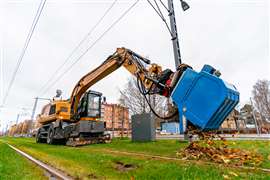 A vacuum bucket attachment removes leaves from tram tracks
“Mechanising that process can therefore create value through the efficiency of the operation itself, rather than through the value of the recovered material.”
The wider business case
Mechanising collection also changes where people need to be while the work is taking place.
Demolition requires careful management of people, plant, structures and debris.
Exclusion and working zones change as a project progresses, while interaction between pedestrians and mobile equipment is an established risk that must be controlled.
Removing the need for workers to manually collect lightweight material therefore reduces the amount of time they spend on foot within active work areas.
Taken together, these gains in labour efficiency, waste handling and safety change the commercial equation around material recovery.
The more efficiently recovery can be incorporated into the demolition process, the less it becomes an additional demand on the resources required to deliver the project.
The environmental objective remains greater recovery and better use of resources.
For demolition contractors, the commercial opportunity lies in achieving that objective without allowing material recovery to become a slow, labour-intensive process sitting alongside the demolition work.
As clients, regulators and project teams place greater emphasis on what happens to demolition materials, contractors will increasingly be judged not only on what they demolish, but on how effectively they manage what is left behind.
The competitive advantage comes from being able to do both efficiently.
--------
This article was produced by KHL Content Studio, in collaboration with experts from Dynaset
--------
All images courtesy of Dynaset
--------