




Read this article in 中文 Français Deutsch Italiano Português Español
Reaching high while keeping stable

30 April 2026
PRODUCT FEATURE: HIGH REACH EXCAVATORS
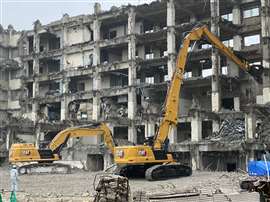 Cat 340 UHD at work (Image: Caterpillar)
High reach excavators are built to take on the toughest challenges in demolition. In this article, we learn from manufacturers how they are helping contractors stay safe despite the extreme demands placed on equipment.
Working at maximum height with heavy tools attached – often on hazardous ground in dense urban environments or at large-scale industrial sites – requires the ultimate in precision and risk management.
Naturally, we find that stability, control and safety are among the main considerations in high-reach demolition, where excavators take down tall and complex structures in a carefully orchestrated sequence.
“In demolition, machines must deliver the right balance between stability, reach, work tool capability and transportability – all while achieving productivity goals and maintaining safety,” comments Caterpillar’s demolition segment specialist – EMEA, Jean-Christophe Etienne.
Stability criteria
Achieving greater reach is only half the equation according to Olivier Rasmont, general manager marketing and engineering at Kobelco. “The real challenge lies in maintaining stability and precision at full extension. Every additional meter amplifies forces throughout the machine, so structural design and counterweight strategy are critical.”
Peter Bauer, segment leader at Volvo Construction Equipment, highlights the varied demands demolition contractors face across different applications and regions, “The biggest challenge is meeting – and ideally exceeding – customer expectations on performance, handling and day-to-day operation.
“Because the applications vary so much across regions, attachments and real site conditions, we need a very strong understanding of the customer’s business.”
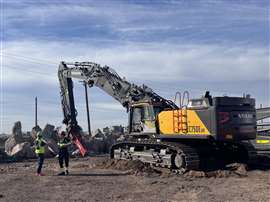 Volvo EC750 High Reach (Image: KHL Group)
Volvo’s new EC950 High Reach excavator, recently introduced in the US, is built to meet the company’s Ultra High Reach (UHR) stability criteria.
These focus on maintaining balance at height with heavy tools using a new reinforced undercarriage design, a 38.1-ton removable counterweight, specialised ring gear and a purpose-built upper frame with a boom adapter. It has joined the EC400, EC500 and EC750 High Reach machines which are available in Europe as well as the US.
Hydraulic performance
Consistent hydraulic performance plays a crucial role, controlling movement to avoid instability during operation and ensuring that large tools remain productive at height.
“Advanced hydraulic systems allow operators to maintain accuracy even at extreme heights,” says Rasmont, highlighting how modern machine design is pushing precision further in high-reach demolition.
“At high reach, hydraulic responsiveness isn’t just about efficiency, it’s about control and confidence for the operator. Fine movements at 40 or 50 metres must feel as predictable as they do at ground level.”
Kobelco’s family of high-reach demolition machines comprise the SK350DLC, SK400DLC, SK550DLC, the new SK650DLC and the flagship SK1300DLC. This range is complemented by three straight boom machines: the SK260DLC, SK300DLC and SK350DLC.
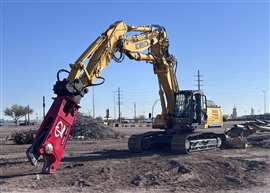 Kobelco excavator at Demolition Phoenix (Image: KHL Group)
Controlling the load
Careful load control strategies must be implemented at all times. Distribution load and resistance to tipping are managed on the excavator by counterweights and by extending the undercarriage on the machine.
Meanwhile, digital systems provide continual support for operators by tracking factors such as boom angle, reach, attachment configuration and machine load.
This reduces the risk of overloading or unsafe operating positions, while also providing alerts or operational data that can be used to improve site safety and operator awareness.
“Our integrated systems, such as stability monitoring, help keep operators informed about their work tool position, ensuring they stay within the safe working range and provide warnings as the machine approaches stability limits during operation,” explains Caterpillar’s Etienne.
The company’s Cat Payload system for its UHD (Ultra High Demolition) excavators provides on-the-go weighing to help avoid overloading, underloading or misloading materials. It also allows operators to achieve precise loading targets (typically within 1%).
The system relies on sensors that calculate material weight during lifting which Cat says can boost productivity by up to 25% and reduce fuel consumption.
Operators of Volvo CE’s excavators enjoy real-time safety monitoring delivered through the total moment indicator (TMI). This gives them continuous feedback to help prevent tipping or overloading and ensure safer, more efficient demolition operations.
Ensuring efficient operation
The balancing act between safety and uptime is always a challenge, one made even harder in demolition because, as Matt Buerstatta, product marketing manager at Komatsu, explained, “High reach excavators work on sites that are uniquely challenging in that there is a certain amount of chaos that demolition brings – from falling debris and risk of impact to mixed construction materials, curious neighbours and members of the public.”
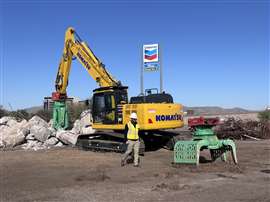 Komatsu PC490LC HRD (Image: KHL Group)
Operating heavy machinery in these demanding environments requires a combination of precision, operator comfort and equipment versatility, he said, adding that “the ability to quickly and efficiently transition between the correct attachments with a quick coupler is also important.”
Alongside attachment versatility, visibility is another critical factor, as operators need a clear understanding of the work area above and around them, as well as awareness of nearby workers and equipment.
“Any design element that improves visibility, communications or overall awareness of the demolition site will help ensure efficient operation, and that you are creating the opportunity for there to be a safer work environment,” he said.
Looking at the impact of unwanted downtime, Buerstatta noted, “The cost of downtime can multiply quickly, so the more data the operator or fleet manager can pull off the machine to get ahead of preventive maintenance or identify potential machine failures the better.”
To support this, Komatsu’s PC490LC HRD features a special HMI (human machine interface) screen that serves as the main control hub for all the extended reach components, giving operators greater control and confidence over some of the machine’s most critical working elements.
Monitoring for safety and efficiency
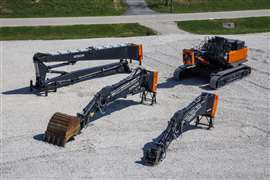 Hitachi ZX600 with boom options (Image: Hitachi CM)
Hitachi’s ZX400MC-7 and ZX600MC-7 demolition excavators also feature stability monitoring systems, along with additional counterweights and hydraulically adjustable undercarriages that extend to improve stability before retracting for easier transport.
Akarsh Shetty, product manager – special applications and new technologies at Hitachi Construction Machinery (Europe), agrees that digital technologies play a critical role in high-reach demolition scenarios.
“Digital technologies such as telematics, sensors and remote diagnostics enhance safety through load and stability monitoring, improve performance using data-driven insights and reduce downtime through faster troubleshooting and more efficient servicing,” he noted.
“They also help businesses monitor machines in real time, enabling them to identify issues before they become major problems and carry out predictive maintenance more effectively.”
Looking ahead, Shetty said the next generation of high-reach excavators will be shaped by advances in digitalisation, more sophisticated hydraulic systems for improved precision and efficiency, enhanced safety technologies and the gradual adoption of automation and remote operation.
New to market
One of the latest high-reach excavators brought to market comes from Hyundai Construction Equipment Europe which introduced the HX520A high-reach demolition (HRD) in April. The new machine sits on a hydraulically adjustable undercarriage that retracts to 3,000 mm for transportation and extends to 4,000 mm to provide stability for high reach work.
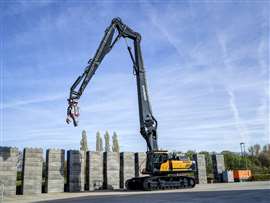 Hyundai HX520AL (Image: HCEE)
In terms of safety, the new HX520A HRD can be fitted with a camera on the demolition boom to give the operator a closer view of the working area. This comes with a load management indicator (LMI), with overload and over pressure warnings, to provide safe working load data in all boom configurations.
Across the market, we see continual developments in high-reach excavators, with advanced stability systems with precise hydraulic control and telematics designed to meet demanding site conditions.
As technology advances, these machines will play an even greater role in making complex demolition work safer, faster and more predictable.

CONNECT WITH THE TEAM