




Read this article in 中文 Français Deutsch Italiano Português Español
How Nuremberg is using public procurement to drive zero-emission demolition

17 August 2026
Project combines public zero-emission tender, Volvo electric machines and conventional construction-site power supply to deliver practical, repeatable results.
A fleet of electric construction equipment and battery electric trucks from Volvo Construction Equipment is working on the demolition of a former nursery site in the Westpark area of Nuremberg, in Germany.
When putting the project out to tender, the municipal authorities incorporated zero-emission requirements into the process to support its climate goals; a first for the region of Bavaria.
The inspiration to take this approach came from a visit to the world’s first fully electric deconstruction project at Siemens’ headquarters, in Erlangen, conducted last year.
“With the CO₂-free demolition of the former Sauerbrey nursery, the City of Nuremberg is deliberately breaking new ground,” said mayor Andreas Krieglstein.
“This project exemplifies the responsibility municipalities must assume in addressing climate change. Sustainable action does not begin with construction projects; it starts with how we dismantle existing buildings.”
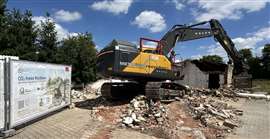 Metzner Recycling’s Volvo EC230 Electric crawler excavator on site in Nuremberg (Image: Volvo)
Managed by Metzner Recycling, supported by Robert Aebi Nuremberg, the fleet in use here comprises a Volvo EC230 Electric crawler excavator, ECR18 Electric compact excavator and L20 Electric compact wheel loader, alongside FM Electric hook-lift truck from Volvo Trucks.
Michael Metzner, managing director of Metzner Recycling GmbH, said, “For us as the contractor, it was crucial to plan the project from the outset so that it could operate reliably within normal construction-site routines. This demolition project shows that CO₂-free worksites are entirely achievable when equipment, logistics and energy supply are considered together.”
Rather than relying on dedicated charging infrastructure, the electric machines and vehicles are powered using standard construction-site electricity,
“This project proves that CO₂-free demolition works not only in theory, but on real construction sites. One of the key factors is that the machines and vehicles can be operated using standard construction-site electricity. That makes the solution practical, scalable and easy for municipalities to replicate as they work towards their climate targets,” commented Peter Bauer, segment leader at Volvo CE.
The project also embraces circular economy principles through the separation of construction materials, allowing suitable materials to be recovered and returned to the value chain wherever possible.
It forms part of the wider expansion and redevelopment of the area, which will be transformed into public green space.

CONNECT WITH THE TEAM