




Read this article in 中文 Français Deutsch Italiano Português Español
World Demolition Awards Shortlist - Recycling & Environmental

05 September 2025
D&Ri is pleased to announce the Recycling & Environmental category shortlist for the 2025 World Demolition Awards, which will take place on 5 November in Nashville, US, as part of the World Demolition Summit.
Congratulations to the following companies who made the Recycling & Environmental shortlist.
Recycling & Environmental
Delsan AIM
COUNTRY: Canada
PROJECT: Environmental remediation works of the former Solutia chemical plant – Parcels A and C
CLIENT: Englobe / City of Montreal
STATEMENT:
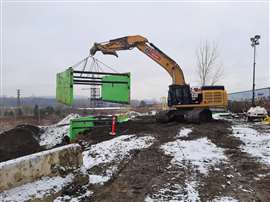 Photo: Delsan AIM
The remediation of the former Solutia chemical plant in Montréal’s Lasalle borough represents a benchmark in complex brownfield rehabilitation.
Once operated by Monsanto and Solutia Inc. (1932–2008), the site was heavily contaminated with hydrocarbons, phthalates, VOCs, asbestos, and mercury. Following the City of Montréal’s acquisition in 2017, a major remediation strategy was initiated.
In 2022, Englobe was appointed as prime contractor, responsible for the high-level environmental strategy, stakeholder coordination, and overall project management.
Englobe partnered with Delsan-AIM Environmental Services, a specialized subcontractor, to execute the site works—including demolition, excavation, and soil treatment—under stringent environmental and health safety conditions.
Among the project’s most impactful innovations was Englobe’s shift from thermal to on-site biotreatment of phthalate-contaminated soils.
Delsan-AIM supported its field implementation, achieving contaminant reductions of up to 96%, while avoiding high-emission, off-site alternatives.
Additional challenges included managing mercury and asbestos, seasonal ecosystem restrictions, and steep terrain. Controlled containment zones, advanced PPE, and ISO 23875-compliant excavator cabins ensured worker protection throughout.
Recycled asphalt, concrete, and woodchips were reused on-site, and over 1,240 truckloads of material were avoided, significantly reducing environmental impact.
Ultimately, more than 80,000 m² of land—equal to 13.5 football fields—was decontaminated, creating a clean, developable space.
This project showcases how strategic planning and real-world execution can successfully transform a hazardous industrial site into a sustainable, high-value asset—setting a new standard in urban environmental remediation.
Demex
COUNTRY: Australia
PROJECT: Acacia Ridge Business Park Redevelopment (Stage 2)
CLIENT: ESR
STATEMENT:
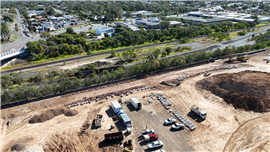 Photo: Demex
Engaged by client ESR delivering a light industrial redevelopment at the Acacia Ridge Business Park, DEMEX completed a comprehensive enabling works program of hazardous materials (hazmat) removal, demolition, and associated civil works demonstrating industry leading environmental performance and recycling.
A second package for the development secured by DEMEX, 40 Fox Road is an 80,000 m2 contaminated site on the Queensland State Government’s Environmental Management Register (EMR).
Formerly operating as Brisbane’s Holden manufacturing facility, the site was characterised by high levels of asbestos. Stringent EMR regulatory requirements and ESR’s tenancy contract binding them to meet 6 Star Green Star rating standards in construction prompted innovative thinking and methodology.
By applying lessons learned from Stage 1 and deploying unique fit for purpose equipment, DEMEX recycled 95% of salvageable materials, processing and reusing 100% of 40,000 m2 of demolished concrete onsite, saving ESR approximately $0.72 M (USD) in equivalent material supply costs.
Reduced timeframe for removal of hardstand reflected environmental benefits in reduced fuel consumption, fewer emissions, and water consumption.
The 350 metre retaining wall design/construction based on MagnumStone® Mechanically Stabilised Earth (MSE) strengthened the project’s environmental credentials.
A large, hollow core, concrete blocking system, MagnumStone®, the lighter, environmentally beneficial construction protects against soil erosion, while supporting heavy or active loads above.
Use of MSE (Mechanically Stabilized Earth) select fill for the retaining wall highlighted the benefits of innovation to achieve project environmental and sustainability rating outcomes.
Despe
COUNTRY: Italy
PROJECT: Demolition of the Hotel E Autorimessa
CLIENT: Portosole C.N.I.S. S.R.L.
STATEMENT:
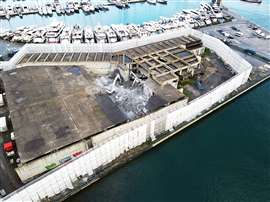 Photo: Despe
The demolition of a building in the port of San Remo, located in an environmentally sensitive area, required a highly specialised approach.
The building, facing the sea on three sides, was constructed of lightweight concrete with polystyrene inserts, a potentially polluting material if dispersed in the marine environment.
For this reason, the project was submitted for approval to the Ministry of Ecological Transition, which imposed five conditions: preparation of an environmental report, continuous monitoring of dust and noise, verification of the absence of hazardous materials, control of the marine biocenosis, and logistical management of the site.
The first phase involved securing the site, with the installation of a 9-metre high perimeter scaffold, covered with dust sheets.
All drains were sealed to prevent marine contamination. Demolition took place in a controlled manner, starting from the interior areas, with the use of a misting system to abate dust and dedicated operators to collect the polystyrene.
To reduce the noise impact, silent hydraulic tools were used. The west wall, exposed to the sea, was cut into sections with a diamond chain saw, avoiding vibration and dust.
The resulting materials were immediately transported to certified recycling centres.
This intervention represents a virtuous example of sustainability applied to demolition, demonstrating how technology, planning and environmental respect can coexist even in complex contexts.
Metzner Recycling
COUNTRY: Germany
PROJECT: Siemens Industrial Campus, electric deconstruction
CLIENT: Siemens Real Estate
STATEMENT:
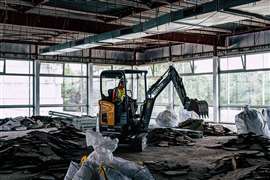 Photo: Metzner Recycling
MMRHP Metzner Recycling, in collaboration with Siemens and Volvo, proudly presents the world’s first electric deconstruction site, setting a new benchmark for sustainable demolition practices.
This innovative project integrates decontamination, dismantling, structural deconstruction, recycling, and logistics, showcasing a comprehensive approach to environmental stewardship.
Key challenges included establishing a reliable power supply and ensuring safety while operating high-voltage equipment. We implemented a dedicated transformer solution and buried the power supply wires underground.
Comprehensive training for all staff on electric machinery and emergency protocols further enhanced safety. Meticulous planning and scheduling of machine activities were essential to maximize energy consumption without overloading the grid.
Close collaboration among stakeholders, led by Volvo, facilitated efficient workflows and charging strategies. This project highlights MMRHP’s commitment to sustainable practices and serves as a blueprint for future endeavors in the demolition sector, emphasizing circular material flow and emission-free job sites, paving the way for a greener future in construction and demolition.
Tscherning
COUNTRY: Denmark
PROJECT: Tscherninghuset
CLIENT: Soren Tscherning
STATEMENT:
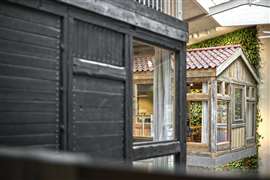 Photo: Tscherning
Tscherninghuset is not just a new office building—it is a physical manifestation of how demolition can fuel circular construction.
Developed by Danish contractor Tscherning, the project combines elements from multiple in-house demolition sites into a single, architecturally ambitious structure.
Nearly every part of the building—concrete, bricks, steel, glass, wood, flooring, and tiles—has a past life.
Rather than demolishing with disposal in mind, Tscherning dismantled structures strategically, harvesting high-quality components for reuse.
These included concrete elements from industrial sites, steel from a demolished hostel, bricks from an old school, and even entire doors and windows from previous renovations.
New construction materials were selected only when necessary. One of the project’s key achievements was proving that reused structural elements can meet modern engineering standards.
Through close collaboration between demolition teams, engineers, and architects, the project delivered a safe, beautiful, and resource-efficient building.
Tscherninghuset is more than a headquarters; it’s a living case study in circular demolition. It challenges the notion that demolition is the end of a building’s life.
Instead, it positions demolition as the starting point of intelligent reuse—maximising environmental benefits, reducing costs, and inspiring a new generation of sustainable construction
CONNECT WITH THE TEAM