




Read this article in 中文 Français Deutsch Italiano Português Español
FOCUS: The trends and challenges facing the European demolition industry

19 November 2026
Europe’s demolition sector continues to evolve as infrastructure investment, urban regeneration and increasingly ambitious circular economy targets reshape market priorities.
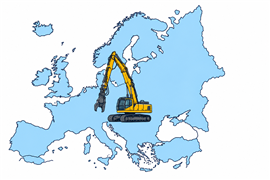
While activity varies between countries, demolition contractors across the region are adapting to tighter environmental regulation, changes in available workforce and rapid advances in technology.
MARKET VALUE
According to market research company IBISWorld, the wider European demolition and site-preparation market is valued at just under €127 billion in 2026, with an expected annual revenue growth rate of 9.4%.
It is a large, but highly fragmented sector, supported by Europe’s ageing building stock, infrastructure renewal and increasingly demanding circular-economy requirements.
While the current economic climate is injecting much volatility into all markets due to the constant shift in fuel prices and interest rates, the overall outlook for the demolition sector in Europe (with UK as the exception) can be said to be cautiously optimistic.
Growth is likely to be strongest in specialist decommissioning, infrastructure, selective demolition and materials recovery compared to conventional building demolition; however, Europe’s stock of older buildings also creates a substantial need for urban regeneration.
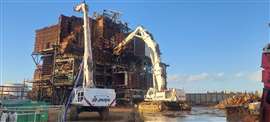 Growth is likely to be strongest in specialist decommissioning amongst others (Image: Despe)
According to the European Commission, around 85% of EU buildings were constructed before 2000, while 75% have poor energy performance.
The Commission’s Renovation Wave strategy aims to renovate 35 million buildings by 2030, potentially creating opportunities for demolition contractors in strip-out, selective dismantling and material recovery alongside wider redevelopment.
WASTE RECYCLING
More than 30% of the EU’s environmental footprint comes from buildings, making it the sector with the highest environmental impact, according to the EEA report, Addressing the environmental and climate footprint of building 2025.
Their decommissioning leads to the largest waste stream in the EU by weight – construction and demolition waste (CDW) accounts for more than a third of all waste in the region.
The good news is that overall, the landfill rate has gone down considerably (from 23% to 16% between 2010 and 2020) in the EU-27, even though the total amount of waste generated has continued to increase.
But while recycling rates are high, most material is downcycled into lower value uses, the report states, despite the potentially high resource value of some CDW components.
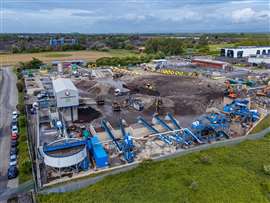 Waste recycling wash plant Blackpool, UK (Image: CDE)
But of course, the level of CDW recycling and material recovery varies greatly across the EU, ranging from less than 10% to over 90%. EU countries apply different definitions of CDW, which makes cross-country comparisons difficult.
The European Commission’s Joint Research Centre (JRC) recently issued a new proposal for end-of-waste criteria. The proposal defines when recycled materials stop being legally classified as waste and become usable products, an important initiative in the work towards reaching the EU’s circular economy goals.
However, the reaction from industry was not unanimously positive. A coalition of associations, including Aggregates Europe, Concrete Europe, EAPA, FEAD, FIR, Recycling Europe and FIEC, have raised ‘significant and serious concerns’ about the proposal.
They warned that overly complex criteria could in fact result in fewer materials achieving end-of-waste status, lower recycling rates, more usable material going to landfill and reduced investment in circular business models.
Instead, they suggest that the EU criteria should act as a common baseline, or minimum safeguard, that still allows individual member states to keep their national systems that better reflect local geology, groundwater, climate and environmental conditions.
 (Image: Symbiot via Adobe Stock)
It is EU’s strategy to become climate neutral by 2050, as set out in the European Green Deal, a policy roadmap published in 2019. This underpins a wide range of the legislation driving decarbonisation in construction and demolition.
This legislation promotes selective demolition, the separation of materials and the safe removal of hazardous substances to support reuse and high-quality recycling. The Waste Framework Directive sets a 70% target by weight for recovery of non-hazardous construction and demolition waste, although this includes backfilling as well as recycling.
Other key measures control cross-border waste shipments, prevent harmful substances from re-entering recycled materials, and establish requirements for recovered materials to be marketed as products.
WORKFORCE ISSUES
Much has been said already about the labour challenges that continue to haunt the industry, as it contends with an ageing workforce, the retirement of experienced personnel and strong competition for staff from other sectors.
Finding new operators is proving increasingly difficult as the number of working age people in Europe is declining.
According to Eurostat, those aged 20–64 (i.e. who are of working age) in relation to the number of older people (aged 65+) fell from 3.7 in 2005 to 2.7 in 2025.
And there is no sign that this downward trend will reverse – in fact by 2100 the ratio may be as low as 1.5 – meaning the pool of working age people will continue to dwindle.
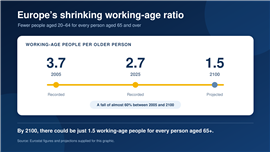 (Infographics: KHL)
The situation is compounded by a declining interest among younger generations to enter the more traditional trades.
This is driven partly by society’s strong emphasis on higher education and many young people’s changing expectations of and attitudes to work and career development.
At the same time, outdated perceptions of demolition, and indeed construction, obscure the increasingly skilled and technology-led nature of the work, making it harder to attract new entrants and replace the knowledge being lost.
There is an insufficient awareness of the broad range of careers available, and in many countries, only limited or inconsistent apprenticeship and training routes exist.
As experienced demolition professionals from the larger generations retire – the remaining baby boomers and the oldest members of generation X – the industry faces not only a lack of staff but also a serious skills drain.
These people take decades of practical experience and in-depth knowledge with them, so recruitment, training and the transfer of expertise to the next generation is more important than ever.
TECHNOLOGY INNOVATION
The adoption of new technologies is widely seen as the answer to the challenges faced by the European demolition industry.
These include highly automated equipment, low-emission machinery and digital solutions developed to address the lack of operators, cost pressures, circular demolition goals and shortened timelines.
While fully autonomous machines of the size needed on large demolition projects are a long way off, excavators are increasingly fitted with advanced control systems, geo-fencing, proximity sensors and operator-assist technologies among others.
These features improve accuracy and boost productivity by helping operators to work more efficiently. They also improve safety both site (and nearby) by keeping operation within defined limits and detecting movement within the work zone.
Europe is also leading the way to cleaner construction and demolition sites, with Norway and the Netherlands proving that zero-emission sites are technically feasible and effective.
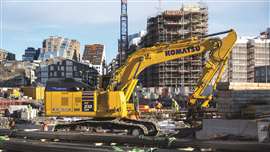 Electric excavator on site in Oslo where low-emission equipment is mandated (Image: Komatsu)
However, higher equipment cost, lack of charging infrastructure and limited options for heavy-duty applications, including demolition, are some of the barriers to adoption of low emission machinery, whether these run on electric power, hydrogen, HVO (hydrotreated vegetable oil) or other alternative fuels.
And finally, at the forefront of developments in recycling, AI-driven technology is being used to create new ways of improving materials recovery.
One example is the EU-funded DISCOVER project which aims to ‘revolutionise’ the construction and demolition industry. It combines robotics, AI and continuous scanning to create detailed building models that help optimise resource use, reduce environmental impacts and support circular construction.
By identifying all the materials that can be recovered and reused, the project promises to help turn demolition sites into ‘material banks’ where waste becomes a valuable commodity and diverted from landfill.
CONCLUSION
The shift towards circular construction is changing demolition’s role in Europe, supported by legislation and new technology.
There is a greater emphasis on retaining the value of buildings, components and materials which encourages selective dismantling, reuse and higher-quality recycling, rather than simply clearing sites.
For demolition contractors, this creates opportunities to become material recovery specialists, while demanding more detailed planning, sorting and collaboration with designers and clients.
On the other side of the coin, the dwindling population and low interest in entering this trade, present problems in an industry that will endure as infrastructure renewal and urban regeneration continue.



CONNECT WITH THE TEAM