




Read this article in 中文 Français Deutsch Italiano Português Español
How NASA’s test towers were brought down in twin implosion

18 November 2026
The successful blowdown of two historic rocket test stands at NASA’s Marshall Space Flight Center in January 2026 was the culmination of months of planning in the face of challenges that would daunt even experienced demolition teams. By Neel Madsen.
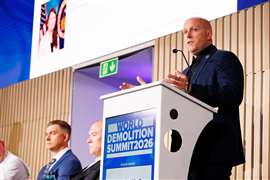 Justin Taylor, MSFC master planner, experimental facility development at NASA (Image: KHL)
In recent memory, some structures have loomed larger in our collective conscience than others. For those who grew up during the Space Age, the test towers at Marshall Space Flight Center (MSFC) in Alabama, US, until recently evoked memories of the Apollo moon missions and the Space Shuttle programme.
Built in 1964, the 363 foot (111 metres) Dynamic Test Stand was the tallest structure in North Alabama at the time of construction. Back then, it joined the smaller Propulsion and Structural Test Facility, better known as the T-tower, from 1957 which reached just over 164 feet (50 metres).
Both iconic structures were successfully taken down on 10 January 2026 by Ahtna Target JV, Rose PE engineering and blasting experts DetX in collaboration with NASA.
The story of this unique project was presented to the World Demolition Summit 2026 in Madrid by NASA’s Megan Vansant, MSFC lead architect and demolition programme manager, and Justin Taylor, MSFC master planner, experimental facility development, with Austin Hays, VP of business development and James “JJ” Martin, director of federal & special projects from Target Contractors, and Ron Gilbert, vice president of blasting operations, Dykon/DetX.
Complicated coordination
After supporting the United States’ space ambitions for many decades, these two National Historic Landmarks, located near Huntsville, became earmarked for demolition as part of a wider modernisation programme – but not before all other avenues had been investigated.
“The last thing that NASA wants to do is tear down structures, specifically a purpose-built, incredibly complicated structure. We don’t want to tear them down if we don’t have to, so we must exhaust every possible resource at our disposal,” commented Justin Taylor on looking for other uses for the test stands before committing to demolition.
Following a complex, multi-layered and long planning process, Target working in joint venture with Ahtna Environmental Inc was awarded the contract. The two test towers were top of the agenda with detonation day set for the start of 2026.
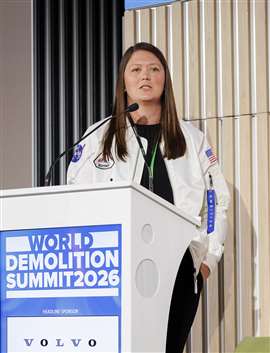 NASA’s Megan Vansant, MSFC lead architect and demolition programme manager (Image: KHL)
Megan Vansant explained the enormity of the challenge as the team worked around tight testing schedules while coordinating with five federal agencies and more than 100 stakeholders across the centre and NASA.
“Most importantly, this project was in an active test site working on missions for the space program, Artemis, SLS, all of those. We had to coordinate with our user groups, in this case the engineering directorate, to make sure we didn’t impact their schedules or any ongoing NASA missions,” she said.
Target Contractors recognised early on that a mission of this magnitude demanded a unified and multidisciplinary approach, said Austin Hays, adding that this realisation laid the groundwork for its joint venture approach.
“Ahtna’s deep federal contracting infrastructure and environmental capabilities combined with Target’s specialised heavy demolition expertise and established performance on previous NASA projects created the exact operational backbone that was required,” he told the delegates.
Not built for demolition
Marshall is one of NASA’s largest field centres with a total workforce of more than 6,000 staff and an annual budget of around US$5 billion. It lies within Redstone Arsenal, a federal centre of excellence with over 75 tenant organisations, specialising in aviation, missiles, space and logistics capabilities.
Carrying out a double demolition of this scale within these confines and to tight timelines was always going to be extremely challenging. Add to that, the unusually high level of technical precision, adaptability and coordination required to bring down the towers which were built to withstand enormous forces.
 (L-R) Austin Hays and James “JJ” Martin, Target Contractors, and Ron Gilbert, Dykon/DetX (Image: KHL)
“These stands were designed to hold rockets in place during testing. Their purpose was to keep the rocket or its components from leaving Earth prematurely,” said Vansant. “The structures were not designed to be demolished or demolished easily. That was the first big hurdle. We knew going in that there would be two implosions.”
Hays said the team began with site walks and safety meetings to understand exactly what it would take to remove the two test stands. He said, “We were looking at thick, heavily reinforced concrete walls, massive structural steel frameworks and intricate embedded utilities, all engineered to hold rocket engines in place during fire and tests.”
During this early planning phase, they mapped out every physical constraint surrounding active NASA facilities, environmental controls, over pressure management and stringent campus security protocols.
Disaster strikes
But just as the demolition plan was coming together, a major tragedy struck. An explosion at the Accurate Energetic Systems (AES) munitions factory in Tennessee claimed 16 lives and in effect brought the project to a sudden halt.
“Losing the capabilities of AES immediately created an industry-wide supply crisis, meaning we had to rethink our entire approach,” said Ron Gilbert who referred to AES as his brothers and sisters.
He told the summit that the team secured an alternative supply converting military products into civilian commercial demolition products, and, with NASA’s support, ran trials both on and off the structures. This meant they were able to validate the performance of these alternatives and finally proceed safely, crucially keeping to the original schedule, in the nick of time.
Echoing Gilbert’s sentiments regarding the devastating effect the incident had on the demolition industry, JJ Martin said, “That tragic day claimed the lives of dedicated colleagues, shook the global energetics community and touched many of us in this room personally. We honour their memory, their service to our field and the families they left behind.” He asked the delegates to join the team in a moment of silence and remembrance as they paid their respects.
With the world watching
Turning back to the project, JJ Martin said the height and structural density of the two test stands made preparing them for demolition a major engineering challenge. The crews worked at height inside the steel frames, carrying out preparatory work while keeping both stands stable until the day of the blowdown.
From a central command post, the team coordinated with NASA leadership, test laboratory staff, site security and federal law enforcement. “We deployed technologies to record seismic ground vibration, air blast over-pressure and drone surveillance, all paired with NASA’s real-time meteorological assets right up to the final second of the countdown,” said Martin.
“Every inch of the exclusion zone was monitored throughout the loading process and up to the day of the implosion. At 9am local time on 10 January 2026, the command post gave the go-ahead. In a matter of seconds, years of planning, preparation, multi-agency coordination, and explosive engineering culminated in a seamlessly executed operation. Both stands came down within seconds.”
He noted that managing the intricacies of an accelerated schedule to achieve the goals of the administration through the transition of directors, shifting of priorities, and a limited supply of energetics required a level of adaptability unlike conventional projects.
“It’s the type of resilience that’s only forged under extreme pressure when time is the rarest commodity, the stakes are at their highest and the world is watching,” he concluded.
A respectful end
The successful blowdown of the two test towers at Marshall is testament to the dedication and tenacity of the people involved; one of the main reasons why this project was chosen as the keynote presentation.
“In the company’s 52-year history, this implosion event ranks as one of the top toughest of all times,” said Gilbert speaking to D&Ri ahead of the WDS. “Years in the making through meticulous planning and preparation, this team endured challenges few will ever experience.
“Together, we pulled as one to accomplish the mission safely – down safe, home safe. With minimal fanfare and little attention, we walked away with something priceless: hard-earned lessons worth sharing.”
Vansant told D&Ri she had no doubt that the success of this project can be attributed to the team’s collective decision-making process, extreme dedication and commitment to honest communication. “Crucially, it provided a respectful end to these two historical landmarks,” she said.


CONNECT WITH THE TEAM