




Read this article in 中文 Français Deutsch Italiano Português Español
Four awards for Despe at World Demolition Awards 2026

11 November 2026
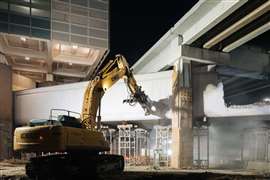
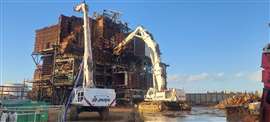 The dismantling of the Gela Refinery SNOX plant in Sicily and the remediation of hazardous materials on the site was one of the four winning projects (Image: Despe)
Despe claimed the Environmental, Industrial, Safety & Training, and Urban Demolition awards, capping a memorable evening for the company.
Managing director Stefano Panseri made four trips to the stage to receive the trophies during the gala dinner held in Madrid on 5 November, prompting host Matt Dawson to quip that drinks would be on Despe later.
“This is the best night we have ever had in the history of the World Demolition Awards 2026,” said Mr Panseri, as he thanked his father and founder of Despe, Giuseppe Panseri, and his brother Roberto Panseri, and especially, all the employees and their families for their support and dedication.
“These awards belong to them because we would not be able to achieve this amazing result without all the families of our employees behind us,” he declared.
FOUR AWARDS – FOUR PROJECTS
The first award for environmental performance was given for the dismantling and demolition of the Pontiletto (small jetty) at Gela Power station in Sicily.
The dismantling of the small jetty at Gela Power Station, performed for Eni Rewind, required a methodology designed to protect the surrounding marine and coastal environment.
 (L-R) Host Matt Dawson, Stefano Panseri and Elisa Finazzi of Despe with Christian Yanes from Steelwrist, who presented the Environmental Award (Image: KHL)
The structure comprised some 14 pipelines supported by steel structures extending 300 metres into the sea and resting on reinforced concrete supports. Preliminary works included removing pipework and technical lines, surveying the seabed by ROV and extracting residual process fluids discovered within the pipelines.
Reinforced concrete sections were cut into controlled blocks using diamond-tipped tools and diamond wire, secured with slings and lifted by crane from a barge before being transferred ashore for processing and material recovery.
An 18 x 6 metre containment tank was positioned on a vessel to capture potential spills or debris, supported by floating booms, skimmers, collection tanks and absorbent materials. Vessel movements were also controlled to protect nearby populations of Cymodocea nodosa seagrass.
The judges were impressed by how the team adapted to unexpected residues in the pipework, using containment and sealed handling to complete dismantling without any spills into the sea. Controlled cutting and strict vessel movements also protected the water and sensitive seagrass beds below.
The second award for industrial demolition recognised the dismantling of the Gela Refinery SNOX plant and the remediation of hazardous materials on the site.
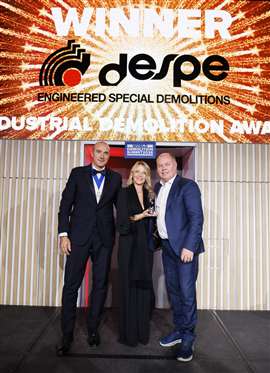 Henrik Sonerud (R), OilQuick, presented Despe with the Industrial Demolition Award (Image: KHL)
This project combined hazardous material remediation with the dismantling of a complex industrial facility under challenging conditions. Unstable sheet metal and inaccessible structures first had to be made safe using operators on telescopic platforms ahead of the removal of man-made vitreous fibres (MMVF) and plant decontamination.
Demolition was undertaken using a fleet of heavy equipment led by a 351-tonne CAT Jumbo Demolition excavator, capable of reaching 48 metres and equipped with a 10-tonne shear, allowing the works to be completed without manual operations at height.
Technical challenges included the mechanised removal of MMVF from unstable structures using a zero-contact vacuum system, the recovery of 10,000 four-metre glass cylinders from distillation towers, and the construction of a 4,000 cubic metre containment structure to enable the safe remote demolition of the chimney.
The judges praised the consistently excellent use of mechanisation to overcome difficult challenges in the dismantling of this industrial facility and the remediation of hazardous materials.
The third award came in the Safety & Training category for the BREATH project at the Chiesi pharmaceutical plant in Nerviano, near Milan.
The combined decommissioning, strip-out and structural demolition at the plant took place while managing multiple hazardous materials. At peak activity, up to 400 workers and 50 contractors were involved, with risks including asbestos, man-made glass fibres, lead-based paints and contamination from active pharmaceutical ingredients (APIs).
 Stephen McCann (R), president of the IDE, presented Despe with the Safety & Training award (Image: KHL)
The safety management system was structured around three levels of control. A total of 42 project-specific RAMS documents were developed and required approval from the safety coordinator before work proceeded.
These were supported by more than 280 daily Toolbox Talks covering changing site risks and over 500 work permits for routine and specialist activities. Site access also required completion of a safety induction and written test, while personnel received specific training in the use of Category 3 personal protective equipment.
The judges noted the scale of the coordination required to protect workers and contractors from multiple hazardous substances. Layered safety controls ensured that work was assessed, authorised and supported by daily briefings and specialist training.
And finally, the Palazzo Marini Heritage deconstruction project in central Rome, Italy, convinced the judges to hand Despe a fourth award; this time for the Urban Demolition category.
Working for Deacapital R.E. SGR Spa, Despe performed the partial deconstruction and demolition of Palazzo Marini; a job that included the preservation of the building’s historic façades and removal of structures up to 30 metres in height.
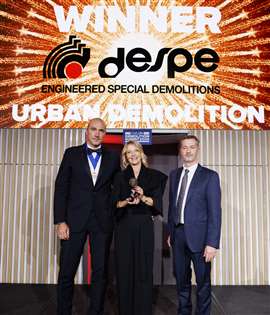 (L-R) Mr Panseri and Ms Finazzi received the Urban Demolition award from Jean-Christophe Etienne, Caterpillar Inc. (Image: KHL)
Located at Piazza San Silvestro close to commercial, tourist and parliamentary buildings, the project was undertaken while surrounding activities and traffic remained operational. The constrained location required a targeted deconstruction methodology designed to control dust, vibration and noise.
Structures adjacent to retained buildings were dismantled selectively, including by hand, with diamond cutting used to separate critical sections. A tower crane moved equipment between floors and lowered demolition material to ground level in self-unloading baskets.
Sheet-metal scaffolding, fire-retardant dust-control nets and temporary protective structures were installed to contain the works. Multiple teams worked simultaneously across the building to meet the project’s restricted programme.
The judges acknowledged the precision required to remove structures up to 30 metres high while preserving historic façades in the centre of this busy capital city. The use of selective dismantling, hand demolition and diamond cutting controlled disruption while surrounding activities and traffic continued.
CONNECT WITH THE TEAM