




Read this article in 中文 Français Deutsch Italiano Português Español
World Demolition Awards shortlist: Urban

25 August 2026
Following the recent announcement of the finalists across all categories of the 2026 World Demolition Awards, D&Ri highlights the projects shortlisted for the Urban Demolition Award.

The category covers demolition projects carried out in challenging urban environments, where restricted space, neighbouring structures, traffic and the surrounding community can add significantly to project complexity.
Congratulations to this year’s shortlisted companies, which are (in alphabetical order):
CARDEM (France)
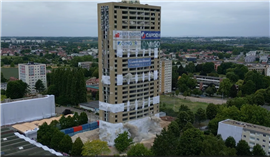
PROJECT: Kennedy Tower Controlled Demolition, Loos
CLIENT: Partenord Habitat (France)
 Cardem
The Kennedy Tower demolition in Loos combined technical complexity, environmental performance and strong community integration. It involved the controlled explosive demolition of a 95-metre-high residential tower located in a dense urban environment, with surrounding structures as close as 20 metres.
An engineered collapse was designed and executed using a combination of structural modelling, high-precision drilling and electronic detonator sequencing. Maintaining structural stability throughout the preparatory works required advanced engineering solutions and careful control of load paths.
Environmental impacts were actively managed through real-time monitoring of vibration and noise, combined with dust control and protective systems. The project also achieved a very high material recovery rate and integrated reuse initiatives.
COLEMANS (UK)
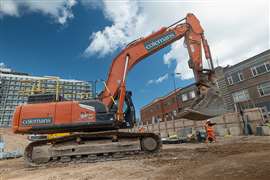
PROJECT: Northampton Town Centre Multi Building Demolition
CLIENT: West Northamptonshire Council
 Colemans
The 37-week demolition and deconstruction programme in Northampton town centre included soft strip, asbestos removal, structural demolition and site clearance adjacent to the Grosvenor Shopping Centre.
Works were planned to maintain uninterrupted retail and residential operations, with engineered structural separations used to protect adjoining units.
Laser scanning and a digital twin supported 4D BIM sequencing, while permanent and mobile monitoring systems were used to manage dust, noise and other environmental impacts.
More than 37,000 tonnes of demolition arisings were processed, achieving a 98% recycling rate, while 18,552 tonnes of site-won material were reused for grading. Of 120 tonnes of recovered structural steel, 25% was re-engineered for permanent propping, while selected 1930s timber was reused to create public benches.
The programme was completed without reported accidents, incidents or disruption to neighbouring operations.
DELSAN-AIM (Canada)
PROJECT: Quartier des Lumières Decommissioning and Demolition
CLIENT: Pomerleau Construction
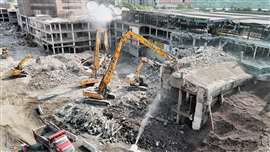
The decommissioning and demolition of the former Maison de Radio-Canada complex in Montreal involved approximately 102,190 sqm of structures across a 418,000 sqm site as part of the $1-billion Quartier des Lumières redevelopment project in Montreal’s Centre-Sud district.
 Delsan-AIM
The works included removal of around 90% of the podium structures, including below-grade levels, footings and foundations, while retaining the 24-storey office tower, occupied sections of the podium and surrounding infrastructure. Peak operations involved up to 75 personnel and 45 pieces of equipment.
Completed within 16 months, the project handled more than 195,000 tonnes of demolition materials and achieved a 95.5% recycling rate.
This included 1,225 tonnes of asbestos-containing materials, around 16,000 tonnes of scrap metal and more than 170,000 tonnes of concrete, with 135,000 tonnes crushed and stockpiled on site for reuse.
DESPE (Italy)
PROJECT: Palazzo Marini Heritage Deconstruction
CLIENT: Deacapital R.E. SGR SPA
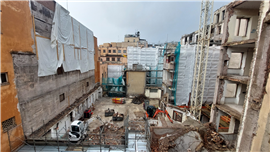
The partial deconstruction and demolition of Palazzo Marini in central Rome required the preservation of its protected historic façades while removing structures up to 30 m high. Located overlooking Piazza San Silvestro and close to commercial, tourist and parliamentary buildings, the project was undertaken while surrounding activities and traffic remained operational.
 Despe
The constrained location required a targeted deconstruction methodology designed to control dust, vibration and noise.
Structures adjacent to retained buildings were dismantled selectively, including by hand, with diamond cutting used to separate critical sections.
A tower crane moved equipment between floors and lowered demolition material to ground level in self-unloading baskets.
Sheet-metal scaffolding, fire-retardant dust-control nets and temporary protective structures were installed to contain the works.
Multiple teams worked simultaneously across the building to meet the project’s restricted programme.
ECO DEMOLIZIONI (Italy)
PROJECT: Via Boncompagni Complex Selective Demolition
CLIENT: Renco Spa
The selective demolition of a city block in Rome’s Ludovisi district formed part of a seismic upgrading and redevelopment programme involving the Boncompagni residential and office complex, the May Fair Residence and the former Church of San Lorenzo da Brindisi.
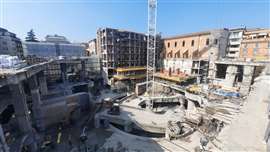 Eco Demolizioni
Extending over eight above-ground floors and five underground levels, the works required precise structural demolition to allow new seismic-resistant cores to be installed while retaining substantial sections of the existing reinforced concrete structures.
Confined working areas and limited access added to the challenge, with demolition, strengthening and reconstruction taking place simultaneously.
Protected elements, including the church façade and ancient Roman walls, required temporary support systems and coordination with heritage authorities. Approximately 97% of aggregates were recovered and processed into secondary raw materials.
TINY’S DEMOLITION & RECYCLING (US)
PROJECT: Legislative Plaza and War Memorial Plaza Demolition
CLIENT: Skanska
A wide-ranging demolition programme at Legislative Plaza, adjacent to the Tennessee State Capitol in Nashville, combined interior, structural and external works within an active government complex.
The scope included office and parking garage demolition, structural concrete cutting for new elevator and mechanical access, sidewalk and waterproofing removal, and demolition above the historic Motlow Tunnel.
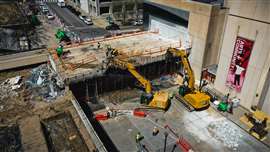 Tiny’s Demolition & Recycling
A key element was the removal of the pedestrian bridge connecting the plaza with the Tennessee Performing Arts Center.
Comprising sixteen 90 ft box beams and a concrete topping slab, the bridge was demolished during a one-week programme involving street closures, temporary scaffolding and shoring, excavators and remote-controlled demolition equipment.
Works also had to be coordinated around asbestos abatement and ongoing public activity. Approximately 10,500 tons of debris were generated, with 88% diverted from landfill.
The winner will be announced at the World Demolition Summit in Madrid, Spain.
BOOK now to attend the event which takes place 3–5 November.


CONNECT WITH THE TEAM