




Read this article in 中文 Français Deutsch Italiano Português Español
World Demolition Awards shortlist: Industrial

25 August 2026
After the recent announcement of the full 2026 World Demolition Awards shortlist, D&Ri turns the spotlight on the companies and projects in contention for the Industrial Demolition Award.

From complex processing facilities to large industrial sites and navy ships, this category recognises projects that demonstrate technical expertise, careful planning and innovative solutions to demanding demolition challenges.
Congratulations to the companies selected for the 2026 shortlist. They are (in alphabetical order):
CARDEM (France)
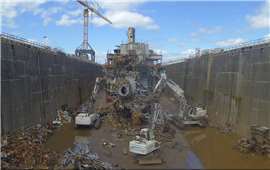
PROJECT: French Navy Warships Deconstruction
CLIENT: French Navy, Fleet Support Service (DSSF)
 Cardem
The deconstruction of eight decommissioned French Navy vessels at the Bordeaux-Bassens dry dock required Cardem to adapt industrial demolition techniques to a complex naval environment. Together, the vessels comprised more than 30,000 tonnes of steel structures, with each requiring detailed engineering studies, stability assessments and carefully sequenced dismantling to maintain structural integrity throughout the works.
Conducted within a live commercial port, the programme combined mechanical demolition, oxy-fuel cutting, heavy lifting and cable-pulling techniques to create a repeatable dismantling process. More than 25,000 hours were worked without a lost-time injury, major safety incident or environmental incident.
Material recovery formed a central part of the project, with more than 95% of demolition materials recovered and recycled under a fully traceable waste management process.
DDM DEMONTAGE (The Netherlands)
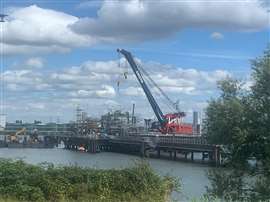
PROJECT: Shell Terminal Tank Storage Decommissioning
CLIENT: Shell
 DDM Demontage
For this project, DDM dismantled a 55-hectare tank storage facility to prepare the site for future infrastructure development. This comprised around 90 storage tanks (including units up to 52 m in diameter and underground tanks with wall thicknesses of up to 30 mm), more than 125 km of pipelines and the internal cleaning of a further 100 km of pipework under strict safety and environmental controls.
The project also included the dismantling of the Europabrücke bridge spanning active road and rail links, and the management of hazards – PFAS contamination, hydrocarbons, asbestos, man-made mineral fibres and unexploded ordnance.
Completed over four years, the project recorded more than 155,000 accident-free working hours while recovering more than 24,000 tonnes of scrap and processing significant quantities of hazardous waste and contaminated soil.
DESPE (Italy)
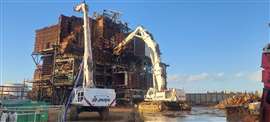
PROJECT: Gela Refinery SNOX Plant Decommissioning
CLIENT: Eni Rewind
This project combined hazardous material remediation with the dismantling of a complex industrial facility under challenging conditions. Unstable sheet metal and inaccessible structures first had to be made safe using operators on telescopic platforms ahead of the removal of man-made vitreous fibres (MMVF) and plant decontamination.
 Despe
Demolition was undertaken using a fleet of heavy equipment led by a 351-tonne CAT Jumbo Demolition excavator, capable of reaching 48 m and equipped with a 10-tonne shear, allowing the works to be completed without manual operations at height.
Technical challenges included the mechanised removal of MMVF from unstable structures using a zero-contact vacuum system, the recovery of 10,000 four-metre glass cylinders from distillation towers, and the construction of a 4,000 cubic metre containment structure to enable the safe remote demolition of the chimney.
HUGHES & SALVIDGE (UK)
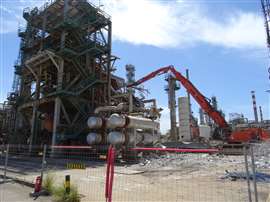
PROJECT: Matosinhos Refinery Demolition and Dismantling
CLIENT: Galp Energia
 Hughes & Salvidge
The demolition of the refinery in Porto, Portugal, formed the most technically demanding phase of a three-stage closure programme. Covering a 2.37 million sqm site, it required the removal of redundant process plants, tanks, pipework and structures, together with hazardous materials, within a live Seveso-regulated environment.
Demolition was carried out across 18 process areas adjacent to operational refinery assets, residential neighbourhoods, a public beach, a hospital and Porto Airport. A significant challenge was a cooling tower containing 280 t of asbestos cement packing. H&S developed and secured regulatory approval for Portugal’s first mechanically demolished asbestos-packed cooling tower, creating a safe and fully controlled methodology.
During the assessment period, 57,600 man-hours were completed without a reportable safety or environmental incident. The project achieved a recycling rate of 93%, with more than 23,600 tonnes of material recovered.
INDEPENDENCE EXCAVATING (US)
PROJECT: Homer City Generation Station Demolition
CLIENT: Homer City Redevelopment
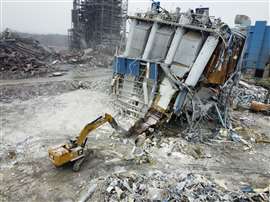 Independence Excavating
This demolition involved the dismantling of one of the largest former coal-fired power plants in eastern US under a compressed programme. Independence carried out structural demolition, environmental decommissioning, foundation removal, concrete processing and scrap recycling while adapting to evolving project requirements. Around 130 personnel and over 65 major items of plant operated across multiple shifts throughout.
The project also overcame a nationwide shortage of explosives by developing alternative implosion methods together with engineering and blasting partners, and, where required, adopting remote-controlled techniques.
Over 250,000 man-hours were completed without a lost-time injury, recordable incident or environmental event, while more than 112,000 gross tons of scrap material were recovered and recycled during the first eight months.
The winner will be announced at the World Demolition Summit in Madrid, Spain.
BOOK now to attend the event which takes place 3–5 November.


CONNECT WITH THE TEAM