




Read this article in 中文 Français Deutsch Italiano Português Español
Autumn seminar informs demolition engineers

25 November 2026
Around 100 members of the Institute of Demolition Engineers were registered for the autumn seminar held in London on 20 November.
The attendees enjoyed a programme of informative presentations covering topics including AI and connected data, environmental impairment liability in demolition, material reuse in circular construction and asbestos surveys.
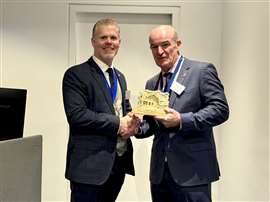 President Stephen McCann (L) and immediate past president Adrian McLean (Image: KHL)
Before the presentation began, new president Stephen McCann presented his predecessor Adrian McLean with a dedicated Jericho stone-carving in appreciation of his leadership and dedicated service as president of the IDE.
Safe use of AI in decision making
How to make better decisions by using connected data was the first topic of the day.
Rory Kilpatrick, founder of Tender Mole – an AI platform that helps automate tender bids and Pre-Qualification Questionnaires (PQQs) – discussed the use of artificial intelligence for demolition contractors.
He opened by highlighting the risks of AI, reviewing several major incidents involving the technology over the past year.
He noted that “these capabilities are also available to attackers, so how you use AI in your business is critical to safety.”
Kilpatrick advocates the use of an ontology – a live digital map linking sites, schedules, plant and finances – as a much safer way to implement AI.
By anchoring the AI to verified, connected business records and requiring human sign-off for every action, contractors can avoid the guesswork and costly errors of standard AI tools.
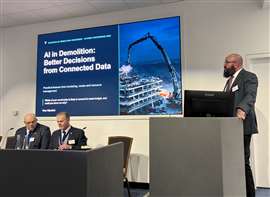 Rory Kilpatrick from Tender Mole talked AI advantages for demolition contractors (Image: KHL)
His solution is Veleslens, a software platform built inside the Tender Mole workspace that extends AI from winning bids to managing live operations.
It reads existing business tools, such as spreadsheets, project reports and accounting software, to build a live map of how projects, suppliers and finances relate to one another.
By connecting all aspects of a business, it can identify issues and suggest solutions as it tracks operations in real time.
To explain the concept, Kilpatrick used discrepancies in waste management recording as an example of how Veleslens instantly flags problems.
Legislation and accountability
Speaking about changes in legislation, Danny Kearney of ProSafe Consultants discussed how the Building Safety Act 2022 affects demolition, remediation and technical work in the construction industry.
The Act has introduced a new standard of accountability regarding how technical standards are proven through documentation like the digital Golden Thread, change control, occurrence reporting (MOR) and safety cases.
“So much of the technical standard to you is relatively familiar, but what’s changed effectively is how you prove that [the work complies with building regulations],” he said.
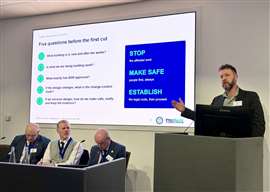 Danny Kearney, ProSafe Consultants, spoke about the implications of the Building Safety Act (Image: KHL)
Before making the first cut, contractors should establish whether they are looking at a High-risk building (HRB) as defined by the government criteria; whether the proposed work is classified as ‘building work’ and what exactly has the Building Safety Regulator has approved.
They also need to agree how any changes or unexpected damage will be handled and reported.
Kearney explained that the nature of the work determines whether approval may be needed, even when the package is described as a soft strip or enabling works.
“It’s not necessarily what the package is called; it’s what the work entails,” he noted. “And it’s about the evidence that the building’s going to remain safe now and in the future.”
Kearney also highlighted the potential impact on project schedules, saying the Building Safety Regulator had recently reported an average of 30 weeks to review applications for work on existing HRBs, against a statutory period of eight weeks.
Environmental liability and PFAS risks
Turning to environmental liability, James Alexander from Meliora ESG spoke about insurance coverage gaps and the emerging challenges posed by PFAS contamination in industrial and demolition projects.
He said public liability and all risks policies can leave contractors exposed to the costs of investigating suspected contamination, dealing with historic pollution or cleaning up gradual leaks.
“Environmental liability may happen without anybody actually suffering identified damage,” he said, adding that the burden of investigation and defence then rests with the contractor as projects are delayed.
Proving the point, he recalled two cases in which piling hit previously unknown underground storage tanks containing solvents and other liquids.
Both claims reached their policy limits, one at £5 million and the other at £10 million.
Alexander also discussed the risks posed by per- and polyfluoroalkyl substances (PFAS), known as ‘forever chemicals’, when concrete slabs are removed or crushed for reuse.
He cited cases where crushing mobilised PFAS contamination beneath a slab, complicating the clean-up, saying contractors should look at past and present uses of neighbouring land for potential sources of pollution and check where their existing insurance leaves them exposed.
“It’s about filling gaps and covering contractual exposure and contractual liability,” he said.
“I’ve written 700 plus policies in 28 years, and I’ve had less than 21 claims. So, it’s not a high frequency loss scenario, but I think of it like a crevasse. It’s a foot wide but half a mile deep.”
From recycling to reuse
Unlocking the value of waste materials was on the agenda for Rob Smith, co-founder and managing director of Material Index, a business established to enable large-scale material reuse through its online marketplace.
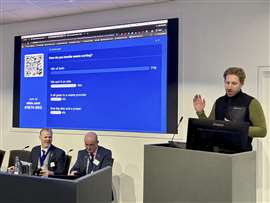 Rob Smith, co-founder of Material Index, used an interactive tool to ask members about their waste handling (Image: KHL)
Outlining the opportunity to recover value from construction materials, he said cities in particular are using and discarding them much faster than before the pandemic.
That faster turnover is generating more waste and putting pressure on supplies, he said.
He linked the growing scarcity to rising material prices, which he said had increased by around 43% since 2019.
“Whilst a lot of material might get recycled, very few components are getting reused as originally intended, and they’re often coming out when they have a long technical life left in them,” he stated.
“Reuse is enabled on site and how it comes out decides where it goes.”
To illustrate the scale of the opportunity, Smith highlighted that the UK uses around 2.5 billion bricks a year and that while 2.3 billion come out of buildings during demolition, only about 150 million reused.
He pointed to the importance of identifying materials before dismantling begins to decide what is worth salvaging.
Through pre-demolition audits, material brokers can connect contractors with buyers directly or even manufacturers that may take back their own products.
As an example, on one London office strip-out, the ceiling tiles went back to the manufacturer while the carpet tiles were resold.
On another large project, the sheer volume of carpet tiles exceeded even what the resale market could absorb.
The discussion also touched on the extra time, labour and safety considerations involved in careful dismantling, and whether the resale value can always justify the cost.
Keltbray at Fifty Fenchurch
 Kevin Ramsey discussing Keltbray’s work at Fifty Fenchurch (Image: KHL)
Another interesting presentation came from Kevin Ramsey, project manager at Keltbray, who shared a high-profile case study.
He described how the company delivered the demolition, ground engineering, excavation and substructure works for the redevelopment of 50 Fenchurch Street in the City of London.
The £73 million project, set on a tight island site, included two listed structures: the Grade I listed All Hallows Staining Church Tower and the Grade II Lambe’s Chapel Crypt.
Both shaped how the team planned the excavation and controlled ground movement.
The historic tower needed to be retained on site, while the crypt was carefully dismantled for storage off site.
Ramsey outlined how demolition of the existing structures ran from September 2023 to April 2024, followed by piling and bulk excavation through August 2025.
He explained that the excavation reached about 18 metres below road level and involved removing some 81,000 cubic metres of material.
Three levels of temporary propping, including bespoke large props, supported the excavation, while a logistics slab provided working space above the basement works.
The team supported the church tower using 26 underpins, an internal raft, four piled supports and a reinforced concrete ring beam.
Hydraulic jacks would allow them to adjust the tower’s level if it moved during excavation.
“Thankfully, we didn’t have to do any of that to the extent of having to rejig the level of the church. It was more just a release mechanism,” said Ramsey, adding that the tower moved only about 5–6 mm against an allowance of 30 mm in either direction.
Issues in asbestos surveying
The afternoon was given over to discussing how to improve the standard of asbestos surveys and the competency of surveyors.
Sam Lord of the Health and Safety Executive (HSE) discussed the quality of asbestos refurbishment and demolition surveys and the difference between the two types.
She highlighted the importance of intrusive inspection, clear commissioning scopes, surveyor competence and accessible reports, and called on the members to help shape guidance on asbestos surveys for refurbishment and demolition.
Lord said HSE was looking at how clients, surveyors and contractors work together and what prevents them from commissioning and delivering effective surveys.
She invited members to share their experience of where asbestos is found during demolition and to give their views on whether phased surveys could improve access to parts of a building that are difficult to inspect before soft stripping.
“You’re probably the best audience to know where asbestos is in the building fabric. So that’s why I want to engage you to try and improve this guidance,” she said.
Demolition surveys should cover the entire building fabric, she stated, while refurbishment surveys should focus on the areas affected by the planned work.
Inadequate intrusive inspection, restricted access and gaps in surveyors’ knowledge of building construction are some of the reasons asbestos can be missed.
Clients must set a clear written scope, agree any limitations upfront and check the experience of the individual surveyor.
She also said reports should show the location and extent of asbestos-containing materials as well as where samples were taken.
HSE specialists have reviewed about 50 surveys referred by inspectors, with around a third leading to enforcement notices or notifications of contravention.
Some are still under investigation, and the rest have been given written or verbal advice.
During the Q&A, several members spoke about the delays and commercial pressure they had come up against on projects where asbestos had been discovered after work started.
Asbestos surveyor competency
This discussion of surveyor competence was continued by Paul Beaumont, who founded the Asbestos Surveyors Guild to improve standards through individual verification and ongoing checks.
His first point was clear – that there is no official accreditation available, “All you need is the ability to build a website and call yourself an asbestos surveyor. That’s all you need. It’s not a protected title.”
The Guild gives clients a way to check the credentials of the individual surveyor they’re appointing.
Beaumont said it verifies qualifications with the issuing bodies and checks refresher training, insurance and working practices, including how survey reports are produced.
Members submit updated training and insurance records annually.
Clients can search the Guild’s online directory by name, survey type and property type, and see whether a surveyor has been verified.
Membership is voluntary, and surveyors are listed as enrolled while their checks are pending.
“The guild is there to help surveyors improve their standards, to improve the industry, and to stop your issues of finding asbestos halfway through demolition, hopefully,” Beaumont concluded.
Any other business
As the IDE rounded up the day, international membership chairman Yazan Osaily outlined the institute’s progress in expanding its international presence with the established Asia-Pacific branch, recently formed European chapter and an American branch planned for January.
He emphasised the importance of giving demolition engineers a stronger voice, particularly in discussions about design, material reuse and the circular economy.
He said, “We want to empower demolition engineers. We want to give them confidence in what they do and tell them they have an important role in the construction cycle.”
Other updates included a report that work towards gaining approval for a Chartered Engineer grade is progressing, although further details remain to be resolved before a hoped-for announcement in the new year.
Meanwhile, there are now 120 learners on the demolition diploma, with 30 having passed interviews and progressed to membership grades.
And finally, members were encouraged to share practical experience on the IDE website’s ‘Lessons Learned’ page to help build the industry’s knowledge base.
The autumn seminar allowed members attending to record six hours towards their CPD requirements in the core category.


CONNECT WITH THE TEAM