




Read this article in 中文 Français Deutsch Italiano Português Español
The changing face of demolition

07 October 2026
Stephen McCann, group MD of Perses Group, has just taken over as president of the Institute of Demolition Engineers. He spoke to D&Ri about the vital role of the IDE and his vision for the future of demolition.
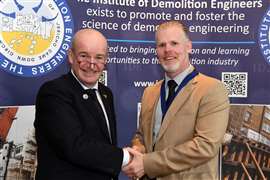 Outgoing president Adrian McLean (L) congratulates Stephen McCann as he takes over the post (Image: IDE)
The Institute of Demolition Engineers (IDE) celebrates a significant milestone this year: its 50th anniversary. It was founded in 1976 to promote demolition engineering as a distinct professional discipline.
“The institute’s golden jubilee gifts us an opportunity not only to reflect on five decades of achievement, but also to recognise how much our industry has changed, and, importantly, to consider where we go next,” said McCann, adding that demolition today bears little resemblance to the industry he grew up in.
“Modern demolition is a highly technical engineering discipline. Teams are taking on increasingly complex decommissioning projects in sectors such as oil and gas, petrochemicals and renewable energy,” he said. “That calls for expertise in how structures behave, temporary works, hazardous materials, environmental protection, recycling, specialist equipment, occupational health and safety.”
McCann believes that this evolution is why the role of the IDE remains so important.
The IDE as framework
Clients, contractors, regulators and other professionals need confidence that those advising on, designing or managing demolition work have the necessary understanding and experience to do so safely and effectively.
“Professional membership must mean more than simply having letters after one’s name; it should represent independent, verifiable evidence of knowledge, experience, competence and, most importantly, the commitment to professional standards,” said McCann.
Through professional assessment, examinations, interviews, continuing professional development and its code of professional conduct, the IDE provides a framework through which demolition engineers can demonstrate that competence throughout their careers.
He added, “As I begin my term as president, I believe our 50th anniversary should be seen not only as a celebration of what has gone before, but as the starting point for the institute’s next phase of development.
“Demolition is becoming more technically demanding, more closely regulated and increasingly international. The IDE must continue to evolve with the profession while safeguarding the standards and values on which it was founded.”
Knowledge of legends
One of McCann’s key priorities is education and the transfer of knowledge. He is the group managing director of Perses Group, a specialist consultancy that delivers education to the demolition industry through the Perses Academy.
The Perses online diploma is endorsed by the IDE, providing a structured route into the profession as well as training for those wishing to further develop their competence and expertise.
“We have a responsibility to ensure that knowledge does not disappear as experienced professionals retire. In my view, this is the biggest threat to our industry: industries have no memory,” said McCann.
“There are no more legends left, and unfortunately once they are gone, the knowledge disappears along with them.”
He said that the industry must create stronger career paths for the next generation and encourage young people to see demolition engineering as a highly skilled, innovative and rewarding profession, he said.
The IDE has an important role to play through examinations, seminars, technical guidance, professional development, academic engagement and recognised qualification routes.
“Sharing knowledge across companies, sectors and international boundaries will strengthen the profession,” he stated.
International reach
McCann’s other major priority for his presidency is the institute’s international development.
The IDE has already taken significant steps towards becoming a more international organisation, including the establishment of two branches: one covering the Asia-Pacific (APAC) region and the other covering mainland Europe.
Both branches are now active and growing, according to McCann, who also said that the institute is seeing increasing interest and opportunities across North America and the Middle East.
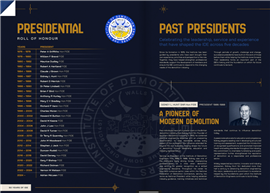 The IDE’s 50 Years of Excellence yearbook (Image: IDE)
“My ambition is for the IDE to become a genuinely international professional home for demolition professionals,” he said.
“Different countries will naturally operate under different legislation, standards and regulatory systems, but the fundamental principles of demolition do not change.
“By bringing demolition professionals together and encouraging the international exchange of knowledge, experience and best practice, I believe we can help raise standards across the globe.”
Summarising his goals for the next two years as president, he concluded, “My responsibility as president is to build on that foundation, broaden our international reach, support the next generation and ensure that the Institute of Demolition Engineers continues to represent the very highest standards of our profession.”
To mark the occasion, the IDE has published a 50th anniversary yearbook which can be accessed online HERE.


CONNECT WITH THE TEAM