




Read this article in 中文 Français Deutsch Italiano Português Español
Volvo CE’s Scott Young on electric’s ‘bumpy’ path and North American resilience

02 April 2026
It was at Bauma Munich 2025 that Volvo Construction Equipment’s (Volvo CE) President, Melker Jernberg, expressed his frustration to Construction Briefing that there weren’t enough stands at the show that were showcasing electric equipment.
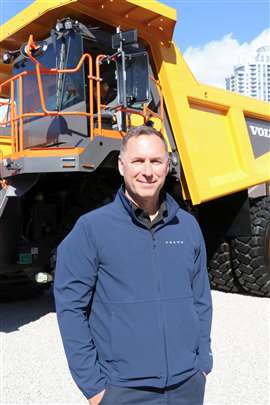 Scott Young, President of North America, Volvo CE. Image: Volvo CE
Fast forward a year to ConExpo 2026 and there seemed to be even less emphasis on electric equipment. One of the notable exceptions was the Volvo CE stand, where Construction Briefing stopped by at the end of a busy show week to speak to Scott Young, president of North America for the brand.
Sitting outside in glorious sunshine, Young concedes that electric construction equipment is less of a conversation than it used to be in North America.
However, he contends that, with technology development pushing down the initial price of investment and the total cost of ownership (TCO) equation looking increasingly positive for electric machines, there is reason to be optimistic.
“We still get customer demand but it is less popular in terms of headlines over the last few years. Of course, some of that comes down to the politics that’s taking place. But we’re still getting customers that request it,” says Young.
“In our booth, we have the electric products by our diesel products because that’s what a job site would look like for a customer as they go through the transformation. The thing that we think supports the future of that market is now we’re into the TCO discussion and we see the technology cost coming down as the technology advances. We know that this is a bumpy adoption curve.”
Young makes the point that the OEM’s L120 Electric, a 20-tonne wheel loader, can now provide around eight hours of work on one charge, which opens up the possibility of it working a full shift without being charged. He also says that it uses about a quarter of the energy of its diesel equivalent which is obviously a large cost saving, especially if the cost of petrol continues to rise.
In terms of demand in North America, he says that it is partly where it might be expected – California, New York – but also in places like Texas and Arizona. He also highlights Canada, where customers have been buying electric equipment to use in cement plants.
“Of course, it’s not going as fast as we would like. But we still see the opportunity where people are asking for it. We’re still excited about it. We continue to invest, but we also continue to invest in the efficiency of our diesel products. And we’re looking at other technologies because we do know that it takes a suite of different offerings for different applications.”
North American opportunity
When Scott Young talks about the North American construction market the word that he uses most frequently is “resilient”. It is a fair choice as, despite facing headwinds such as one of the most acute skills shortages in construction in the world and the complications of President Trump’s tariffs, the market has performed well.
There’s a reason why at ConExpo one of the major trends was companies looking to invest more in North America – it is the world’s largest market for construction equipment. While 2025 may not have seen any growth from the year before, 2024 was a pretty good year, so remaining at that level is no bad thing.
 Volvo CE’s stand at ConExpo 2026 in Las Vegas, US. Image: Volvo CE
Volvo CE was one of the companies that announced investment into North America, with the OEM unveiling a US$1.2 billion spend. The company says that this is designed to strengthen manufacturing capabilities, regionalise supply chains and support the next generation of sustainable technologies.
A centrepiece of this strategy is a $40 million investment in its Shippensburg facility, which will bring production of excavators and large wheeled loader models to the US in early 2026.
“Of course there’s uncertainty with things that are happening geopolitically, but we also know that these can be short duration or long duration. But that’s what we’ve managed through the business, over hundreds of years” says Young.
“This is an advanced market and there is a lot of growth. I think coming from Covid times we all learned a lot about resilience and how to improve delivery for our customers. That started a chain of making sure our investment, our supply base and so forth, is set up to handle some uncertainty. It has prepared us for what we’re facing today.”
Focusing specifically on the $40 million investment in the Shippensburg facility, Young says that the investment, “is to shorten lead times and create more efficiency in our delivery models. When you have a strong supply base and a strong manufacturing footprint close to the customers, it also supports the uptime for a customer.
“It is also so we can grow, because we want to grow in North America. We feel that we can achieve a higher market potential in terms of our penetration into the market. We really have a beautiful set of products that fit that segment in terms of size, class and capability.”
Young is – understandably – somewhat coy on exact growth plans for the region but does say that the company feels that it can grow the volume they have out of that facility in Shippensburg to a point where they could supply over 50% of what they sell in North America from that one plant.
The times they are a-changing
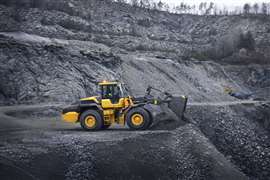 Volvo CE have been early adopters and innovators regarding electric consturction equipment. Image: Volvo CE
The construction industry is still, at its heart, a traditional and conservative beast. However, there is no doubt that the sector has undergone substantial change over the last decade through technology and alternative power. Young says that he counts himself lucky that he gets to do his job in the midst of all this change.
“I get the good fortune in my role that I get to see the technology that’s coming. I get access to the technology we’re developing,” he says, smiling as he settles back in his chair, basking in the baking Nevada sunshine.
“This industry is in one of the biggest transformations that we have had, maybe ever. I think we’ll look back and say this was a pretty amazing time where we took on some big challenges and we helped change the industry going forward.”
Young is referencing alterative power, but it is not just that – AI is being increasingly embedded into the systems of processes of major OEMs like Volvo CE.
“There are so many alternative power systems out there but it’s also about AI and how does that support us? And then, of course, putting the solution around the product where customers are looking at how do they drive more efficiency in their job site, how do they create more success?
“It’s really the confluence of all of those things happening in this window of time. This period of time is when all of these things are coming together; it’s going be interesting to see how we come out of that.”
With that, the interview draws to a close and Scott Young heads back on to the company’s stand to talk to members of staff, customers, and visitors about what alternative power and new technology means for the industry today and, perhaps, speculating with them about where it could lead us to tomorrow.

CONNECT WITH THE TEAM