




Read this article in 中文 Français Deutsch Italiano Português Español
Sany America CEO: ‘We’re here to stay’

16 March 2026
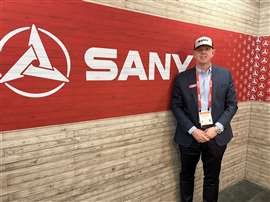 Sany America CEO David Nicoll (Image: Neil Gerrard/KHL Group)
Sany America’s chief executive has underlined the Chinese equipment manufacturer’s long-term commitment to the North American market, even as it faces intense competition from established domestic brands and an evolving tariff landscape.
Speaking to Construction Briefing at ConExpo-Con/Agg 2026 in Las Vegas, David Nicoll said the company was determined to build on two decades of growth in the region. Sany is marking its 20th anniversary in North America this year.
“We’ve made a big investment into North America and we’re here to stay,” Nicoll said.
Sany used the trade show to present what it described as its most comprehensive North American portfolio to date, displaying 32 machines and 17 attachments, including 10 new models developed for the regional market.
Among the equipment on show were the SY10U mini excavator, designed with zero tail swing for tight urban jobsites, the SY335LC medium excavator powered by a 9-litre Cummins engine, and the SCA3300A lattice boom crawler crane equipped with a smart windshield that adjusts tint depending on sunlight.
Alongside the machines themselves, Sany used the event to highlight a range of digital tools and support services. These include the SANY AI Service Assistant (SASA), which provides intelligent diagnostics and parts identification, and RootPilot, a high-precision 3D guidance system intended to improve productivity on site.
Nicoll said the technology demonstrations reflected the company’s broader strategy of combining equipment development with investment in product support and digital capabilities.
‘Bullish’ on US prospects
Nicoll said Sany was “bullish” on its growth prospects in the North American market, with flat to modest growth in 2026, followed by a rebound in 2027 driven by capital investment and a broader economic expansion over the long term.
“Through the end of the decade, we see a compound annual growth rate (CAGR) of 5% or better, supported by infrastructure, investment, urbanisation, and continued trends in mechanisation as the US invests in things like data centres. So we’re bullish,” he said.
A commonly sold machine for US data centre projects, he noted, is Sany’s SY500 50t heavy-duty excavator, he noted.
And he added that renewable energy projects would also provide growth in machine sales.
Expanding footprint in North America
Nicoll, who has served as CEO of Sany America since 2024, joined the company following a long career with Caterpillar and Perkins, where he was most recently Caterpillar’s vice president, earthmoving medium wheel products.
He said Sany has steadily expanded its North American footprint since establishing a regional headquarters in Peachtree City, Georgia, where it operates a 230-acre campus housing manufacturing, logistics, parts operations and research and development.
“We’ve got our North American headquarters in Peachtree City, Georgia. We’re on 230 acres where we have manufacturing, parts, logistics, and research and development,” Nicoll said.
The company also operates a Canadian office in Toronto and maintains four parts distribution centres in Georgia, North Carolina, California and Ontario to support its dealer network.
According to Nicoll, Sany currently works with 72 dealers operating from 191 locations across the region, a network that has expanded significantly in recent years.
“Our dealer network is part of the Sany family and they’re growing with us today,” he said. “We have 72 dealers in 191 locations, and that is significant growth since the last ConExpo.”
Competing with established brands
Although Sany is one of the world’s largest construction equipment manufacturers, Nicoll acknowledged that in North America it remains relatively new compared with long-established domestic competitors.
To build trust among contractors, he said the company emphasises both machine quality and product support.
“First of all, we believe in our world-class engineering quality,” Nicoll said. “One way we demonstrate that is that we offer a five-year, 5,000-hour warranty for most of our construction equipment as standard, which is the best standard warranty in the industry.”
He added that Sany is also using rental fleets and dealer partnerships to introduce contractors to its machines.
“When you have a new brand, sometimes it just takes some time to get customers in the machine,” he said.
Navigating tariffs and global supply chains
The company has also had to navigate a changing trade environment over the past year. Nicoll described the geopolitical tariff landscape as “very dynamic” and said Sany had, at times, absorbed tariff costs on aftermarket parts rather than passing them on to customers.
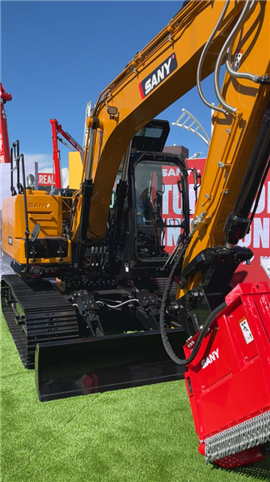 Sany’s SY135C excavator was among the machines on display at ConExpo 2026 (Image: KHL Group)
“There was a time on aftermarket parts where we had to pay a 100% or more tariff, and we did,” he said. “We didn’t raise our price. We just absorbed that cost and made sure that our customer had the parts that they need to get their machines repaired.”
Nicoll added that while tariffs can affect equipment manufacturers, global supply chains remain essential to the industry.
“I believe in free trade. I didn’t learn that here – I learned that at Caterpillar,” he said. “There are some components, such as hydraulic components or small diesel engines, that are very hard to find domestically.”
He also noted that the tariff landscape has shifted since a US Supreme Court decision last month to scrap certain duties on imports imposed by President Donald Trump last year, which led to Trump introducing new 10% global tariffs under a different mechanism.
Nicoll suggested that the latest development had an effect on OEMs across the board, rather than on manufacturers based in a certain country, like China. “Now the tariffs don’t vary country by country as much as they did. The new 122 tariff is 10% really across the board. Section 232, which is the steel and aluminium tariff is across the board,” he said.
To manage the risks presented by tariffs and to supply chains, Sany operates a global manufacturing footprint with facilities in the US, China, India, Indonesia, Turkey and Germany, while also exploring further expansion opportunities.
Despite the competitive landscape and policy uncertainties, Nicoll said the company remained confident about its long-term prospects in North America.
“I think it’s important for our customers to see that Sany’s here to stay,” he said.

CONNECT WITH THE TEAM