




Read this article in 中文 Français Deutsch Italiano Português Español
Interview: How TVA safely brought down a compromised smokestack

05 January 2026
When a modern smokestack did not fall as planned, the Tennessee Valley Authority (TVA) team faced a high-risk challenge. Jason Curtsinger, Senior Manager of Demolition at TVA, tells D&RI how the company overcame it.
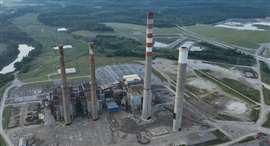 Photo: TVA
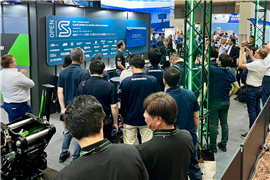
Speaking at the World Demolition Summit (WDS) in Nashville in November, Jason Curtstinger, Senior Manager of Demolition at the Tennessee Valley Authority (TVA), garnered much praise for his review of a recent implosion project at a fossil plant in the Tennessee River Valley.
During the decommissioning of several retired smokestacks, one modern scrubber stack, part of four structures imploded on the site, did not fall as planned.
Instead, it squatted rather than toppling, creating a compromised structure that required immediate re-evaluation.
In an hour-long session at WDS, Curtsinger captivated delegates, revealing how the company went about turning what was an unexpected event into a learning moment. And ultimately, a successful project.
“This stack was unique,” Curtsinger tells Demolition & Recycling International (D&RI). “Out of all the sites where we have performed implosions, we have not had any issues like this. We ended up with a compromised stack, but our priority was always safety.”
Cross-disciplinary coordination
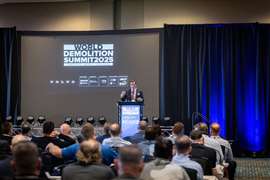 Curtsinger speaking at WDS 2025.
The initial implosion took place in August 2024, with DH Griffin contracted as the prime contractor. DH Griffin then hired the engineering and demolition firms involved.
To ensure safety and precision, a third-party engineering firm was also brought in to review plans and calculations following the initial implosion event.
This, says Curtsinger, meant that cross-disciplinary coordination work between the respective teams was key, especially at this stage of evaluation.
“We held routine meetings, at least two to three times a week, and shared models and ideas. The two engineering firms utilized different finite element models, reviewed each other’s work, and ultimately aligned on the plan for felling the compromised stack.
“That collaboration continued even after the stack was down, as we evaluated what caused the squatting and what we could learn.”
Initial planning considered multiple approaches, including traditional blasting and redrilling. However, the remote-operated excavator with hoe ram attachment emerged as the safest option. This particular piece of equipment was owned by DH Griffin for use in high hazard situations to maximize worker safety.
“When we evaluated the amount of time people would be working under the stack with drilling and blasting versus the remote-operated excavator with hoe ram option, it was easy to see the remote operation was safer with zero people next to the stack versus a crew working for three or four days. From a safety perspective, the decision was clear.”
Adapting to unexpected conditions
Unexpected conditions during the implosion forced midcourse adjustments. The stack leaned unpredictably, requiring updated survey data on its off-center position and height.
Both engineering teams updated their models with this data to ensure the method for bringing the stack down was reliable.
“Because we were running two different models on separate platforms, we had to confirm they were working well together. Once we did, we felt confident the stack could be safely brought down,” says Curtsinger.
Again, communication remained critical throughout. TVA maintained an open flow of information from leadership down to contractors.
“We at TVA did not dictate the solution,” Curtsinger notes. “We relied on the demolition and engineering experts to assess the options. We always had incremental steps to move forward, even if the entire project plan had to change due to conditions encountered.
“That methodical approach, taking the time to step back and analyse before moving forward, kept the project controlled.”
Lessons learned for the demolition industry
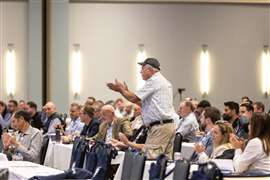 Curtinger’s keynote at WDS was well received by delegates
According to Curtsinger, the lessons learned from the event are key to informing industry practice.
He explains that measures such as strengthening hinges, adding additional cuts, and verifying existing information, such as concrete strength, can significantly improve the implosion design.
Adjusting the bird-mouth height and refining blast patterns are also critical factors, while running detailed computer simulations should model the stack’s unique structural behaviour.
The lessons are also being put into practice, with another power industry peer successfully imploding a thin-walled, wide diameter stack using the lessons learned from this project.
In that respect, Curtsinger emphasizes the importance of sharing lessons to improve industry safety; “The demolition industry should share these experiences. If knowledge is not shared, there’s a gap that could lead to incidents where people are hurt or structures are damaged.
“By sharing our experience, two similar stacks have since been brought down safely using the lessons learned from our event. They went down perfectly because the knowledge was applied.”
A blueprint for safe demolition
The project ultimately stands as a case study in safety, innovation, and collaboration, he says. The remote-operated excavator solution not only mitigated risk but also demonstrated the value of cross-disciplinary teamwork, thorough analysis, and adaptive planning.
“The implosion didn’t go exactly as planned, but no one was hurt, and power wasn’t interrupted. It ultimately was a technical success and a learning opportunity,” Curtsinger concludes.
After careful evaluation and the implementation of the innovative remote-operated approach, the compromised smokestack was safely brought down in September 2024, marking the successful completion of that project milestone.
“Moving forward, any similar structures will be evaluated in detail, with lessons from this project applied to ensure safety and effectiveness every time.”
Video: TVA implodes 540 ft cooling tower
The Tennessee Valley Authority (TVA) has safely imploded the 540 ft cooling tower at its Hartsville property in Trousdale County.
The implosion, carried out by TVA’s Demolition team in the early morning hours of September 18, brought down the massive hyperbolic structure in a matter of seconds.
The tower was originally built in the 1970s as part of a planned nuclear power plant that was never completed. In the decades since, the unused structure had become a target for trespassing, creating growing safety concerns for the public and first responders.
“Removing the cooling tower not only eliminates a safety risk, it’s also part of our effort to remove obsolete infrastructure and prepare sites for any future opportunities,” said Jayme Hobson, General Manager, Demolition. “We’re also putting the materials from the cooling tower to good use.”
Much of the tower’s material will be repurposed. Concrete will be crushed into smaller pieces and spread across the Hartsville property to create a gravel lot for heavy equipment storage, while steel from the structure will be recycled.
TVA said the approach reflects its commitment to maximizing the use of resources across its projects.
“Even though the cooling tower is gone, we’re preserving everything we can for other uses,” Hobson said. “It’s important to make use of materials when we can – and Hartsville is a great example of how we do that for all our projects.”
The implosion is part of a wider TVA program to retire obsolete facilities and prepare for future energy needs. Similar demolition work has recently taken place at Paradise in Kentucky and at Bull Run in Harriman, Tennessee.
With the Valley region’s population and economy growing faster than the national average, TVA plans to add more than 6,200 megawatts of new generating capacity to its system in the coming years. These additions are intended to replace retiring assets, support economic development, and enable further electrification.
While there are no immediate redevelopment plans for the former cooling tower site, TVA said it continuously evaluates its properties for future opportunities that align with its mission. Portions of the Hartsville site remain in active use, serving as office space and staging areas for heavy equipment supporting other TVA projects.

CONNECT WITH THE TEAM