




Read this article in 中文 Français Deutsch Italiano Português Español
World Demolition Awards shortlist: Recycling

25 August 2026
With the finalists for the 2026 World Demolition Awards now confirmed, D&Ri highlights the companies and projects shortlisted for this year’s Recycling Award.

The category recognises outstanding achievement in the recovery, reuse and recycling of materials generated by demolition, rewarding approaches that maximise resources while reducing waste and environmental impact.
Congratulations to the following companies (in alphabetical order) selected for this year’s shortlist:
DEMEX (Australia)
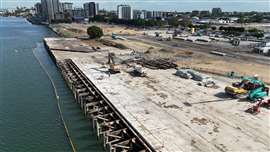
PROJECT: M4 Wharf Demolition, Northshore Hamilton
CLIENT: BMD Group
 Demex
The complete demolition of the 302 m-long M4 Wharf at Northshore Hamilton on the Brisbane River comprised aged timber piles and girders supporting a reinforced concrete deck. Working over water in a tidal environment, the project involved deteriorated structures, asbestos contamination, live site conditions and unstable ground.
Demolishing from the wharf rather than using a land-based crane allowed joists, girders and piles to be removed in full lengths, recovering more than 34,000 linear metres of Ironbark and Tallowood timber for reuse in building and landscaping applications. The alternative land-based methodology was estimated to limit timber recovery to around 60%.
All 16,266 tonnes of concrete and brick were crushed and reused on site as subgrade, avoiding the export of waste and import of virgin fill, as well as an estimated 1,200 heavy vehicle movements. Reinforcing steel was also fully recovered, with effectively no demolition material sent to landfill.
DESPE (Italy)
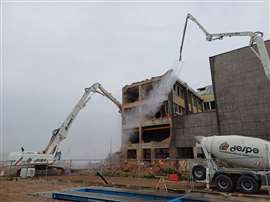
PROJECT: CISE Site Demolition and Material Recovery
CLIENT: Cyrusone Italy I
 Despe
The demolition of the former CISE nuclear research site in Segrate, Italy, covered approximately 72,000 sqm, including 55 buildings comprising industrial units, offices, laboratories, warehouses and plant towers. The works combined demolition, soft strip-out, asbestos remediation and excavation over approximately one year, with material recovery integrated into the planning and demolition sequence.
Around 250,000 tonnes of material were generated during the works, while a further 30,000 sqm of certified material was used for backfilling. Recycling objectives were incorporated into the engineering, site logistics and sequencing from the outset to maximise recovery and minimise disposal. Almost all the material was recovered and diverted from landfill, resulting in a reported landfill diversion rate of close to 100%.
GRUPO MITRE (Argentina)
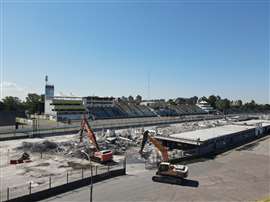
PROJECT: Oscar and Juan Gálvez Race Circuit Demolition
CLIENT: UTE COARCO – Inmac – SE.MI.S.A.
 Grupo Mitre
The demolition works at racetrack in Buenos Aires included more than 12,800 sqm of buildings and grandstands and 63,000 sqm of pavements. A circular economy strategy centred on processing and reusing demolition materials directly on site.
In total, 24,762 tonnes of material were recovered, representing 94% of all materials generated by the works. This included 14,091 tonnes of concrete, 10,584 tonnes of asphalt and 86.63 tonnes of steel. Concrete and asphalt were crushed and processed on site to produce recycled aggregates for use in the racetrack’s new infrastructure.
The recovered material was subsequently used as base material for the new training track, secondary roads and pit facilities, as well as for the foundations of new buildings. On-site processing also reduced waste transportation and the requirement for imported virgin aggregates.
TSCHERNING (Denmark)
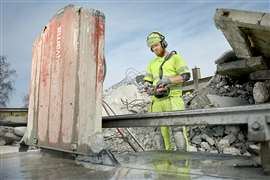
PROJECT: TT Slab Recovery and Reuse – Ishøj Demolition
CLIENT: Copenhagen Municipality
 Tscherning
The project involved the selective dismantling and reuse of approximately 22 precast concrete TT slabs from an industrial building in Ishøj, Denmark. Rather than crushing the concrete for use as recycled aggregate, the slabs were removed while retaining their structural integrity and repurposed as urban furniture.
Following limited adaptation, the recovered elements were used to create benches and integrated planting structures installed at six public locations across Copenhagen. Material assessment and planning for reuse were incorporated at an early stage to allow the slabs to be safely extracted, transported and adapted for their new purpose.
The project brought together demolition contractors, designers and municipal stakeholders to coordinate the recovery and reuse process. By retaining the concrete elements in their original form, the project avoided additional processing and reduced the requirement for newly manufactured materials.
The award will be presented at the World Demolition Summit in Madrid, Spain, on 5 November.

CONNECT WITH THE TEAM