




Read this article in 中文 Français Deutsch Italiano Português Español
World Demolition Awards shortlist: Collaboration

25 August 2026
Following the announcement of this year’s World Demolition Awards finalists, D&Ri introduces the companies and project teams shortlisted for the Collaboration in Demolition Award.

The category recognises projects where successful delivery has depended on exceptional cooperation between contractors, clients, engineers, suppliers and other project partners, demonstrating what can be achieved through an effective collaborative approach.
D&Ri congratulates the following companies and project teams on making this year’s shortlist:
GRUPO MITRE (Argentina)
PROJECT: La Plata Warehouse Demolition
CLIENT: Municipality of La Plata
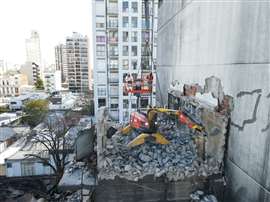
Following a major fire at an electrical appliance warehouse in central La Plata, Argentina, the emergency demolition required collaboration between Grupo Mitre, the Municipality, Civil Defence, the Fire Department, Police and structural engineering specialists.
 Grupo Mitre
Located within a densely populated area surrounded by residential and commercial properties, the fire-damaged structure presented a significant collapse risk. Drone surveys and continuous structural monitoring were used to identify unstable areas and inform the demolition sequence, alongside perimeter exclusion zones and dynamic safety measures. In the highest-risk areas, a remote-controlled demolition robot was suspended from a 160-tonne mobile crane, allowing work to proceed without exposing personnel to the unstable structure.
The demolition was completed without incidents, uncontrolled collapses or damage to neighbouring buildings. Dust suppression and material recovery measures were also implemented, with 1,395 tonnes of material recovered for reuse and recycling.
JBV DEMOLITION (UK)
PROJECT: Sellafield East Blower House Demolition
CLIENT: Sellafield
 JBV Demolition
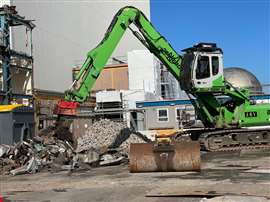
Cumbria Nuclear Solutions (CNSL), appointed by Sellafield Ltd, contracted JBV Group Holdings to deliver the demolition of the Pile 1 Reactor Blower House at the Sellafield nuclear site in Cumbria, UK.
Constructed in 1957, the structure was in a constrained area adjacent to legacy ponds and silos containing radioactive waste, with contaminated cooling ducts beneath the building. The project required close collaboration between Sellafield, CNSL and JBV to manage radiological, structural and logistical risks under regulatory oversight from the Office for Nuclear Regulation.
A safety-case-led methodology, supported by engineering calculations and temporary works designs, enabled demolition to proceed in controlled phases while protecting adjacent nuclear assets. The project ran from April 2017 to June 2026, with more than 60,000 hours worked without a lost-time injury, accident or reportable event.
PRIESTLY DEMOLITION (US)
PROJECT: UTHSC Medical Tower Deconstruction
CLIENT: Flintco, University of Tennessee
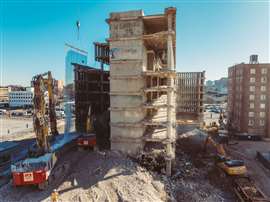
The deconstruction of the UTHSC Medical Tower brought together Priestly Demolition, Green City Demolition, Tiny’s Demolition, Aegis and Flintco in a coordinated programme covering abatement, interior strip-out and structural demolition.
 Priestly Demolition
Tiny’s Demolition completed the interior demolition, while Aegis carried out the required abatement works ahead of structural demolition by the Priestly Demolition and Green City Demolition team. Flintco provided local expertise, industry relationships and coordination support throughout the project. Sequencing and communication between the project partners allowed each phase to progress while maintaining the overall demolition programme and addressing site-specific challenges.
The works were completed with zero lost-time incidents. Material recovery was also incorporated into the programme, with 100% of the structural steel and concrete generated during demolition recovered for recycling.
THOMPSONS OF PRUDHOE (UK)
PROJECT: Coursington, Allan and Draffen (CAD) Towers Demolition
CLIENT: North Lanarkshire Council
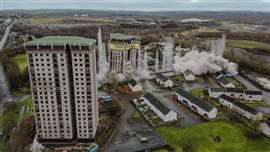
The demolition of the former CAD Towers in Motherwell, Scotland was delivered through collaboration between North Lanarkshire Council, Perses, Thompsons and PDC. Built in 1970, the three 20-storey residential towers had been local landmarks for more than 50 years.
 Thompsons of Prudhoe
Following unsuccessful work by a previous contractor, the project inherited partially completed demolition, structural instability, incomplete asbestos removal and the discovery of post-tensioned concrete construction. The partners developed a programme to stabilise the structures, remove hazardous materials and prepare the towers for demolition.
Following detailed assessments, explosive blowdown was selected as the safest and most viable method. Preparatory works included strip-out, removal of glazing and cladding, structural modifications and blast modelling. All three towers were demolished in a single controlled operation without damage to neighbouring properties or reported incidents.
The winner will be announced at the World Demolition Summit in Madrid, Spain.
BOOK now to attend the event which takes place 3–5 November.


CONNECT WITH THE TEAM