




Read this article in 中文 Français Deutsch Italiano Português Español
How demolition robots improve efficiency and safety in industrial applications

24 September 2026
Demolition robots have been around for more than 50 years. They provide an efficient, remote-controlled method of dismantling structures while reducing the risk to operators in dangerous environments.
These compact machines are equipped with a chassis, a hydraulic arm and specialised attachments designed to break down concrete, steel and masonry anywhere from small confined indoor spaces to large industrial demolition projects, underground or on top of a chimney. Most run on electric motors and impress by their high power-to-size ratio.
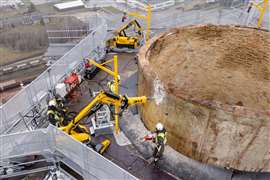 Next Level Demolition used remote-controlled robots to help take down two chimneys at the Akmenė cement plant in Lithuania (Image: Next Level)
Safer solution
In terms of suppliers, the market is dominated by two manufacturers, Brokk and Husqvarna Construction, both originate in Sweden.
Brokk introduced the concept of the demolition robot in 1976 and up through the 1980s and 1990s continued to develop new models. By 1994, it had sold over 1,000 machines globally. During the 1990s and 2000s, this technology became mainstream and over the next ten years moved into specialist applications, such as nuclear decommissioning, tunnelling, mining and other hazardous environments.
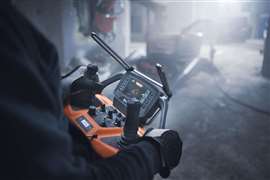
“Robotic demolition machines provide a safer solution to tackle projects in dangerous environments like places with excessive heat, fumes and even toxins,” said Jeff Keeling, vice president of sales & marketing at Brokk Inc. “They’re perfect for areas where crew members can’t go, and the radio link remote control allows operators to stand up to 300 metres (984 feet) away from the machine in a safe location.”
He says that most of the time, contractors consider demolition robots when they need to fit a heavy-hitting piece of equipment into a confined space or in situations where it would be dangerous to have an operator sitting in an excavator.
“Demolition robots really shine in applications like ‘top-down’ demolition. If, for example, a team was demolishing a chimney that the high-reach excavator couldn’t reach the top of, they might use a crane to position a demolition robot at the top of the chimney and break it down until the high-reach could get to it,” he says.
“Placing an operator in a cab under material that is being moved would be dangerous, but a remote-controlled demolition robot keeps the operator away from dangerous falling debris.”
Key requirements
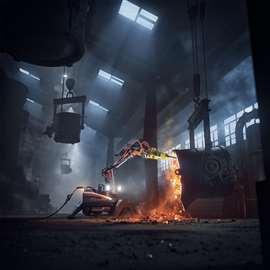 Husqvarna DX 145 (Image: Husqvarna)
Husqvarna’s DXR range of demolition robots first came to market in 2009 and is used in construction projects and industrial applications, as well as in mining and tunnelling operations. They can be configured with various factory-installed feature packages that adapt the machines to different attachments and working conditions.
An additional hydraulic function gives operators precise control of attachments such as rotating grapples and shears, while enhanced cooling allows certain models to work continuously at full power in hotter environments, including cement kilns and steel plants. A heat protection package is also available for tasks such as deslagging, shielding key components from radiant and conducted heat.
“Operator and overall jobsite safety are among Husqvarna’s most important core principles,” says Daniel Lundberg, global product manager, demolition robots, noting that it is always important that operators maintain a safe distance when using a demolition robot.
“Remote operation is essential in certain applications where the environment may present risks such as falls, structural collapse, extreme temperatures or radiant heat,” he explains.
When asked what technical improvements customers are asking for most often, he says that power is always a key requirement. “Customers want machines that can operate for long periods without service interruptions or repairs. Reliability and stability are critical, but serviceability also plays an important role in ensuring a product’s longevity.”
He says the electro-hydraulic system, which uses an electric motor to drive the hydraulics, means “a tremendous amount of power is packed into a compact format.”
This means that the robot can deliver the force needed for breaking work while remaining small enough to manoeuvre in restricted industrial spaces, making it useful inside plants and structures where a larger machine could not work.
Labour issues
Demolition robots can also mitigate some of the issues around the labour shortages in today’s market, as they allow much smaller crews to tackle jobs that would otherwise require many more bodies on hazardous industrial sites. In addition, they can help meet increasingly stricter regulatory demands and new legislation around working conditions, as well as time pressures.
“Labour shortages haven’t gotten any better in the last few years, and there are plenty of projects to be done,” says Jeff Keeling from Brokk. “A single demolition robot can supplement a crew of two or three people that used to take 10 to 20 people, making projects possible during labour shortages.”
Alongside the pressure to find enough workers, rising labour costs are strengthening the business case for demolition robots.
“The market is growing steadily, driven by increasing demands for safety and efficiency. In some cases, regulations related to extended working hours, and vibration exposure also contribute to adoption,” says Lundberg. “Rising labour costs are another factor, making demolition robots an increasingly cost-effective solution.”
Attachment power
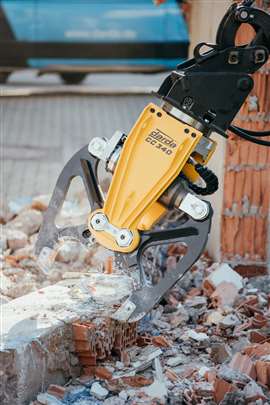 Darda concrete crusher attachment (Image: Darda)
Brokk acquired German attachment manufacturer Darda in 2006. It develops high-performance attachments, including concrete crushers, steel shears, cutters and splitting cylinders for demolition robots.
When choosing attachments, the power-to-weight ratio is one of the most decisive factors, according to Bernd Ströbele, sales director at Darda GmbH, who explains that the goal is to achieve the highest possible crushing or cutting performance while keeping the attachment’s weight low.
He says that Darda’s booster systems enable very high breaking and cutting forces despite the compact design of the attachment, meaning smaller machines can deliver comparable demolition performance to significantly larger machines. “That performance makes a huge difference in hard-to-reach areas, on ceilings with limited load-bearing capacities or during interior demolition projects,” states Ströbele.
Darda’s small, lightweight concrete shears – such as the CC340 which weighs only 150 kg (330 pounds) – are currently in high demand. Demolition contractors can use it with smaller carriers without worrying about increasing the machine weight or their transportation costs, according to Ströbele.
“Other popular attachments are our steel-cutting tools – steel shears and multi cutters. They benefit from the same power-to-weight principles and are being used for projects like the rapid interior demolition of industrial facilities.”
Refractory demolition
Robotic demolition also extends into confined industrial spaces. A specialist robotic equipment manufacturer based in Northern Ireland, Leonard (until recently G. Leonard) develops and deploys robotic systems for refractory removal and industrial maintenance.
Specifically, the company offers robotic refractory demolition, installation and industrial maintenance services for the cement, metal processing, energy, power, waste-to-energy, biomass, glass and civil engineering sectors. It is active across Europe, North America, the Middle East, Africa, and Asia-Pacific.
Leonard recently launched the new range of Descender robotic demolition and installation arms, which can operate remotely to break out linings and built-up material inside cement plants and other industrial equipment.
 Managing director Mark Leonard (Image: Leonard)
Cement remains a core market for the company, but it plans to expand further into adjacent heavy industries where refractory-lined, high-temperature and confined-space assets are common. Here, traditional methods of removing refractory can require teams to enter unstable, confined and/or cooling structures during shutdown periods, with operators facing safety and time pressures.
“Our refractory and demolition solutions have proven that massive productivity gains can be achieved while also greatly improving the safety and efficiency of the critical path during shutdown periods,” said managing director Mark Leonard.
“We’re helping to shorten those timeframes while also keeping more people out of harm’s way, so we see massive growth potential and high demand for our technology.”
Future developments
Over the past five decades, the demolition robot has become a core tool for handling demanding and dangerous applications in industrial demolition. So, what can we expect to see in the near future in terms of developments in this segment?
“Most of the developments we see on the machines themselves focus on fine-tuning performance and increasing efficiency. The biggest advances are in the new ways operators have found to use the machine,” says Keeling.
He explains that contractors looking to maximise the profitability of their demolition robot approach them with unique projects. “We help them investigate alternative options to accomplish their tasks. Sometimes, that results in an entirely new attachment,” he adds. “We’ve developed specialised attachments in the past for projects like helical pier installation, torches for cutting through metal and a modified drill arm for confined spaces.”
Darda’s Bernd Ströbele agrees that improving efficiency is key to the future of demolition robots: “The deciding factor when choosing what machine and attachment to use for demolition is no longer just the size of the machine, but how efficiently it can get the task done.”
In his conclusion, Daniel Lundberg at Husqvarna says that the company’s DXR demolition robots will continue to expand into new applications, “helping companies and operators perform increasingly advanced and hazardous tasks more safely and efficiently.” He predicts that semi-autonomous or AI-assisted demolition systems will “to some extent” become commercially viable within the next five to six years.


CONNECT WITH THE TEAM