




Read this article in 中文 Français Deutsch Italiano Português Español
Demolition under cover

16 July 2026
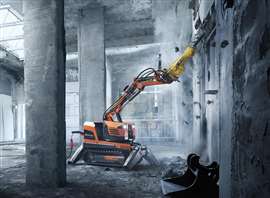 Husqvarna demolition robot (Image: Husqvarna)
In this article, we look at some of the machinery available for indoor demolition such as small excavators, electric compact loaders and demolition robots.
Not all demolition involves big buildings coming down in carefully orchestrated implosions or large excavators munching away on concrete at great heights. Much work takes place inside buildings and structures, or even underground, which requires a very different set of skills and naturally much smaller machines.
Indoor demolition work largely determines the success of the entire renovation project, according to Akarsh Shetty, Hitachi Construction Machinery Europe (HCME) product manager for special applications and new technologies, who adds, “Without a good plan, attention to safety and professional execution, a renovation can quickly be delayed or become dangerous.”
Jiri Karmazin, product manager at Czechia-based Firstgreen Industries, agrees. “Indoor demolition is rarely about one single challenge. Contractors need compact machines that can work in tight spaces, reduce manual labour and, most importantly, keep operators away from hazardous areas,” he says.
He points to ventilation and dust as major issues, along with a number of other key concerns. “Exhaust emissions can create serious limitations and additional costs. Dust is also a constant challenge in demolition, and conventional combustion-engine machines may suffer from clogged radiators and air filters.
“Floor load limits, access to upper floors, transport through narrow doors and corridors, and restrictions on storing fuel inside buildings due to fire safety risks are also common concerns.”
Small excavators for easy access
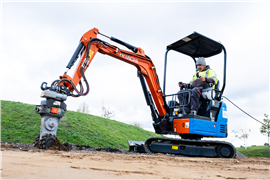 Hitachi ZE17 cable-operated mini excavator (Image: HCM)
While Hitachi Construction Machinery (HCM) does not manufacture demolition-specific machines, its standard excavator range is built with the precision and controllability that these environments demand, says Norihiko Kinugawa, HCME product manager mini excavators, explaining they can easily be configured with the right attachments, along with dust suppression and the noise reduction features required.
In addition, the company’s joint venture with Kiesel Technology Entwicklung (KTEG), in Germany, develops machines suited for special applications. One such is the ZE17 cable-operated mini excavator, which is based on the Hitachi ZX17U-6 excavator.
Designed for emission-free operation, the ZE17 has an engine speed of 3,000 rpm and has demonstrated performance superior to its diesel equivalent in user tests, making it well suited to indoor demolition applications, according to Akarsh Shetty, HCME product manager for special applications and new technologies.
“Considering the complexity involved in indoor demolition projects, contractors and owners need specialist equipment that works reliably and efficiently, while contributing to a safety-first approach.”
Emily Pagura, product marketing manager at John Deere, says compact equipment is increasingly important for demolition work where space is limited.
“With space one of the biggest concerns, the smallest machines in our portfolio help address that need,” she says. She highlights the 317 P-Tier compact track loader, 318 P-Tier skid steer and the 17 and 26 P-Tier compact excavators as models well suited to these applications.
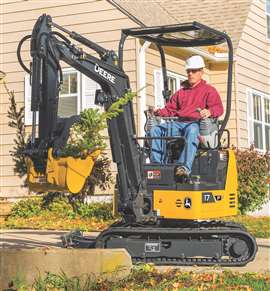 John Deere 17 P-Tier mini excavator (Image: John Deere)
The machines can be equipped with a range of attachments to increase their versatility. The compact track loader and skid steer can be fitted with hydraulic hammers for breaking concrete and grapples for handling debris, while the compact excavators can be equipped with hydraulic hammers and thumbs to grab, sort and move material on site.
She adds, “Reversing fans, additional LED lighting packages and small size are the specific features that make a difference to efficient operation in indoor demolition. The 17 P-Tier has retractable tracks to get you down to 3 ft 3 in in width, enabling an operator to fit through small openings.”
Going all electric indoors
Firstgreen Industries has focused on combining battery-electric power with remote-control technology, replacing the conventional combustion engine, exhaust system and cooling package with a simpler electric drivetrain.
“Electric drive gives us a real advantage. Without a combustion engine, exhaust system or cooling system, the machine can be more compact, cleaner and less demanding on ventilation,” says Karmazin.
Remote operation is another key feature, enabling operators to work from a safe distance while maintaining a clear view of the demolition process.
This can also help improve productivity and reduce reliance on manual labour, while onboard telematics provide machine utilisation and operating data to support fleet management, according to the company.
In addition, multiple charging options enable the machines to be adapted to a wide range of project requirements.
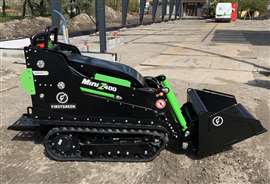 Firstgreen MiniZ 400 electric loader (Image: Firstgreen Industries)
Among Firstgreen’s range, the MiniZ 100% electric loader is its most widely used machine for indoor demolition. The compact tracked machine is narrow enough to pass through openings as small as 80 cm (31.5 in), while its tracked undercarriage provides greater stability when lifting loads and helps reduce ground pressure on sensitive floors. Its compatibility with a wide range of attachments makes it particularly versatile, says Karmazin.
Firstgreen also offers the Elise range of lithium-battery-powered skid steer loaders, which features a conventional cab and can also be equipped with remote-control functionality.
Meanwhile, Toro’s battery-powered compact utility loaders and material buggies are engineered to deliver robust performance equal to their gas counterparts and tailored to the demands of interior demolition, says Kaitlyn Ingli, product marketing manager.
Its range for interior demolition includes the eDingo 500 and eDingo TX 750 compact utility loaders, both designed to work in confined spaces. Measuring 76 cm (30 in) and 80 cm (31.5 in) wide respectively, the machines are narrow enough to pass through standard doorways while offering the power to carry out a range of demolition and material-handling tasks, according to Ingli.
A dedicated range of attachments, including floor scrapers, grapple buckets, buckets and adjustable forks, allows Toro’s machines to undertake work ranging from floor removal to debris handling.
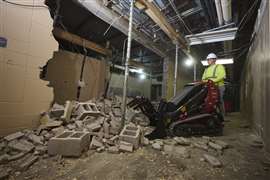 eDingo TX 750 compact utility loader from Toro (Image: Toro)
Toro’s electric Ultra Buggy range, including the e2500, e2500-TS and e2500-THL, has been designed for transporting demolition waste. They are 80 cm (31.5 in) wide and have a carrying capacity of 1,134 kg (2,500 lb). The e2500-TS features a 180-degree swivel skip for more flexible unloading, while the e2500-THL provides a 193-cm (76-in) dump height for loading directly into containers.
Power for the machines is provided by Toro’s HyperCell lithium-ion battery system, which the company says can deliver up to eight hours of continuous operation.
“For contractors, the greatest solution Toro battery-powered equipment delivers is the ability to drastically shrink project timelines and labour costs. An interior demo job that would traditionally take a large crew a couple of months using manual methods can potentially be completed in just a few weeks with a smaller crew utilising eDingos and an electric Ultra Buggy,” concludes Ingli.
Enter the robot
Indoor demolition projects often make use of robotic machines capable of climbing stairs and gaining access easily. These electrically powered, exhaust-free machines offer remote-controlled, safe operation, helping to keep workers out of harm’s way, while getting on with the job.
Comfortable working in confined spaces where even the smallest excavator would struggle, these specialised robots can be equipped with attachments such as breakers, crushers and buckets allowing them to tackle demolition jobs.
“This market is growing steadily, driven by increasing demands for safety and efficiency. In some cases, regulations related to extended working hours and vibration exposure also contribute to adoption,” said Daniel Lundberg, global product manager - demolition robots at Husqvarna Construction, adding, “Rising labour costs is another factor, making demolition robots an increasingly cost-effective solution.”
The company’s DXR series of robots is available in five sizes, each in several variants. They were first introduced to the market by the Swedish manufacturer in 2009, with the latest model launched in 2024.
This was the compact DXR 95 demolition robot which without attachments weighs just 589 kg (1,299 lb) meaning it can fit into an ordinary van, according to Husqvarna. The company also highlights the robot’s high uptime and ease of operation.
The DXR 95 has a reach of 3.16 metres and offers 9.8 kW of rated input power. The largest robot in the range, the DXR 315 which comes with a power of 27 kW, can reach up to 5.5 metres and weighs up to 2,255 kg (4,971 lb) depending on the configuration.
Another robotic demolition machine manufacturer of Swedish heritage is Brokk, which added the 110+ model to its lineup in January 2026.
Introduced as part of the company’s 50th anniversary celebrations, the new model is designed to build on the success of the original Brokk 110, while incorporating the latest advances in powertrain technology. Like other Brokk machines,
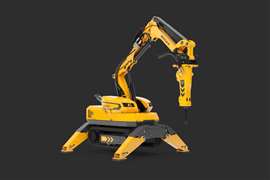 The Brokk 110+ is equipped with SmartPower+ (Image: Brokk)
The Brokk 110+ is equipped with the company’s new SmartPower+ system, an intelligent heavy-duty electrical powertrain developed specifically for Brokk demolition robots.
According to the manufacturer, the system enhances the machine’s versatility and performance while retaining the compact dimensions that have made the Brokk 110 a popular choice for contractors.
“Versatility, capability and trust have defined the Brokk 110 for a decade,” said CEO Martin Krupicka at the launch. “The Brokk 110+ continues that legacy, offering a noticeable step forward while staying true to the compact form that operators rely on.”
Conclusion
Overcoming the many obstacles connected with indoor demolition, such as emissions, ventilation, noise, confined spaces, dust, safety risks and labour shortages remains a challenge. Having the right equipment ensures contractors can deliver safely and on time in an ever more regulated part of the market.
“Indoor demolition is becoming more demanding. Contractors need equipment that helps them overcome restrictions around emissions, access, safety and labour availability, not equipment that creates more restrictions on site,” says Karmazin.
“One recent customer in Switzerland used three of our machines simultaneously on the sixth floor of a commercial building, working around eight to ten hours per day. For us, that is exactly the type of application where electric compact machines make practical sense,” he says.
The machines had already been in service for several years and, according to the company, had paid for themselves many times over through higher productivity and reduced manual labour.

CONNECT WITH THE TEAM