




Read this article in 中文 Français Deutsch Italiano Português Español
How electric equipment is redefining interior demolition

22 June 2026
Electric construction equipment can help contractors navigate the specific constraints and demands of interior demolition work, while offering multiple benefits over comparable diesel-powered machines, says Darren Ashton, product manager-compact equipment, Volvo Construction Equipment.
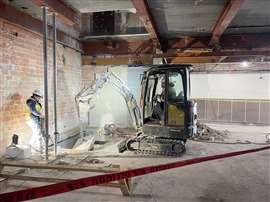 Robles1 in Texas has grown its niche in interior demolition by switching to emissions-free electric excavators (Image: Volvo CE)
Compared to open-air demolition where excavators have ample room to manoeuvre, indoor demolition work is much more confined, forcing contractors to operate under difficult constraints.
Using traditional diesel equipment for these projects introduces additional safety, regulatory and environmental challenges. Electric heavy equipment can help address many of these associated concerns, including:
1. Space constraints
Machines must be small enough to pass through standard commercial doorways without structural damage, yet robust enough to complete the required tasks for the job. Once inside, standard two-piece booms on compact excavators often lack the vertical articulation or pin height required to easily reach ceilings or overhead mechanical systems.
The Volvo EC18 Electric compact excavator is a sub-2-ton machine suitable for access through low entry points while offering the pin height needed to reach higher points.
2. Fuel emissions
When operating inside closed structures, carbon monoxide and exhaust fumes can accumulate and present a safety hazard. Contractors typically rely on exhaust scrubbers and temporary industrial ventilation systems as a solution. But even with those controls, crews must wear carbon monoxide badges.
When emission levels spike, safety regulations require work stoppages, forcing the crew to evacuate for 30 to 45 minutes until the air clears. This downtime greatly slows project timelines and efficiency. A zero-emission, battery-electric excavator eliminates carbon monoxide hazards and exhaust-related work delays and helps ensure the comfort and safety of workers.
3. Strict regulatory and noise requirements
Indoor demolition projects often happen in active urban areas, historic buildings undergoing renovations or occupied commercial zones where noise must be kept to a minimum. These sites are typically subject to local, regional and national regulatory control.
Diesel engines generate high decibel levels that reverberate off concrete interior walls, presenting challenges for noise regulations and worker safety.
Electric equipment operates much quieter than diesel machines. This provides benefits for noise reduction – especially important for jobsites in residential or busy areas – and it also allows operators to easily communicate with nearby crew members.
4. Structural and weight limitations
Finally, demolition work on multi-story suspended concrete slabs requires a machine lightweight enough to stay within floor load limits but powerful enough to get the job done. Many compact electric machines stay within the weight requirements.
Battery life and charging
Contractors considering electric equipment for interior demolition work may see battery life and charging as potential hurdles. But these machines can perform on one charge for much of the day during a typical application. If they’re used in harsher environments, it may require a quick charge over lunch to ensure they’re ready to go for the afternoon.
Under normal operation of the Volvo EC18 Electric compact excavator, contractors can expect up to six hours of battery life with a full charge. The machine can plug into a standard 120-volt outlet overnight to return to 100% capacity by morning. But for optimal commercial charging, it is recommended to use a 240-volt NEMA 14-50 outlet with an SAE J1772 adapter (standard EV plug) for faster charging.
Diesel-powered machines often stand idle for multiple hours a day, wasting energy and money, while electric equipment shuts off when not in use. Coupled with the fact that electric machines require zero fuel expenses and minimal engine maintenance, this benefit lowers the total cost of ownership.
Providing an edge for a Texas-based contractor
One family-owned demolition contractor based in Texas was able to grow its niche in interior demolition thanks to a switch to emissions-free electric excavators.
The team at Robles1 specialises in interior demo work, including hard plaster, concrete openings and structural shoring. They note that safety inspectors are tightening focus on indoor dust and emissions, so having a fleet of electric machines helps set them apart from competitors who are unequipped with those options for interior work.
The Robles1 crew used to run diesel machines with scrubbers, but they experienced constant work stoppages due to CO tester alarms. Transitioning to EC18 electric machines from Volvo eliminated this problem. By going electric, Robles1 was able to cut emissions so they can continue working more efficiently throughout the day.
Before making the switch, it often took a crew of 20 people to manually perform these tough tasks on a typical interior demolition job. Using an electric compact excavator allows them to accomplish the same work on schedule with just five to six people, saving significant labour time.
The team is satisfied with the machine’s performance, verifying that it delivers the same speed, strength and power as a diesel version, maintaining full performance even when the battery drops below 30%.

CONNECT WITH THE TEAM