




Read this article in 中文 Français Deutsch Italiano Português Español
The projects that won the World Demolition Award (Industrial)

11 December 2025
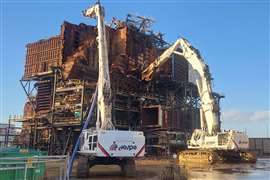
Independence Demolition (ID) carried out the full environmental decommissioning, demolition, and site restoration of DTE Energy’s historic Trenton Channel Power Plant, a 100-year-old coal-fired facility along the Detroit River in Trenton, Michigan.
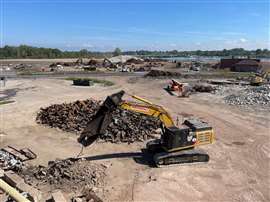 Photo: Independence Demolition
The 60-acre site presented extraordinary challenges, including aging infrastructure, hazardous materials, proximity to live utilities, active rail lines, and protected waterway habitats.
The project involved safely removing two 600-foot stacks, twin boiler houses, and a 650-foot turbine bay while preparing the site for future redevelopment.
Independence Demolition
Challenges and constraints
The overall project involved safely removing two 600-foot stacks, twin boiler houses, and a 650-foot turbine bay while managing hazardous materials, maintaining critical infrastructure, and preparing the site for future redevelopment.
The turbine bay posed one of the most significant challenges, as it was located just 25 feet from a live 120-kV substation that could not be de-energized. Extreme precision in demolition sequencing was required to avoid disruption to the substation.
Legacy contaminants across the site included asbestos, PCBs, oils, chemical tanks, and other universal waste, all of which required careful abatement and disposal.
Environmental factors were equally demanding: approximately 20 million gallons of water per month required treatment, and air quality had to be continuously monitored to meet regulatory standards.
The site also required coordination with multiple agencies spanning environmental, utility, and transportation sectors to ensure all operations complied with regulations.
The project was further complicated by the use of explosives, work in confined spaces, and the presence of sensitive infrastructure. Each element demanded meticulous planning, specialized equipment, and strict procedural controls to safely complete the work.
Equipment and approach
The project began with a full utility make-safe and environmental remediation. Settling ponds were dredged and dewatered, asbestos and PCB materials were abated, and oils, chemical tanks, and universal wastes were removed.
Demolition sequencing involved two explosive events to bring down the stacks and boiler houses.
The turbine bay, located adjacent to the live substation, was dismantled mechanically using pre-cutting and shielded zones, with vibration monitoring and blast shielding via connex boxes. Every movement was reviewed with DTE engineers and third-party specialists.
Advanced technologies were employed, including digital dashboards, drone mapping, live dust and vibration monitoring, and just-in-time deliveries to ensure the schedule was maintained and rework minimized. Lean management strategies coordinated multiple crews across shifts and subcontractors.
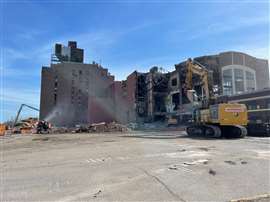 Photo: Independence Demolition
Collaboration and safety
Safety was a top priority. All team members participated in project-specific orientations, daily toolbox talks, confined-space rescue planning, and live utility tracking.
Blast events were conducted within strict public safety protocols, including exclusion zones, air monitoring, and coordination with fire and EMS personnel.
Weekly progress meetings, field reports, and permit logs ensured full transparency with DTE, environmental consultants, and regulatory agencies.
The on-site project manager acted as the single point of contact while live data from drones, dust monitors, and vibration sensors provided real-time visibility for all stakeholders.
The project was completed with zero OSHA-recordable injuries across 400,000 man-hours.
Materials management and environmental performance
The project successfully removed all major structures, including the 600-foot stacks, boiler houses, and turbine bay. Material recovery was significant: ID recycled 49,000 GT of scrap steel and 100,000 cubic yards of concrete, achieving a 98.6% diversion rate from landfill.
Over 340 million gallons of water were treated to meet discharge standards before entering the Detroit River.
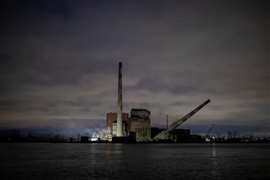 Photo: Independence Demolition
The cleared site is now ready to host a 220 MW / 880 MWh battery storage facility, supporting Michigan’s clean-energy goals.
Programme and outcome
ID completed the Trenton Channel Power Plant project on time and on budget over a 22-month schedule.
The operation successfully removed the 600-foot stacks, boiler houses, and turbine hall while maintaining live substation operations.
The decommissioned site now hosts a 220 MW / 880 MWh battery storage facility, capable of powering 40,000 homes and supporting Michigan’s clean-energy goals.
Veit USA
Veit was also recognised for the completion of one of Minnesota’s most significant industrial dismantling and recycling projects at the former LTV Steel Mining site in Hoyt Lakes, once home to the world’s largest concentrator.
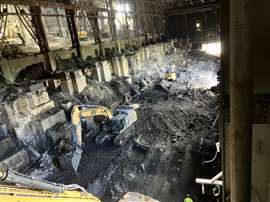 Photo: Veit USA
The 384,000-square-foot facility, originally constructed in the 1950s, processed 63,000 tons of taconite ore per day and had been idle for decades.
The project prepared the site for its next chapter as part of the NewRange Copper Nickel Project.
Scope and execution
Veit was contracted to perform interior demolition and remove obsolete process equipment and infrastructure across the massive concentrator.
The scope included 67 rod and ball mills (~190 tons each), 270 magnetic separators, three thickeners, 36 vibrating pan feeder lines, ore storage bins, steel structures, concrete foundations, and floors.
Recycling and material repurposing were prioritized throughout. The team salvaged 32,000 tons of structural steel, more than twice the amount used to build U.S. Bank Stadium.
Seventy-two thousand tons of ore were repurposed into temporary access roads supporting demolition operations, and 65,500 tons of concrete were crushed for future reuse, avoiding landfilling and reducing environmental impact.
Complex selective demolition was carried out within the active superstructure, preserving the building’s integrity for future operations.
Challenges and constraints
The project involved careful planning to safely manage legacy materials, high-elevation removals, and confined-space dismantling.
The sheer scale of equipment, tight internal access, and the need to preserve parts of the structure for future use demanded meticulous sequencing, specialized equipment, and experienced craft workers.
Collaboration and safety Safety was a core focus. Across more than 70,000 labor hours, a team of 50 union craft workers completed all work without a single recordable or lost-time incident.
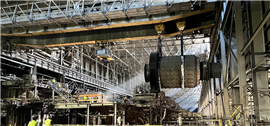 Photo: Veit USA
Daily safety meetings, rigorous pre-planning, and adherence to strict safety protocols ensured personnel protection throughout the project.
International collaboration was integral. Veit partnered with engineers and operations directors from NewRange Copper Nickel, who traveled globally to provide expertise on mining operations.
This joint effort ensured adherence to world-class safety, quality, and performance standards.
Programme and outcome
The project began with interior abatement in May 2023, progressed to full-scale dismantlement by June, and officially completed in January 2025.
Materials recovery and site preparation were completed efficiently, readying the facility for its future role in the NewRange Copper Nickel processing operations.
CONNECT WITH THE TEAM