




Read this article in 中文 Français Deutsch Italiano Português Español
Opinion | Exercising the critical thinking muscle on OEM rankings

12 October 2026
Even posts on LinkedIn are sometimes not true. How do you spot the red flags?
Nothing generates clicks on a social media post more than a ranking. I personally like something fact-based (rankings based on anything you can count), but I feel like I’m in the minority.
If you really want to blow up your comments, provide a ranking of the ‘best’ something. Offer an opinion and start a (hopefully!) good-natured debate. The clicks, comments and interactions make for great reach, lots of eyeballs and a satisfying spike in your post analytics.
Click-bait is not fact
But I have a problem with the way click-bait is spilling into LinkedIn.
LinkedIn sh*t posters (technical term) have worked out that they can’t just produce a made-up ranking say something is ‘the best’ without justification. Doing the research into easily accessible public domain information seems to be too much like hard work for many. Instead, the strategy is to say words to the effect of ‘Our ranking is based on a range of factors and our own proprietary weighting & scoring framework.’
But a bigger concern is the growing number of plausible click-bait articles from semi-credible sources.
In the area where I work, more and more of these centre on electric construction equipment and the manufacturers active in that area. It is a new branch of the industry and general understanding of the markets is perhaps not as good as for traditional diesel equipment. It is therefore ripe for misinformation.
If you’ve attended Off-Highway Research’s free webinars on this subject, or heard me speak at industry conferences, you’ll be fully aware that 80% of the global market for electric equipment is in China and that Chinese OEMs command more than 90% of the global market through exporting their products and approach, predominantly to emerging economies.
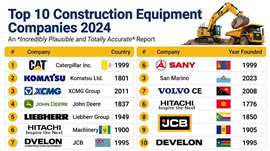 Rankings posted on social media garner plenty of engagement and look superficially plausible but look closer and all is not as it should be, argues Chris Sleight (Image generated using AI)
Even armed with that knowledge, a European might think, ‘OK, China’s in the lead, but Norway and the Netherlands are the next most significant markets.’
Not so. Our data shows very clearly that electric equipment sales in India will be greater than either of these countries in unit terms this year. Due to the focus on high-value mining & quarrying equipment in India, those sales will be worth almost twice as much as those of electric equipment in one of the leading European markets.
These are provable facts, although it has taken Off-Highway Research many years in the market to be able to gather such information via our own primary research.
For those who don’t have access to such facts, or who wouldn’t want facts to get in the way of a quick & easy click-bait post, the trend is to go qualitative and produce rankings of the ‘most important’ markets, the ‘best’ equipment brands, the ‘five OEMs to watch.’ The rubric of the posts inevitably goes on to say results were arrived at using their ‘proprietary framework matrix methodology, which weighs and scores a range of critical factors’ (add or delete from this word salad as applicable).
Dig deeper and ask questions
Dressed up with a nice logo, professional presentation and the fact that they’re on LinkedIn, these woolly qualitative measures and opinions somehow morph into facts.
I will happily admit that I don’t know what these opaque methodologies really are. I suspect there’s not much substance but I don’t really know. My concern is the ‘findings’ in these posts are being swallowed whole by clients and used for the basis of important decisions just because they look plausible (or perhaps because they happen to reinforce an existing opinion or flatter a company the publisher is trying to win business from).
Qualitative research has a place. What I would say is proper research has solid methodologies which stand up to scrutiny. If you see one of these vague posts and questionable rankings – whether it reinforces your current view or not – ask a few basic questions of the poster before you buy into it:
Specifically what factors are you benchmarking?
How did you research them?
For technical metrics, what is your expertise in assessing them?
How are different factors weighted to produce your overall score & ranking?
You can’t expect someone to reveal the full calculation, but they should be able to give credible answers, list specific factors they’re assessing and establish their expertise if they’re making a judgement on a technical parameter. If you get another ‘complex framework matrix multiple factors’ word salad answer, that’s a real red flag.
AI slop – the thin end of a wedge?
Those who follow me on LinkedIn will know I take time (and have a bit of fun) calling out the most egregious and entshi**ifying AI slop posts I see. Maybe I should work on being a bit less triggered, but when I see something so obviously wrong and when the publisher is a company which one minute is posting about the global motor grader market, and next minute has a report to promote about the market for toilet seats in Kazakhstan, something in me can’t let it go.
I am amused that these posts broadcast the ignorance of the publisher so loudly.
But part of me is also concerned that someone somewhere might think they are true and that danger is all the greater when semi-credible sources engage in a version of this practice.
So I take the time to post a fact-based critique and try my best to hold back on the sarcasm (not always successfully).
To sum up, I’d go back to where I started. If you want to rank things, pick something which is clearly defined and countable. Once you start to rank ‘the best’ you are producing league tables of one person’s opinion or an AI bot’s hallucinations. That’s no basis for a business decision.
The author: Chris Sleight is managing director of Off-Highway Research. Before joining Off-Highway, Chris was editor of both Construction Europe and International Construction magazines.



CONNECT WITH THE TEAM