



Read this article in 中文 Français Deutsch Italiano Português Español
Inside XCMG’s plan to become a truly global giant

22 May 2026
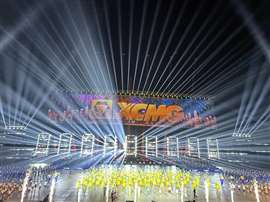 Dancers at the conclusion of the launch event for XCMG’s 8th International Customer Festival (Image: KHL Group)
As XCMG rises to third place in the Yellow Table, chairman Mr. Yang Dongsheng speaks exclusively with Neil Gerrard about the Chinese manufacturer’s ambitious overseas growth plans, the huge impact of AI on construction, and a new approach to M&A.
With a light and video show that wouldn’t have looked out of place at a rock concert, a vast stage, hundreds of dancers, and a cavalcade of its latest machines, XCMG’s 8th International Customer Festival in Xuzhou, China, was quite the spectacle.
Laid on for an audience of 2,850 customers and dealers from over 100 countries, as well as local dignitaries and other VIPs, the bombastic display served as a demonstration both of just how far Chinese manufacturing has come and as an emphatic statement of intent.
XCMG has risen to become the world’s third largest construction equipment manufacturer, according to the latest Yellow Table published earlier this year.
And it’s clear that the company wants to ensure its name is even better known outside of China in the future.
In an exclusive interview, XCMG’s chairman Mr. Yang Dongsheng sat down with Construction Briefing prior to the International Customer Festival’s launch event to describe how that future might look.
Mr. Yang’s patient and kindly manner belies a steely resolve to further the company’s international reputation and standing.
“We have invited our customers here to see XCMG up close so they can observe the changes in our business divisions, especially in intelligent manufacturing,” he says via an interpreter. “In the production of our products, we have higher quality control and higher efficiency, a better production process.”
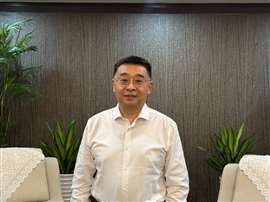 XCMG chairman Mr. Yang Dongsheng (Image: KHL Group)
No longer just a seller of machines
Mr. Yang is quick to emphasise that XCMG is no longer simply a company that makes and sells machines.
Instead, he wants the OEM’s customers to understand that it is transforming itself into a solutions provider, powered by the latest developments in technology and new forms of energy.
“We would like customers to see XCMG as a growing new participant in the global construction machinery industry and let them see that we deserve number three in the Yellow Table,” he says.
He adds, “Dealers cannot only sell products. They have to transform from selling products to selling solutions and also providing better services to their customers.
“At the same time, in the whole lifecycle of services, we have to empower our dealers through our IoT [under the umbrella of its Hanyun operating system] and the reliability of our products, the whole lifecycle solution.”
He points out that there is now an established CRM system, dealer portal system, warehouse management system, and localised internet platforms, running from HQ to business regions, to dealers.
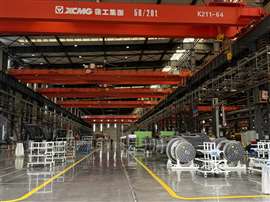 Visitors to Xuzhou, China, were given a tour of several different XCMG factories producing cranes, excavators, access equipment, and mining equipment (Image: KHL Group)
International expansion
XCMG already lays claim to be the market leader in several different machinery categories within China itself – it produces the full gamut of construction equipment from excavators and wheeled loaders, to mining machinery, cranes, motor graders, crushers and more.
But it has also been growing its presence overseas steadily in recent years.
Mr. Yang candidly compares the company to a “primary school student” in its early efforts to learn the workings of international markets.
“In the past, we were only a vendor, just selling products. We thought it was okay to sell products but in fact customers need solutions,” he notes. “They need more services to help them solve their problems. So we have to empower our dealers and our customers in the entire lifecycle.”
Having gleaned a greater understanding of market demands, the company has grown at a rate of around 10% a year overseas, to the point where nearly 50% of the group’s revenue comes from outside China.
Mr. Yang’s aim is to push that even further, to 60% by 2030. The thinking behind the strategy is to help the business smooth out fluctuations in revenue in its home market, where sales can be prone to peaks and troughs.
“We need to hedge the risk of domestic fluctuations in the overseas market. From the perspective of risk management, we can rely more on the international market.”
That’s not to say that XCMG won’t be prudent in its approach, he adds. He stresses that the company understands the importance of following the rules and regulations of local markets if it wants to succeed.
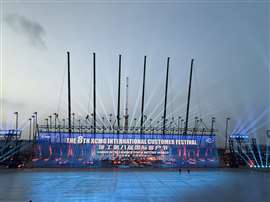 XCMG’s own machines were used to suspend a giant screen for the International Customer Festival launch event (Image: KHL Group)
Thanks to past experiences, he says the company is now more alive to a host of different risks, whether legal, technical, exchange rates, or in the sphere of employment.
“Only by developing safely can we achieve sustainability. If we blindly charge ahead, maybe we will end up achieving the opposite. Therefore, I believe risk management is also an important lesson we learned,” he says.
Among the hurdles that lie in XCMG’s way along that path are, of course, a bewildering collection of new tariffs amid strained trade relations, particularly between China and the US.
They have changed XCMG’s approach to its global strategy, Mr. Yang explains.
“In the past, we have relied heavily on our dealers and support them overseas with parts and service. And now because tariffs are driving up our costs, we are readjusting our layout and our investment in the overseas market, including our international strategy or plans…We must learn how to coordinate and utilise global resources and local resources. “
What that means in practice is speeding up the process of localisation of its manufacturing operations and parts distrubution – something that the company was looking at prior to the eruption of a trade war in 2025 and which XCMG now plans to accelerate.
But localisation can present challenges in some countries and regions due to the cost of labour and exchange rates, Mr. Yang says. That means developing resources and local facilities in locations that are accessible to those markets but where labour and component costs are more competitive, he says.
“We believe that localisation will need to go further and deeper to serve XCMG’s international strategy,” he says.
AI to bring ‘huge change’
Mr. Yang is in no doubt that a wave of rapid technological development driven by artificial intelligence (AI), will bring “huge change” to construction equipment.
“We need to actively embrace and explore how to integrate AI technology with our construction machinery. Besides automation and internet of things, we are also bringing AI and construction technology together,” he says.
He envisages AI being embodied in the machines themselves to allow them to make autonomous plans and decisions, following their own paths to address the needs of a construction project.
“Right now, the intelligence of machines is only at level two or three,” he says, referring to the commonly cited five levels of AI automation (where level one is rules-based automation and level five is fully cognitive AI).
While machines are currently akin to an assistant – unable to make plans or decisions on their own, he sees a future within the next five years where they reach level four.
And it isn’t just the machines themselves that will benefit from that trend. XCMG is also applying AI to its manufacturing processes. Construction Briefing witnessed that progress when it took a tour of an XCMG factory in Xuzhou that features an intelligent welding line for large tonnage crawler crane frames, with parts being transported autonomously by robots from one process to another. According to XCMG, it is one of only 15 factories to be part of a national pilot for “smart factory leaders”.
Mr. Yang says that embedding intelligence in its manufacturing will not only make the production of XCMG machines more efficient, it will also benefit the customer by “allowing us to achieve the optimal balance between quality and cost”.
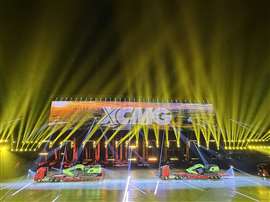 XCMG presented a cavalcade of its newest machines to an audience of 2,850 people at the launch event in Xuzhou, China (Image: KHL Group)
M&A – but not as we knew it?
Up until now, XCMG’s growth has been organic and the company has not really felt the need to open its wallet and buy up other companies to grow.
That is set to change – but don’t expect it to go out and snap up other rival machinery manufacturers.
Mr. Yang acknowledges that XCMG’s future involves mergers and acquisitions, but it’s more likely to take the form of strategic deals with companies that can drive development of its digital and electrification capabilities.
“Looking back on our history at XCMG, most of the time we relied heavily on ourselves for growth. And now with our globalisation strategy, to have such a large overseas revenue share of around 60% by 2030, if we still follow the traditional path of internal development, it is far from enough,” says Mr. Yang.
“Therefore we will have to strengthen the personnel in mergers and acquisitions. We need them to keep an eye on good global opportunities and choices and we will also work with our overseas partners including some intermediary institutions.
“And in the future, we will mainly focus on intelligence, electrification, unmanned driving, digital hydraulics, and other innovative companies. Originally it was mainly focused only around construction machinery and products. And in the future, actually we are also doing software to accelerate the growth of construction equipment’s intelligence. So this is the area where we have to change quickly to meet the market demands.”
Electrification’s moment?
It’s well known that electric construction equipment has found far more customers within China than outside it.
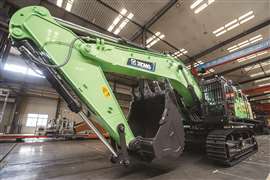
Mr. Yang also acknowledges good demand for electric machines in western and northern Europe, Australia, and Japan. But in general, sales of electric machines overseas have been much slower for all manufacturers often due to their high capital cost comparative to diesel machines.
Nonetheless, the fact that many of the machines on display during the International Customer Festival’s launch event were painted green (to denote an electric or hybrid machine), shows XCMG’s continued commitment to electrification.
And Mr. Yang believes there has been a significant increase in the need for the technology ever since the shutdown of the Strait of Hormuz amid the US and Israel’s conflict with Iran.
Whether that results in significant growth in sales of electric machines depends, in his view, on the attitude each country now takes to electrification and what kind of policies governments and regions put in place to further the development of electric construction equipment.
‘Firm determination’
As the sensory overload of International Customer Festival draws to a close, stage performers and schoolchildren who took part in the show, dealers, customers, and XCMG executives linger on to take selfies in front of a massive screen, suspended in the air by an array of XCMG machines.
As a final act, they release colourful helium balloons that float slowly upwards into the Xuzhou night sky.
It’s a fitting metaphor for the inexorable rise of XCMG itself and brings to mind Mr. Yang’s words from just a couple of days earlier: “In terms of global development, we have a firm determination that we will never waver,” he says.
After such a display, who would doubt it?

CONNECT WITH THE TEAM