




Read this article in 中文 Français Deutsch Italiano Português Español
Drilling and foundations: building the base of tomorrow’s infrastructure

11 June 2026
Whether it’s for large-scale infrastructure – overground and underground – or small urban projects, drilling and foundation equipment plays a pivotal role in ensuring success.
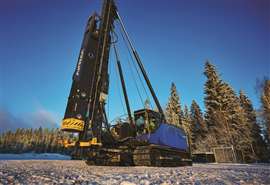 Junttan has expanded its Evolution Series with the new PM5 drilling rig Image: Junttan
Contractors are faced with many site constraints and safety risks, along with a multitude of other challenges, while under pressure to deliver projects safely, on time and within budget.
They are up against the elements, quite literally, dealing with a variety of unpredictable ground and soil conditions, groundwater issues, adverse weather and many other environmental factors.
The latest equipment designed to alleviate these pressures met visitors at ConExpo 2026 in Las Vegas, US. Among the many solutions on show were the PM5 pile-driving rig from Junttan and Sandvik’s new Ranger DX1010i drill rig. Epiroc demonstrated the SmartROC D65 fully autonomous drilling rig, while Liebherr showcased the latest generation of its LB 35 drilling rig, the LB 35.1, with a new lattice boom extension.
With the new PM5 pile-driving rig, Finland-based Junttan expanded the Evolution Series, which first came to market in early 2025 with the DR5 drilling rig. The new rig offers a maximum pile length of 20 to 27m and represents a complete redesign. The company says that it is aimed at raising standards in productivity, accuracy and ease of operation, according to the company.
Among the key features of the PM5, according to the company, is the optimised kinematic design and revised component layout. The telescopic mast has been engineered to allow the rig to handle both extreme vertical pile lengths and high inclination work in shorter leader configurations.
Transportation and mobilisation have also been key priorities. The PM5 can be transported as a complete, work-ready unit, which helps to minimise logistics costs and downtime. There is also the option to configure the rig with a remote-control system, so operators can perform most positioning and setup actions from outside the cab.
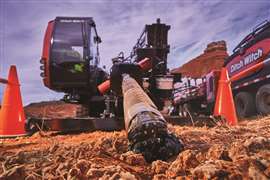 Ditch Witch All-Terrain technology uses a dual-pipe drilling system. Image: Ditch Witch
Another safety feature is the patent-pending hydraulically locking leader connection capability for tool-free operation, which reduces the need for working at heights.
Going horizontal
As underground environments become more congested, the demand for Horizontal Directional Drilling (HDD) equipment is growing steadily in step with the acceleration of infrastructure projects, according to Seth Matthesen, HDD product manager for Ditch Witch.
He told International Construction that contractors are expanding and modernising their HDD fleets to handle longer crossings, tighter project timelines and more complex installations. He noted that broadband fibre expansion and the rapid growth of data centres are still among the strongest drivers.
“Broadband buildouts require thousands of miles of new conduit installations, often in developed areas where open trenching is not practical. HDD allows crews to install fibre quickly with minimal disruption to roads, neighbourhoods and existing utilities,” he explained.
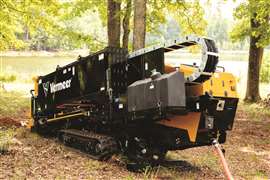 Vermeer’s D24 HDD is designed for installation of utilities in urban areas. Image: Vermeer
Data centres require large volumes of fibre, high-capacity power lines and extensive water infrastructure for cooling systems. Each system depends on reliable underground installation methods.
“AI has added a powerful new catalyst,” agreed Dave Wisniewski, VP of Vermeer Environmental and Infrastructure Sales. He pointed to the latest figures from the US Energy Information Administration, which projects that data centres could consume up to 12% of the nation’s electricity by 2028, up from 4.4% in 2023.
Efforts to move electric transmission and distribution lines underground to improve grid resiliency, particularly in wildfire-prone and high-storm areas is also increasing the need for HDD capabilities.
“Natural disasters have repeatedly exposed the grid’s vulnerabilities. Strengthening and protecting those systems is now a priority, and trenchless technology plays a vital role in that work,” stated Wisniewski.
Cory Maker, Ditch Witch technology product manager, also highlighted that modern HDD machines can capture detailed operating data with more than 150 parameters, such as rotation speed, thrust, and drilling fluid flow.
“That information gives contractors a clearer picture of how machines are performing and helps crews adjust drilling strategies in real time,” said Maker.
The company’s Orange Intel telematics platform allows contractors to monitor machine utilisation, diagnostics and maintenance needs across their HDD fleets. This data can improve uptime and help crews stay on schedule.
Longer feed, deeper holes
The latest addition to Sandvik’s Ranger drilling solutions is the DX1010i, a tophammer surface drilling rig for mining and quarrying. Among the new features is a long-feed system that produces up to 6.4 m of single-pass drilling capability and a boost in compressor output.
Capable of drilling holes with a diameter of 89 to 140mm, the DX1010i is equipped with a 30kW hydraulic rock drill.
Sandvik explained that the high-capacity compressor delivers a flush rate of 11 cubic metres per minute, which effectively clears deeper boreholes. Moreover, the water system offers an optional extra tank, increasing capacity to 500 litres, for longer drilling sessions.
The new rig includes the “safe and comfortable” iCab cabin with air conditioning as well as connectivity for Sandvik’s digital solutions, improved one hole automation with collaring automatics and the iClean drilling automation system.
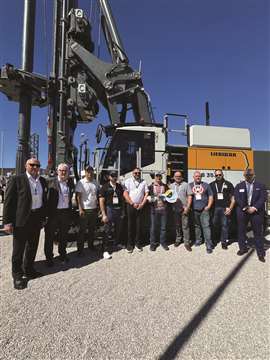 New York Concrete Corp has taken delivery of an LB 45.1 with new lattice extension. Image: Liebherr
At the Las Vegas event, Liebherr presented its LB 35.1 rig fitted with a new lattice boom extension for reaching greater drilling depths. Like all LB models, the new generation rig is designed for deep foundation applications, such as Kelly drilling, continuous flight auger drilling or double rotary drilling.
The lattice boom extends the maximum drilling depth to 37.5m for applications using full or partial displacement, which Liebherr notes corresponds to an increase of 6 m.
This new feature, says the company, creates the advantage for customers that the compact LB 35.1 can be deployed even for large pile depths. In addition, it can be retrofitted to any LB 35.1 and LB 45.1 model rigs.
One of the first to take delivery of a Liebherr drilling rig with the new lattice extension is US-based New York Concrete Corporation, which has invested in an LB 45.1.
The company works for both public and private sector clients in the metropolitan area, thus having access to a wide variety of complex urban sites. As well as wanting the extended reach capability, the company also chose the rig for its compactness and ease of transport.
Smart and connected
Another noticeable trend in drilling and foundations is the shift toward highly connected, data-driven jobsites.
Data monitoring has become standard practice, supporting more efficient operations, improving operator safety and enabling better prediction of maintenance needs. This shift is clearly reflected in equipment development, where connectivity and automation are increasingly built into modern systems.
Liebherr’s LB 35.1 can be equipped with a series of automated systems. These include a drilling assistant that automates the concreting process during continuous flight auger (CFA) operations, as well as a slack rope monitoring system designed to prevent rope loosening. Additionally, the machine can be configured with an automatic leader alignment feature to further improve precision during operation.
Whether it is deeper drilling, longer crossings or more connected jobsites, the technology on show at ConExpo and other industry events suggests that drilling and foundation equipment is evolving quickly to meet growing infrastructure demands.
As projects become more complex and timelines tighten, the ability to go deeper, faster and further will continue to define the next generation of equipment, and the contractors that rely on it.

CONNECT WITH THE TEAM