




Read this article in 中文 Français Deutsch Italiano Português Español
Bridge demolition in Germany makes use of crane

17 March 2026
Railway tracks under old bridge structure prohibited use of conventional demolition or dismantling methods.
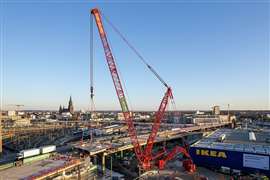 The Liebherr LR 11000 crawler crane in action at the demolition project in Ulm, Germany (Image credit: Liebherr)
A Liebherr LR 11000 crawler crane has been used to dismantle a large road bridge in Ulm, in southern Germany, with 56 individual segments – weighing of up to 510 tonnes – lifted off.
The railway tracks running underneath, with a width of over 100 metres, and the associated overhead lines, did not allow for demolition by explosion or conventional excavation.
In addition, the project was subject to enormous time pressure, as the railway line had to be closed during the work.
Swiss crane and logistics company Emil Egger AG (ETE) brought the LR 11000 crawler crane to the city on the Danube for this challenging task.
Around 40 heavy transports and four days of assembly were required before the powerful crawler crane could begin its round-the-clock operation against the backdrop of Ulm Minster.
The project was carried out by the crane in two phases. For the initial, heavier lifts over shorter distances, the crawler crane was configured with an 84-metre-long lattice main boom (SL2DBV).
The boom was then extended to 128 metres to reach the more distant sections. The large crane operated with a maximum ballast of up to 750 tonnes.
The derrick ballast accounted for 450 tonnes, which was extended to a radius of 30 metres for some lifting operations using the hydraulically adjustable V-frame folding frame.
“We developed the dismantling concept together with the construction and logistics company Max Wild,” said Michael Egger, managing director of ETE. “A major challenge in this large infrastructure project here in Ulm was the segmentation of the bridge sections.”
The demolition followed a clearly defined procedure. First, each carriageway segment was attached to the hook of the crawler crane and picked up. Then the concrete saws began their work on the bridge.
“It was crucial to determine the weight of the individual segments as accurately as possible. Only then could we compensate for the expected load via the extendable derrick ballast and safely lift the component after it had been completely cut through,” explained Egger.
The crawler crane was supported by a Liebherr LTM 1650-8.1, which had also come to Ulm from Switzerland.
Initially, the mobile crane helped to set up the LR 11000. It then moved to the opposite side of the track and took over the dismantling of an access ramp to the old bridge structure.
Like the use of the large crane, individual ramp segments weighing up to 110 tonnes were hooked up, the concrete structure was sawn apart and finally removed piece by piece.
The demolition has made way for the construction of a new bridge at Ulm, which is due to be completed in autumn next year.
CONNECT WITH THE TEAM