




Read this article in 中文 Français Deutsch Italiano Português Español
How do you control squat risk when felling a concrete stack?

29 September 2026
Modern concrete stacks often have wider diameters and thinner walls than older structures which can create a problem during explosive demolition.
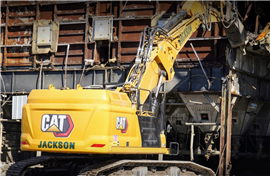
Instead of rotating cleanly towards its intended fall zone, a stack may drop vertically, partially arrest or move off course.
A documented squat event in the US in 2024 underscores that this failure mode is a practical concern as more of these modern stacks reach their end of life.
At the World Demolition Summit 2026, Mark Ramun, vice president of industrial services at Jackson Demolition, will examine how his team addressed that risk during the demolition of a 650 ft (198 m) concrete stack.
Progressive collapse modelling identified a high risk of instability at the stack’s hinge, linked to changes in wall thickness and variations in the concrete.
With a restricted fall zone, the team developed a steel reinforcement system to support the hinge’s compression zone and help the structure rotate in the planned direction.
Mark will explain how the team assessed the squat risk, designed the reinforcement and compared the stack’s behaviour during demolition with the model’s predictions.
The session will offer a case study in using engineering analysis to plan the explosive felling of modern concrete stacks.

Headquartered in Schenectady, New York, Jackson Demolition Service is a full service industrial and commercial demolition contractor that has been in continuous operation and owned by the same family for over 70 years.
Mark Ramun, vice president of industrial services

Specialising in large-scale industrial demolition and power plant decommissioning, Mark is a third-generation demolition contractor.
He began his career more than 35 years ago as a labourer in the field and has since worked across field operations, estimating and project management.
This progression has provided him with deep, practical experience in controlled felling, structural dismantling and the coordination of complex demolition efforts involving engineers and blasting specialists.
His work focuses on practical risk management, constructability and the application of engineering analysis to improve predictability in high-hazard demolition environments.
With a degree in business from the University of Pittsburgh, Mark is a licenced demolition contractor and an active member of the NDA, where he has served on numerous committees.
He has also served as a guest lecturer in the Missouri University of Science and Technology’s explosives engineering programme.
CONNECT WITH THE TEAM