



The project that won the World Demolition Award for Safety & Training

04 December 2025
At the Motor Oil Hellas refinery in Corinth, Greece, the decommissioning and dismantling of the U-1100 unit represented a technically complex and logistically demanding project.
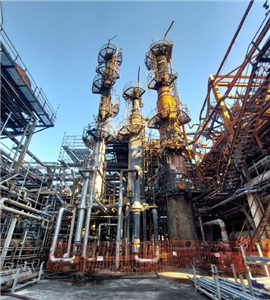 Photo: Despe
Conducted within an operational refinery, the project, carried out by Despe, aimed to remove obsolete and compromised structures while maintaining the functional and structural integrity of adjacent facilities.
Safety, environmental protection, and operational continuity were central to every stage of the work.
Project environment and challenges
The operational area included pipe-racks between alignments 6 and 11 with active and decommissioned lines, steelwork structures with dense piping networks, process columns over 20 metres high, and air coolers previously damaged by fire.
External areas contained interconnected pipes, some potentially containing residual product.
Working in this environment required careful management of multiple critical issues from Despe: the proximity of active installations, residual chemicals in pipes, compromised fire-damaged structures, working at height, and ATEX-rated zones with potentially explosive atmospheres.
The team, composed of 20-25 specialised operators, including internal Despe personnel, MOH technicians, and subcontractors, worked in rotating shifts under continuous supervision.
Each operator received intensive, project-specific training, including operational simulations, ATEX risk management, emergency procedures, and instruction in the use of robotic and remote demolition equipment.
Daily briefings ensured risks were assessed in real time, and cross-functional coordination was maintained throughout the operation.
Technologies and methods
The project used advanced technologies to manage risk and ensure precision. Perimeter laser barriers prevented accidental contact between robotic excavators and operational equipment.
The Fly Demolition System allowed remote operations at height, reducing direct exposure of personnel. Robotic hydrocutting was used to drill and inertise each pipe individually, with residues safely collected before final cutting.
Selective cutting with hydraulic or mechanical shears was only carried out after full inertisation.
Fire-damaged air coolers and columns were dismantled with long-arm excavators and high-capacity cranes using a top-down, progressive removal sequence to prevent structural collapse.
Columns were slung and cut into sections after creating safe manoeuvring corridors. Selective demolition techniques were applied to structures compromised by fire to reduce static and dynamic loads, ensuring stability throughout the process.
Coordination and safety management
The project relied on continuous coordination between Despe operators, MOH technicians, and external teams. Communication channels were maintained at all times, and dedicated signage and protected routes ensured safety for non-operational personnel.
HSE teams, field engineers, and operators performed cross-checks to maintain compliance with safety protocols.
Safety performance was a central priority. The project was completed without incidents or accidents. All operations followed strict phase-specific procedures, with the integration of robotic and remote technologies further minimising risk to personnel.
Outcomes
The project achieved complete and safe separation of the U-1100 unit from active systems, recovery of requested components, and total dismantling of the area according to the planned schedule. There were no environmental or operational impacts on adjacent facilities.
The client highlighted the collaborative spirit, commitment to safety, and effective teamwork demonstrated throughout the project, emphasising how these factors contributed to the successful completion of all project milestones.
Key Project Highlights – U-1100 Decommissioning
Zero incidents in a live refinery environment: All operations were completed without accidents, despite proximity to active units and hazardous conditions.
Remote-controlled demolition technologies: Hydrocutting robots and the Fly Demolition System enabled precise separation of live and obsolete assets while keeping personnel safe.
Controlled dismantling of fire-damaged structures: Columns and air coolers were removed top-down in a sequenced approach to prevent structural collapse.
Continuous coordination with refinery staff: Safety, access routes, and operational continuity were maintained throughout the project.
Highly trained team and rigorous procedures: Operators followed phase-specific safety protocols and procedures for all demolition and recovery activities.


CONNECT WITH THE TEAM