




Read this article in 中文 Français Deutsch Italiano Português Español
Sharp increase in the value of China’s Belt and Road construction contracts in 2025

19 January 2026
Chinese construction companies saw the value of contracts they were awarded around the world under the Belt and Road Initiative (BRI) increase sharply in 2025.
A new report from the Green Finance & Development Centre at the Fudan International School of Finance in China, together with the Griffith Asia Institute, found that 2025 saw the highest level of BRI engagement ever, even as a trade war with the US broke out.
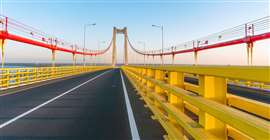 The Maputo-Katembe bridge in Mozambique, the longest suspension bridge on the African continent, was built under China’s Belt and Road initiative (Image: Malajscy via AdobeStock - stock.adobe.com)
Chinese firms were awarded construction contracts worth US$128.4 billion during the year (+81% on 2024), while investments China made under the BRI around the world totalled $85.2 billion (+62%).
Countries with the highest construction engagement were Nigeria ($24.6 billion), the Republic of Congo ($23.1 billion), Saudi Arabia ($19.8 billion), and Iraq ($4.5 billion).
Africa topped the rank of BRI engagement, reaching $61.2 billion – an increase of 283% on the previous year.
The reports authors suggested that part of the reason for increased Chinese engagement in Africa could be explained by lower US tariffs in Africa compared to Asia.
Construction contracts under the BRI can be financed through loans provided by Chinese financial institutions and contractors, with the project sometimes receiving guarantees through the host country, potentially backed up resources like oil and gas.
In terms of sectors, it was the energy sector (+$54.1 billion), real estate (+$17.8 billion), metals and mining (+$11.2 billion), and utilities (+$10.4 billion) that grew particularly strongly compared to 2024.
The report tracked a total of 350 deals in 2025, which was a 19% increase in deal numbers on 2024.
The main focus of China’s overseas BRI engagement continued to be in energy (43% of the total). Compared to the early years of the BRI, the transport sector dropped to its lowest level of only 6.2% share of the BRI engagement (compared to a high of 28% in 2018).
Energy engagement saw big increases in both oil and gas and green energy generation.
Oil and gas surged to about $71.5 billion, more than triple the previous record year of 2024. Green energy engagement reached new records with $18.3 billion in wind, solar, and waste-to-energy projects.
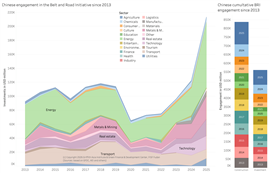 Image: China’s Belt and Road Initiative (BRI) Investments in 2025 report by Green Finance & Development Centre
In metals and mining, copper, which is in demand for data centre construction, saw a significant surge in Chinese investment in the second half of 2025.
One of the report’s authors, Christoph Nedopil, said, “For 2026, a further expansion of BRI investments and construction contracts seems possible despite (or because of) global economic headwinds driven by US-led trade impositions. On the one hand, there is clear need for investments to boost growth to support the green transition both in China and in BRI countries. This provides continued opportunities for mining and minerals processing deals, technology deals (e.g., EV manufacturing, battery manufacturing) and green energy (e.g., energy production and transmission). China refers to these industries (electric vehicles, batteries and renewable energy) as the “New Three”.
“Furthermore, global trade volatilities and uncertainties can spur investments in supply chain resilience and exploration of new markets by Chinese companies. However, risks emerge due to uncertainty of possible activities by global financial institutions with strong US board presence (e.g., World Bank Group, Asian Development Bank), while China dominated development banks (e.g., AIIB, NDB) should provide infrastructure development opportunities for Chinese contractors.
“Nevertheless, I expect Chinese BRI engagement to reach lower levels in 2026 with fewer megadeals. With strong engagement in sectors requiring significant investment (e.g., mining, manufacturing), and increasing ability to scale energy investment as well as data centres, I expect deal size to also remain large.”

CONNECT WITH THE TEAM