




Read this article in 中文 Français Deutsch Italiano Português Español
German demolition conference addresses key industry issues

17 March 2026
Europe’s largest industry gathering for demolition and dismantling, Fachtagung Abbruch, brought together over 1,300 professionals and 125 exhibitors in Berlin on 13 March.
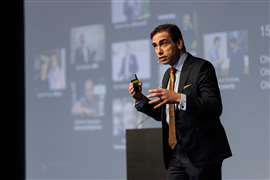 Keynote speaker Sven Gábor Jánszky captivated the audience (Image credit: Jule Halsinger)
The conference programme covered a multitude of topics ranging from machinery technology and occupational safety to AI, digitalisation, data analysis, circularity and recycling processes.
Hosted by the German Demolition Association (Deutscher Abbruchverband, DA), the event included a trade exhibition featuring 125 exhibitors, expert speakers and a wide range of opportunities for networking.
In addition to national visitors, international guests also took the opportunity to learn about developments, projects and innovations on site.
Never standard always tailor-made
In his opening remarks, DA managing director Andreas Pocha welcomed the participants and emphasised the industry’s special strength: demolition is never “standard” but always a tailor-made solution, technically, organisationally and legally.
He said, “One thing remains constant: the values of our industry. Safety, quality, responsibility and pragmatic solution orientation are always at the centre.”
The conference programme was moderated by German journalist, TV presenter and physicist Kristina zur Mühlen, who has a keen interest in sustainability, AI and digital transformation.
After each presentation, participants were able to submit questions to the speakers via an online tool.
The future of demolition to 2035
Demolition is set to become a central pillar of the construction and real estate economy by 2035, according to futurist Sven Gábor Jánszky, who gave the opening speech.
No longer a downstream service, he said, demolition will increasingly determine project costs, timelines, carbon performance and material availability, driven by ESG pressures, EU taxonomy rules and tighter documentation requirements.
Advances in AI, digital twins and robotics are expected to transform the sector, enabling data-led planning, simulation of dismantling scenarios and more precise material recovery.
As hazardous and highly technical tasks shift to machines, human roles will evolve towards planning, oversight and quality management, making early investment in data and technology critical for future competitiveness.
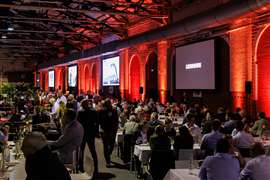 Evening networking (Image credit: Jule Halsinger)
Cases in point: demolition stories
The case studies presented from across the sector highlighted both the complexity and opportunity of modern demolition.
Projects ranged from dismantling within live industrial sites and nuclear decommissioning under strict regulation, to precision urban work where blasting is replaced by controlled methods, and major infrastructure removal under active traffic.
Across all examples, common themes emerged: the growing importance of real-time data, AI-supported decision-making and circular economy principles, with reuse of materials increasingly seen as a revenue driver rather than an afterthought.
Fachtagung Abbruch returns on 5 March 2027 at the same venue in Berlin.
CONNECT WITH THE TEAM