




Read this article in 中文 Français Deutsch Italiano Português Español
Can trucking unlock hydrogen for construction equipment?
05 October 2026
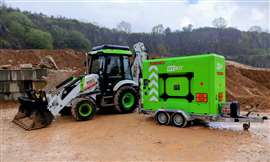 The JCB 3CX Hydrogen backhoe loader
As hydrogen gathers momentum in road transport, Robert Droogleever asks whether trucking can finally create the scale, infrastructure and economics needed to bring hydrogen into mainstream construction equipment.
Hydrogen has spent years hovering on the edge of the construction equipment market – technically promising but held back by cost, infrastructure and the fact that contractors cannot refuel machines with a fuel that is barely available.
That is why a new European push to accelerate hydrogen trucking could matter well beyond the road. Volvo Group, Daimler Truck, Toyota, Bosch, Air Liquide, TotalEnergies, TEAL Mobility and MB Energy are working to align vehicle launches with refuelling infrastructure and more competitive/available hydrogen supply. If trucking can create the scale and network that hydrogen has so far lacked, construction equipment could be one of the industries to benefit.
The question is whether that will be enough to move hydrogen-powered machinery from prototype to practical option.
How hydrogen could power construction
For construction equipment, hydrogen is being explored through two main technology paths – fuel cells and combustion engines. Fuel cells generate electricity through an electrochemical reaction, and this electricity is used to power motors and hydraulics. Hydrogen combustion engines burn hydrogen gas in internal combustion engines that are very similar to conventional diesel engines. These hydrogen solutions compete in the zero- or near-zero-emission space with battery electric power and biofuels.
While OEMs regularly announce that they are testing hydrogen prototypes, it is telling that none of these seem to become commercially available. (With JCB’s hydrogen combustion engine backhoe, pictured above, the exception that proves the rule.)
The benefits for hydrogen over diesel are zero tail pipe pollutants (when using fuel cells), high energy density, fast refueling, high torque and low noise. However, there are still plenty of challenges that need to be addressed. And that’s before we compare hydrogen to battery electric and diesel.
Why hydrogen remains a hard sell
The first issue is the cost of fuel. Hydrogen is not a natural resource. It is made (preferably) from green power like wind or solar. Converting this power into hydrogen and back again into electricity is very inefficient compared to storing energy in a battery. Also, the fuel cells are expensive as they include costly items like high-pressure tanks and platinum catalysts.
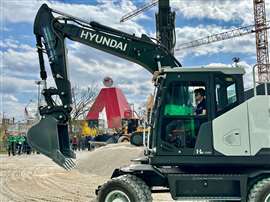 Ben Wade, a 19-year-old UK-native and construction machine operator, exhibits a new Hyundai hydrogen fuel cell prototype at Bauma 2025. In addition expos, Wade works in forestry-segment machine operation and creates content for his social media pages. Image: Mitchell Keller
Secondly, there is the lack of supply infrastructure. H – hydrogen is not widely available, and its use in on-highway trucks and buses remains very low. Currently, almost all (99%) hydrogen is used in industrial applications, like refineries, fertiliser plants and steel mills. It is simply not a viable resource for a construction company, and the lack of nationwide refueling infrastructures makes using hydrogen to power equipment is a non-starter.
The third point is related to on-vehicle issues. Because of volume of the tanks there is a limit to storage capacity on a vehicle. While hydrogen’s energy density is high, its energy-per volume is much lower than diesel, so you need large high-pressure tanks on the equipment to get the same range/running time as diesel. Or smaller ones and more frequent refueling. This sounds like the same problem as battery electric machines, except that the fuelling a hydrogen machine is much quicker. In addition, the reliability of sensitive hydrogen equipment on the machine is not proven yet.
The fourth obstacle is safety. Hydrogen is highly flammable with a non-visible flame. The industry will need to do a lot of training and apply new standards before it can implement this new fuel.
Hydrogen advocates are working to address many of these challenges. Greater production volumes should help bring down the cost of both hydrogen and fuel-cell technology, while converting hydrogen into carriers such as ammonia could make it easier to store and transport. In regions with abundant low-cost renewable energy, such as parts of Australia, producing hydrogen locally could also make economic sense for heavy-duty applications such as mining trucks and locomotives. We still believe there is a large challenge to make hydrogen effective on construction equipment with a lower total cost of ownership compared to diesel and battery electric. If a contractor wants to purchase a zero-emission construction machine there are many battery electric options available. For sure, these machines have their own challenges, but you can buy these machines today and they will do the job.
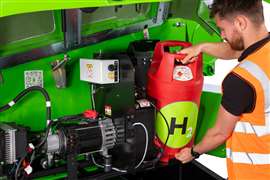 The G20 hydrogen bottle can be changed by hand, with no equipment required. (Image: Niftylift).
What happens if trucking gets hydrogen moving?
For now, battery electric remains the more practical zero-emission option for most construction equipment, simply because the machines, charging solutions and supporting infrastructure already exist. Hydrogen still has significant ground to make up on cost, availability, storage and proven reliability.
But the renewed push behind hydrogen trucking could change the equation. If the on-road sector succeeds in building greater production scale, lowering fuel costs and creating the refuelling infrastructure that hydrogen has so far lacked, off-highway equipment could benefit from the same ecosystem. Trucking may not solve every challenge facing hydrogen in construction, but it could finally remove some of the biggest barriers that have kept the technology stuck at prototype stage.
Whether that is enough to unlock hydrogen for construction equipment remains to be seen. But for the first time in a while, the answer may depend as much on what happens on the highway as on what happens on the jobsite.
Robert Droogleever is a consultant for off-highway consultancy abcg.


CONNECT WITH THE TEAM