




Read this article in 中文 Français Deutsch Italiano Português Español
5 big talking points from Bauma China 2026

26 November 2026
As Bauma China 2026 in Shanghai draws to a close, the KHL team reflects on some of the major talking points from Asia’s biggest construction machinery trade show, which this year hosted 4,120 exhibitors across two venues.
1) Autonomy is moving closer
The much-heralded shift towards autonomous machinery in construction has, so far, been slow. It is clear that widespread adoption is still years away. However, the direction of travel is clear, with several of the major Chinese machinery manufacturers debuting autonomous machines, some of them without cabs.
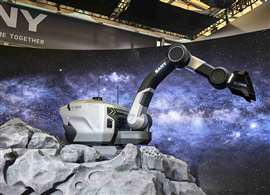 Sany’s all-electric excavator robot prototype (Image: KHL Group)
Sany highlighted its autonomous paving and compaction fleet, which it says has already been deployed across 23 provinces in China. Machines on show included the SSP135C-10R autonomous paver and STR130C-10R autonomous tandem roller.
Lovol’s cabless LTE100i wide-bodied truck took a prominent position on its stand. Meanwhile, XCMG was giving live demonstrations of cabless autonomous machines like its XS265EP 26-tonne battery electric single-drum vibratory roller, and a cabless variant of its XE215 EV excavator with embodied AI.
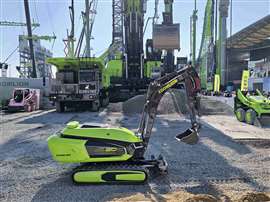 Zoomlion’s prototype ZE20 all-electric robotic excavator in action at Bauma China 2026 (Image: KHL Group)
Zoomlion also demonstrated several different autonomous machines, including a cabless ZE75 excavator and an autonomous ZS080 skid steer loader. Even more futuristic was Zoomlion’s all-electric two-tonne ZE20 excavator, which does away with hydraulics in favour of electromechanical linear actuators and is still a prototype. And its AI-powered humanoid bipedal ZO1 and wheeled ZO3 robots showcased their capabilities in construction, industrial sorting, and human-machine interaction. Over at Sany’s indoor display in Hall E3, its E-Move all-electric robot excavator prototype was also drawing attention from the crowds.
2) Chinese OEMs keep the faith on electric
Battery-electric construction and mining equipment is already well established within China itself. But outside of China it is a different story. The share of battery-electric excavators sold in 2025 in Europe and the US was less than 1%, according to Off-Highway Research. For battery electric wheeled loaders, that figure was less than 1% in the US, 5% in Europe, and 42% in China. The fact that there were so many battery electric machines at Bauma China was hardly a surprise given their popularity in the domestic market. But the range of machines in display has increased, from the staple wheeled loaders and wide body trucks to machines like excavators, pavers, rollers, and mobile cranes.
There was also the technology required to run those machines on display, such as mobile charging solutions and battery swap technology. With the China V domestic emissions standard coming up, many midsize Chinese OEMs aren’t expected to make the investment developing diesel machines to meet it due to high development costs. Instead, they are expected to go “all-in” on electric machines in the hope that in three years’ time the market is mature enough to accept them. Manufacturers also expressed an expectation that take-up of battery electric in developed markets like Europe, although slow up until this point, will start to accelerate.
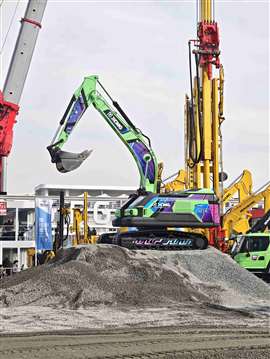 XCMG’s cabless, autonomous XE215 EV excavator prototype on the demonstration ground at Bauma China 2026 (Image: KHL Group)
3) Fierce domestic competition breeds FOMO (fear of missing out)
Even with against a relatively subdued economic backdrop, Bauma China was bigger than ever – spread across two separate venues in Shanghai for the first time, bringing together more than 4,000 exhibitors across 400,000 sq m of exhibition space.
The majority of visitors to the show were from within China itself – a market in which construction and mining machinery manufacturers find themselves locked in fierce competition. More than one OEM remarked privately that margins on domestic machine sales are slim to zero or in some cases even negative. But such is the level of competition that none wants to miss out on new and repeat business by not having a strong enough presence at the show.
That competition, while uncomfortable for the industry itself, is also undoubtedly driving rapid innovation that is bringing ever more sophisticated, reliable, and cost-effective equipment to the market. It also explains the shrinking presence of western OEMs: While there were still some major brands representing western manufacturers at Bauma China, including Cat, Fayat China, Herrenknecht, Wirtgen China and more, there were also many notable absences from companies who, just a few years ago, would have viewed China as a lucrative export market.
4) Overseas markets are a major focus for Chinese firms
Every Chinese manufacturer that Construction Briefing and the wider KHL team spoke to is keen to expand into overseas markets to find customers for the high volume of machines they are producing, and at the same time is hopeful for better profit margins than they are achieving at home.
Several major players are already generating more than 50% of their revenue from overseas, with some looking at increasing that proportion even higher to 60% or more. Southeast Asia, Europe, India, Africa, and North America were all mentioned as potential targets for expansion. Although – given the number of players with the same ambitions and the increasingly protectionist policies of governments in North America and Europe in particular – it remains to be seen if Chinese manufacturers can hold onto the more respectable profit margins they seek.
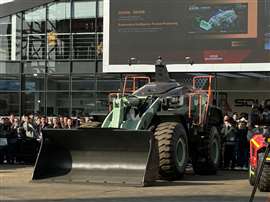 A cabless SDLG L958Hev electric wheeled loader (Image: KHL Group)
5) Russia continues to look to China for new machines
Although there were no official numbers at the time of writing, anecdotal evidence suggested that Russians made up one of the largest, if not the largest, component of international visitors to Bauma China (perhaps challenged only by those from Australia and New Zealand).
Few OEMs named Russia as one of their main target markets, but the war in Ukraine and sanctions in the West have clearly ensured that Russia looks eastward for its construction equipment needs.
That is a situation that looks likely to persist long after any eventual end to the war. It also helped to explain why there were plenty of machines like backhoe loaders and telehandlers – machines popular among Russian customers – taking a prominent place on OEMs’ stands, as well as flyers for manufacturing services being handed out to international visitors in Russian.
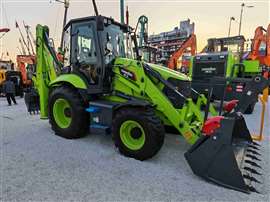 A Lonking 83C-E battery-electric backhoe loader (Image: KHL Group)

CONNECT WITH THE TEAM