




Read this article in 中文 Français Deutsch Italiano Português Español
Tackling the toughest concrete on Germany’s biggest power station demolition with the Demarec DCC-110-D XTR
Partner Content produced by KHL Content Studio
13 November 2026
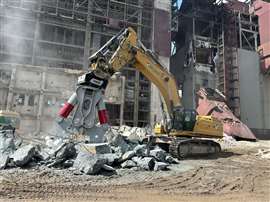 BECKER Unternehmensgruppe has invested in heavy excavators capable of carrying the Demarec DCC-110-D XTR (Image: BECKER Unternehmensgruppe)
Large-scale demolition projects are never less than demanding. But when German demolition joint venture company PORR Becker Abbruchtechnik embarked on dismantling a former coal-fired power station in the industrial Ruhr area of the country, it took those demands to a whole new level.
Unusually thick concrete and a mass of steel reinforcement, not just above ground but in the foundations below, meant that traditional concrete crushing attachments and scrap shears just weren’t going to cut it for what is thought to be the biggest power station demolition project ever in Germany.
That’s where some of the latest and most powerful equipment from demolition and recycling specialist Demarec entered the picture.
Demolition on a huge scale
At the former Voerde power station, the scale is striking: 4.3 million cubic metres of enclosed building space, including three chimneys reaching up to 260m and four boiler houses, each 100m tall. There was also a 165m cooling tower that already been brought down by controlled explosion.
For Michael Pfeiffer, one of the BECKER Group’s two managing partners alongside his cousin Christian Becker, the project illustrates how industrial demolition is changing the company’s equipment requirements.
BECKER employs approximately 300 people, while its PORR Becker Abbruchtechnik joint venture specialises in complex dismantling projects, including power stations and industrial facilities. Pfeiffer says the joint venture has undertaken seven power station projects over six years, involving both full and partial demolition.
Voerde, however, presented particularly demanding combinations of concrete and steel, alongside a tight programme. Foundations extended three to four metres deep, while base slabs measure between 1.5m and 2.5m thick. Large-diameter reinforcement adds to the difficulty of breaking them apart.
“As is often the case, the main challenge is the tight project timeline combined with the sheer volume of concrete,” says Pfeiffer.
Meeting that challenge meant looking beyond the attachments the contractor had previously relied on. Working with equipment supplier Hopf, BECKER selected Demarec’s DCC-110-D XTR concrete crusher, equipped with the manufacturer’s patented DemaPower 2.0 system.
For Pfeiffer, the attraction was the combination of high crushing force, rapid closing speed, and a jaw opening large enough to tackle substantial concrete sections.
“We acquired the necessary equipment, carefully selecting the right components, and in collaboration with the company Hopf, we developed a solution that was not previously available on the market,” he says.
“Ultimately, we wanted a tool that would set new standards - one capable of tackling large concrete cross-sections and the significant challenges they present.”
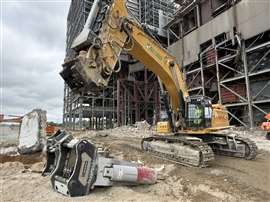 The Oilquick system allows for rapid switching between attachments (Image: Demarec)
New excavators
The investment extended to the carrier machines. With an operating weight of around 12.5 tonnes in BECKER’s configuration and a jaw opening of approximately 2.2m, the attachment required excavators capable of putting its capacity to work.
BECKER has invested in several large excavators, matching the attachment’s weight and crushing capability with the reach required on site. Those include two Hitachi ZX 890s, the 94-tonne Cat 395, and a Hitachi KMC 1200. Another machine, the Liebherr R 980, is set to be deployed from spring 2027. Pfeiffer says the resulting configurations allow the contractor to tackle foundations and slabs at ground level, as well as elevated concrete elements at heights of up to 27m.
“The massive 2.2-meter jaw opening and the 2,750-kilonewton crushing force were the decisive factors in choosing this attachment; it allowed us to combine power and reach, while simultaneously ensuring cost-effectiveness and safe operation,” he explains.
More efficient operations
The difference becomes apparent in the sequence of work. Previously, thick concrete sections could require several stages of preparation and breaking, using smaller machines, hydraulic breakers and less powerful attachments. With the DCC-110-D XTR, Pfeiffer says, suitable elements can be gripped and broken in a single operation.
That is particularly valuable around the power station’s substantial slabs and turbine pedestals, where concrete can be two metres thick. Reducing repeated breaking and repositioning helps the team progress through the material more quickly. Cutting through the concrete with the DCC-110-D XTR was found to be twice as fast as using a 10-tonne hydraulic breaker.
Opening and closing speed matters alongside force. An attachment that can tackle the section and move promptly into its next cycle gives the operator a more productive working rhythm.
“It’s extremely reliable and not prone to breakdowns; it just keeps running consistently,” says Pfeiffer.
The contractor’s experience has already prompted a second purchase of the same size of concrete crusher. Pfeiffer attributes that decision both to performance on site and to the confidence built through its relationships with Demarec and Hopf.
Hopf’s involvement began with discussions about the work ahead and recommendations for suitable attachments. It continued through commissioning, operator instruction and adjustments such as fine-tuning oil pressure.
For a contractor working to demanding deadlines, having that level of support and reassurance is part of the purchasing decision and justifies the investment.
“Buy cheap, buy twice,” Pfeiffer notes, citing a maxim that is common to both German and English. He highlights direct communication, quick decisions and the ability to obtain assistance promptly.
“At the end of the day, we’re all working toward a specific deadline on the job site, and having a reliable partner is simply worth its weight in gold,” he adds.
Ease of maintenance and peace of mind
Maintenance and protection also influence productivity. BECKER uses OilQuick quick-couplers across its equipment, and Pfeiffer values the protected routing of hoses and pipework in its attachment setup.
Working through heavily reinforced concrete exposes equipment to snagging hazards. Keeping hydraulic connections protected helps reduce the risk of damage when the attachment encounters tangled reinforcement.
“You can imagine what it’s like - there’s a tangled mess of rebar inside two meters of concrete and when you reach in and pull, it’s easy to snag a hose or a line,” says Pfeiffer. “With this setup, that’s virtually impossible. You’d have to be extremely reckless to cause any damage to the hoses or piping. Our staff are well-trained and fully briefed, so that doesn’t happen. If any maintenance is required, a quick call to the team at Hopf is all it takes; they’re always ready to jump in.”
At the time of the interview, the units had been operating for several weeks. “We’ve had these units in operation for a few weeks now, and everything is running like clockwork. It is performing absolutely brilliantly,” he added.
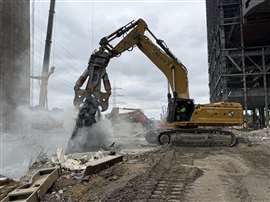 Cutting concrete with the Demarec DCC-110-D XTR was twice as fast as with a 10-tonne hydraulic breaker (Image: Demarec)
A powerful scrap shear
Concrete, though, is only part of Voerde’s demolition challenge. The project also uses a Demarec DXS-90 scrap shear to process the substantial steel sections left behind as structures come down.
Following the explosive demolition of a boiler house, the team faced large piles of steelwork requiring cutting and separation. Pfeiffer says the DXS-90, which is Demarec’s most powerful scrap shear, could cut through and extract major components, opening access for other equipment to continue processing.
“With a cutting force of 15,300 kilonewtons (kN) at the throat, it delivers power exactly where we need it - directly onto the steel and structural beam,” he says.
Also equipped with DemaPower 2.0, an advanced four-chamber hydraulic cylinder system that increases power by up to 25% and with accelerated opening and closing that are four to five seconds faster, the scrap shear complements the concrete crusher by addressing another demanding stage of the dismantling operation.
“Much like our concrete shears, this tool has become indispensable for our large-scale demolition projects, and we will certainly continue to rely on it in the future,” says Pfeiffer.
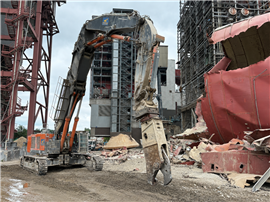 PORR-Becker is also using the DemaPower 2.0-equipped DXS-90 scrap shear, its most powerful model, to tackle steal on the site (Image: Demarec)
A key role in high recycling and reuse levels
Both attachments sit within a wider material-processing operation. After initial breaking, additional equipment separates reinforcing steel from concrete. The metal is cut into pieces suitable for containers and sent for scrap recycling.
Concrete passes through a mobile crushing plant on site to produce the required aggregate size. Where conditions and permissions allow, BECKER prefers to retain that material for use on the project, including as a construction base layer. Alternatively, it can be supplied for use elsewhere.
“We are already managing to achieve a recycling rate of 95% to 98% from our dismantling operations,” says Pfeiffer. “This means that everything we dismantle is reintroduced into the market in some form, whether it’s through steel processing, the thermal recovery of waste wood, or - especially in the case of concrete and construction debris -recycling it for use in road construction.”
For Pfeiffer, efficient demolition and material recovery are closely connected: breaking large elements is the first stage in preparing their constituent materials for subsequent processing and reuse.
The purchasing calculation therefore goes beyond the attachment’s initial price. Output, durability, maintenance requirements and the availability of service all influence the cost of completing the work.
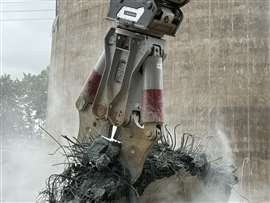 The two-cylinder Demarec DCC-110 features the DemaPower 2.0 system, which promises up to 25% more power (Image: Demarec)
Advice for contractors
BECKER’s experience with smaller Demarec attachments helped establish confidence before it committed to the larger equipment, while the Voerde project has provided the demanding application in which that decision could be tested.
Pfeiffer’s advice to other contractors is to consider the full working relationship, including what happens when equipment needs attention and the project programme leaves little room for delay.
“We cannot afford to lose any time. We have deadlines to meet on the construction site, along with very high expectations and stringent requirements and we have to live up to them,” he says.
At Voerde, that has meant investing in larger carriers, powerful attachments and the support needed to keep them working. With a second DCC-110-D XTR already purchased, BECKER has backed its initial assessment with a further commitment.
“We need reliable, high-performance partners and high-performance equipment,” says Pfeiffer. “That is the combination we use to inform our decision-making process and, ultimately, to move forward with a purchase. We are very satisfied with the product, and as our operations continue to develop and further investments become necessary, we will certainly bring Hopf on board again and, in all likelihood, choose Demarec once more.”
--------
This article was produced by KHL Content Studio, in collaboration with experts from BECKER Unternehmensgruppe and Demarec.
--------
All images courtesy of Demarec.
--------