




Read this article in 中文 Français Deutsch Italiano Português Español
How technology can help train new operators and improve safety

20 July 2026
As skilled labour shortages bring more inexperienced operators onto demolition sites, intelligent machine technologies and digital training tools are helping contractors improve safety, accelerate learning and maintain productivity without compromising performance. By Wade Turlington, head of compact equipment product management, Volvo Construction Equipment.
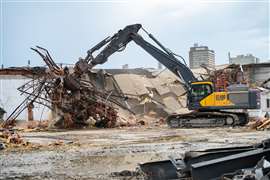 Modern machine technology is improving safety while accelerating operator training in demolition (Image: Volvo CE)
Demolition work sites are typically active, tightly packed spaces with a lot of hazards. Errors in these environments can lead to structural collapses and severe safety incidents, so following best practices for jobsite safety and operator technique is critical to avoid these potential risks.
This is especially important as demolition and recycling contractors deal with an influx of new machine operators due to the skilled labour shortage in the industry as more experienced workers retire.
The good news is that machine advancements and operator training resources are available to help address the skilled labour shortage. A number of machine technologies and equipment services bridge the training gap for new operators, improving jobsite safety and productivity as a result.
Challenges facing the industry
A 2025 survey conducted by the Associated General Contractors of America and the National Center for Construction Education and Research (NCCER) noted that 92% of contractors say they’re having a hard time filling open positions, and 45% of firms say labour shortages are causing project delays.
Many construction sectors face severe labour and skills shortages tied to aging demographics and a lack of incoming younger workers to replace them. The story is no different in the highly specialised demolition and material sorting and recycling industry. Demolition requires workers skilled in structural integrity, heavy equipment operation and hazardous material abatement.
In addition to the labour shortage, there has also been a push in recent years toward more complex material recovery and reuse in demolition projects. This has made these skilled labour roles even more critical as there is more demand for the work. Finding available, qualified personnel to manage complex structural demolition and material sorting can add time and money to your project timelines because of the shortage.
Due to the nature of the work, safety is always a priority on these jobsites. Onboarding less experienced operators comes with challenges regarding safety and efficiency, as new workers learn best practices and techniques.
Machine advancements and technologies
The reality of having operators who are new or have little demolition experience is that they often take longer to complete the work and may use techniques that pose safety risks and are harder on the machines.
To combat this and protect equipment from premature wear, the priority should be on choosing equipment and technologies that focus on intuitive ease-of-use and help operators get up to speed quickly in high-hazard demolition environments.
Available technologies to consider in excavators and wheel loaders include:
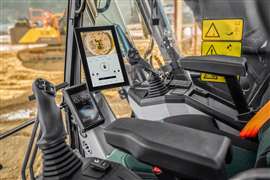 Smart View with Obstacle Detection gives operators a 360-degree view of the machine’s surroundings (Image: Volvo CE)
Cameras and visual assistance: On a busy site, operators may worry about injuring someone or damaging the machine or property. Equipment vision systems provide real-time views of the surroundings and automatic alerts as needed, letting operators focus on the work.
For example, Volvo Smart View with Obstacle Detection gives operators a 360-degree view of the machine’s surroundings using a camera and radar detection system. It can identify obstacles as either an object or a human being, allowing operators to take the appropriate action.
Advanced telematics: Advanced telematics systems can spot potential operator errors that may happen more frequently with newer operators, helping correct their technique. These systems can track specific operator behaviour trends or issues. For example, if an operator is lifting heavy pieces of concrete or steel over the side of the excavator, the telematics system would document the potential safety hazard so a site manager can address it with the operator, helping prevent an issue down the road.
Volvo Lift Assist tells operators how much they are lifting and the safe lifting parameters, based on the maximum possible load and position of the excavator. Volvo Demolition Assist is designed specifically for high-reach excavators used in demolition applications, providing real-time monitoring of machine stability, boom orientation and working range to prevent tipping hazards. It uses integrated sensors to give operators dynamic visual and audible alerts while deconstructing structures.
These types of systems give guidance to help new hires correct bad habits, allowing them to work with the smoothness and efficiency of veteran operators.
Automated machine control: Some available machine technologies help take the physical effort out of grading. For example, Volvo Active Control for excavators is an automated machine control system that allows operators to set their grade and push a button to let the excavator manage the boom and bucket movements. This helps them achieve better precision, avoid underground hazards and prevent overhead contact, among other benefits.
Excavator work modes: Some models are available with work modes that help maintain the optimal balance between engine rpm and hydraulic flow. A common misconception is that running at the highest mode automatically results in more power, but operating in the highest mode all the time can unnecessarily waste fuel and push the machine beyond optimal efficiency levels.
When a machine has selectable work modes, it is easier to ensure the right mode for the task. This gives operators the perfect balance of power and speed for the job at hand while burning as little fuel as possible, putting less stress on the machine over time.
Attachment versatility: Demolition requires a range of specialised tasks, including sorting, crushing, cutting and lifting. A machine with attachment versatility that uses tools like quick couplers allows one operator to pivot tasks easily. A quick coupler allows an operator to shift quickly without leaving the cab. This reduces the need for manual, ground-level labour where there are higher risks on a demolition site.
Operator training solutions
Proper training cannot be overlooked as a key part of getting operators up to speed faster. A commitment to operator development can help reduce incident rates, optimise machine longevity and act as a tool for recruiting talent looking for professional career development.
Virtual reality training programs provide a safe environment for new operators to build their skills. They can experience simulated structural failures, tip-overs or attachment stalls without burning a drop of fuel or risking injury.
Some modern machines now also feature built-in, real-time coaching apps on the cab screen. For example, Volvo’s Operator Coaching app for wheel loaders and excavators provides real-time guidance on idling, braking, accelerator pedal usage and time spent with the transmission in lock-up. It will also identify inefficient behaviour such as holding the brakes and accelerator or running in a fixed gear.
Volvo Operator Coaching for excavators shows operators a visual display of how they are performing when it comes to utilisation, swing, dump height and relief pressure. Operators can also see operating time, average fuel consumption and total fuel consumption. Technology like this is a great way to get operators instant feedback and learn on the job.
Conclusion
Demolition contractors must pivot from viewing technology as an expense to seeing it as an automated, scalable training resource.
Utilising the tools available on modern machines can help train the workforce faster in the face of the ongoing labour shortage, acting as a safety net as new operators learn the ropes.
A combination of proper training, proactive telematics monitoring and machine technology can reduce jobsite safety incidents and wear and tear on the fleet. These best practices can also improve job satisfaction for operators, driving long-term worker retention.

CONNECT WITH THE TEAM