




Read this article in 中文 Français Deutsch Italiano Português Español
Why Zoomlion is taking the long view on international expansion challenges

02 April 2026
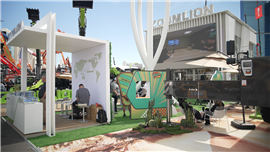 Zoomlion’s stand in the Festival Grounds at ConExpo-Con/Agg 2026 in Las Vegas (Image: KHL Group)
With the ongoing confusion over tariffs and a general animosity from the Trump administration towards Chinese imports, you might expect a Chinese manufacturer at a US trade show to cut a somewhat glum figure.
Not a bit of it from William Tan, deputy general manager of Zoomlion International Trading Company, who spoke to Construction Briefing at ConExpo in Las Vegas in early March.
Instead, Mr Tan exudes confidence as he explains in fluent English how Zoomlion, whose products run the full gamut of construction equipment from MEWPs, earthmoving and concrete equipment, to tower cranes, remains committed to the North American market.
That commitment, he suggests, is rooted in a long-term view of the region rather than short-term market cycles or policy shifts.
“Zoomlion has been present in North America for decades,” he says. “Our position is always to try to improve and reinforce in every single point: regarding the product development, regarding our commercial strategy, regarding our localisation investment. At this stage, I think we’re in a very key moment to reinforce our brand awareness.”
For Mr Tan, the opportunity in North America is less about timing the market and more about positioning the business.
“While we see a great opportunity in the next three to five years, our vision regarding North America is much longer than this period,” he adds.
While Chinese OEMs have often been characterised as export-driven, Zoomlion is pursuing a more localised and embedded approach, building local assembly, supply chains and service capabilities.
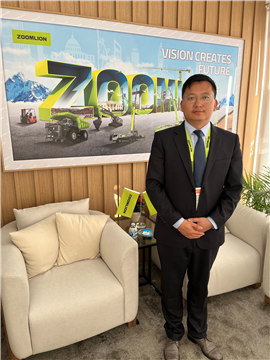 Mr. William Tan, vice president, Zoomlion Global
“We want to present a North American brand here,” Mr Tan says. “The more deeply localised we are, I think the more success we are going to acquire in the future.”
There are already signs of that strategy in practice. The company assembles concrete equipment just outside Milwaukee, Wisconsin, under both the Zoomlion and Cifa brands, for example. And Tan says it continues to expand its dealer and aftersales network across the US and Canada. Beyond North America, it has also recently opened a new factory in Hungary, underlining a broader push to localise production closer to end markets.
Product breadth is another pillar of Zoomlion’s approach. Rather than focusing on a single segment, the company aims to use its extensive portfolio of machines to gain traction with big contractors and rental firms.
There’s also no one type of equipment where Tan sees more universal demand than others. Instead, it’s more dependent on the region or state, he says. “For example, in some states, our earthmoving equipment has enormous success. Our customers appreciate the very special design for our hydraulic systems, and also how fast our machines can complete excavation work.”
He also points to aerial work platforms as an area where Chinese manufacturers, including Zoomlion, have been able to translate domestic market strength into international growth, particularly as electrification gains traction.
On the concrete side, the company is leaning on its global experience and local partnerships. Its truck-mounted pumps, for example, are paired with locally sourced chassis in the US, reflecting both regulatory requirements and customer expectations. Although he hopes the company will eventually start making its own chassis in the region.
“Our concrete pumps rank in the top three in the world and our experience in the different jobsites in the Middle East, in Europe, in Latin America is helping us to optimise here in North America,” Mr Tan says.
Adaption key to international growth
That global experience feeds into another recurring theme: adaptation. Entering the North American market requires not only meeting regulatory standards and certification standards in areas like engines, emissions, and safety, but tailoring equipment to specific jobsite conditions.
“The adaptation is a common strategy - it’s always ongoing,” Mr Tan explains. “Here in North America, there is the highest selected standard. So that is the first job: We need to study before we enter the market. We take a huge amount of time and investment to study how to adapt in the first place.”
Beyond compliance, adaptation extends to how machines perform in different environments. He cites Canada as an example, where short construction windows punctuated by long winters require more powerful and efficient equipment to maximise productivity in limited timeframes.
Alongside product and compliance, the development of a dealer and service network is critical to building credibility in a mature market.
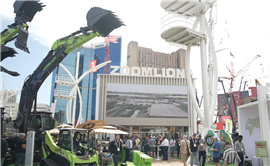 Zoomlion’s stand in the Festival Groups at ConExpo-Con/Agg 2026 in Las Vegas, USA (Image: KHL Group)
“The dealer is like a valuable partner for us,” Mr Tan says. “It’s about how we can build up the trust and how to allow the dealer to be healthy and grow this market step by step.”
Zoomlion has invested in training and aftersales infrastructure, including a facility in Houston, as it seeks to address one of the more persistent barriers for new OEM entrants: service capability.
Tariffs, meanwhile, are treated less as a defining obstacle and more as a variable to be managed.
“Tariffs are a great subject that we could spend a whole day discussing. If you look back 50 years or 100 years, tariffs were a common thing. So we try to recognise this as a certain factor, whatever the country. Last month, Brazil launched a new tariff, for example. It’s a regular policy to do that. So we will adapt ourselves regarding the tariff subject.”
He also appears to suggest that such policies may change in the future. “It is happening in the short term. Today is like this, tomorrow maybe like that,” he adds. “So that is our our consideration for this and how we think in the future about this. Nobody knows. So we just try to be better ourselves. We try to be better prepared.”
That approach reflects a broader pragmatism. Rather than reacting to short-term policy changes, the company is focusing on controllable factors such as localisation, supply chain flexibility and responsiveness to customers.
At ConExpo itself, Tan sees evidence that this strategy is beginning to gain traction.
“The first key message is Zoomlion is always here,” he says, pointing out that this is the seventh ConExpo the company has been involved with, as it positions itself as a global brand.
He also notes increasing interest in newer technologies, particularly electrification and artificial intelligence, as well as growing demand from large customers for integrated, multi-product solutions.
Opportunities in the Middle East?
Earlier this year, Zoomlion also had a significant presence at the Heavy Equipment Connect trade show in Dammam, Saudi Arabia.
Asked about Saudi Arabia and the wider region, Mr Tan acknowledges the impact of recent geopolitical tensions but remains focused on underlying demand.
“What has happened is geographical conflict…none of the business operations can focus and prepare for that,” he says. “But we will keep investing in the Middle East - this great geographical zone will bring a bigger potential.”
He describes the region as strategically important, driven by large-scale infrastructure programmes and sustained government-backed investment.
“This market is indeed of strategic importance for us,” Mr Tan says. “We will continue a solid strategy. We need to study more deeply how we can serve our market and our key customers there better.”
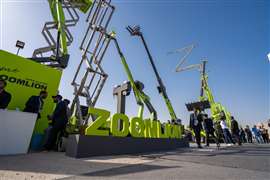 Zoomlion had a significant presence at the Heavy Equipment Connect trade show in Dammam, Saudi Arabia, in February 2026 (Image: NIDC)
As in North America, localisation is key. Zoomlion has been investing in warehousing, spare parts centres, technical facilities and training capabilities in the region, reflecting the scale and complexity of projects underway.
The OEM’s home market of China, meanwhile, remains both a foundation and a point of contrast. Mr Tan characterises the domestic market as having undergone a period of adjustment in recent years, but stresses that this is part of a longer-term cycle.
“In the last 10 years, we are facing some great challenges but we should remain very confident in the Chinese economy,” he says.
He points to areas such as earthmoving, agriculture and mining as offering continued growth potential, while emphasising that Zoomlion’s international strategy predates any recent slowdown and hasn’t been influenced by a more difficult economic setting at home.
“Our international strategy has been settled many years ago,” Tan says. “The international market is one of the top strategies at Zoomlion group level.”
He sees three key themes in the world of construction equipment: More intelligent machines, greener products, and a more globalised approach.
Back in Las Vegas, that global outlook sits somewhat at odds with the political backdrop outlined at the start. Yet, as Mr Tan makes clear, Zoomlion is not shaping its strategy around short-term tensions.

CONNECT WITH THE TEAM