




Read this article in 中文 Français Deutsch Italiano Português Español
Why contractors want excavator safety built in

21 September 2026
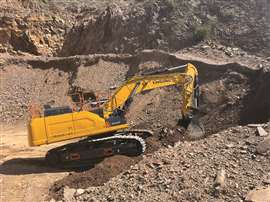
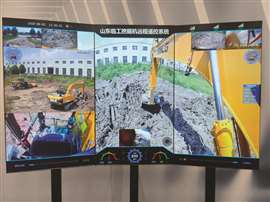 SDLG’s remote control system removes operators from hazardous environments Image: SDLG
Contractors buying an excavator can now choose from cameras, human-detection systems and technology that restricts where the machine can move. But equipping it for site can still mean a series of extra installations.
Contractors buying an excavator can now choose from cameras, human-detection systems and technology that restricts where the machine can move. But equipping it for site can still mean a series of extra installations.
And that means a cab crowded with screens.
For some contractors, the priority is getting those systems built into the machine from the start.
“A lot of these are third-party fit systems, so you have lots of different installs once you buy a machine,” says Warren Wilkinson, business stream leader for Plant & Power Solutions at Select Plant Hire (part of UK-based Laing O’Rourke).
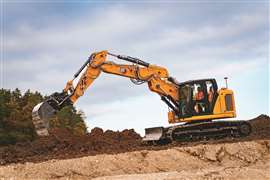 Caterpillar launched the 319 compact radius excavator at ConExpo 2026 with wide tracks for extra stability Image:
Height and slew restrictors, human-form recognition, machine control and cameras may come from different suppliers. Each can be useful in its own right but combining them creates a practical challenge for the contractor and the operator.
Separate displays can add distractions and obstruct the visibility manufacturers have spent decades improving. The question is increasingly how to bring those functions together.
Brian Stellbrink, excavator market professional at Caterpillar, acknowledges the problem.
“There are some very good solutions out there but pretty soon you end up with four or five different displays.
“When we talk to contractors, they want less clutter in the cab, more integration into the machine’s monitor and into the joystick controls, and we’re acting on that as a manufacturer,” he says.
Caterpillar’s person-detection camera, for example, is integrated into the standard machine display rather than requiring another monitor.
Protecting people around the machine
The demand for integration reflects a broader change in what contractors expect excavator safety systems to do.
Twenty years ago, the emphasis was largely on protecting the operator through stronger cabs, guarding, seat belts and better sight lines. Today, attention increasingly extends to everyone working around the machine.
Wilkinson describes a shift from roll-over and falling-object protection towards load indicators, height and slew restrictions, and systems that support exclusion zones.
The conditions in which excavators work are adding urgency to that change. Restricted sites and tighter programmes can bring more people and machines into close proximity.
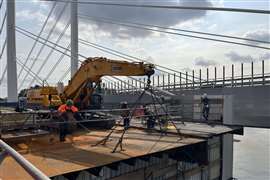
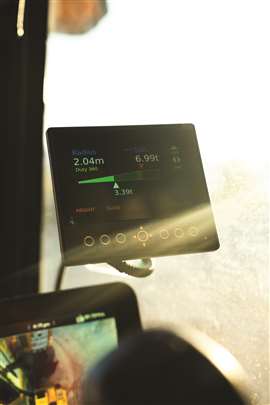 A Komatsu HB365 LC hybrid excavator with slew and height restrictions, part of Select Plant Hire’s fleet
“The velocity on projects is increasing. There’s more contractors working together on the same job and more activities going on concurrently, which drives more of a need for safety of those outside the machine,” Stellbrink says.
Todd Sutton III, EHS director at Skanska USA Civil West, says camera systems, ranging from rear-view cameras to 360-degree birds-eye views, have become a must-have.
“What was once considered an enhancement is now a baseline expectation because of the visibility it provides in increasingly complex and congested work environments,” he says.
Kevin Randall, director of technical services at Balfour Beatty Asset & Technology Solutions, sees human-form recognition as a particularly significant advance over earlier systems that detected objects.
“The advent of human-form recognition was a game-changer for me,” he says. “My frustration with the industry is that we are not taking this up. The OEMs seem to be quite slow in adopting the technology.”
Randall has seen detection systems change how people approach machinery. An external warning tells a worker that the machine has detected them, while an alert inside the cab notifies the operator.
That’s important because the operator’s attention is often directed towards the task at hand.
“When you are trying to control the machine, your focus is on the thing that you are trying to control and dig with,” he says.
“You are not looking in your peripheral vision or over to your side where someone might approach.”
From warning to intervention
And detecting a person around a machine is only part of the challenge. A warning still depends on the operator noticing it and responding.
The next step is for the excavator to restrict the movement creating the danger.
Manufacturers all over the world are developing systems that combine detection with intervention.
China-based XCMG’s Intelligent Control Safety system, for example, uses attitude sensors, vision and radar technology for functions including rollover warnings, boom anti-fall protection, and personnel detection-based speed control and emergency locking.
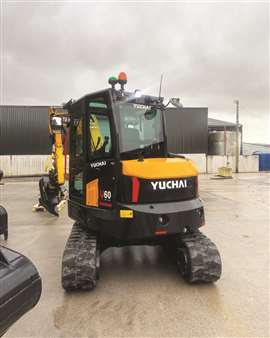 Rearview cameras and travel alarms are standard on Yuchai Equipment’s U60 Image: Yuchai
Meanwhile, Chinese OEM LiuGong describes a progression from audio-visual warnings to speed limiting and emergency braking. It also points to continuous video recording as a means of reconstructing an incident afterwards.
For contractors, however, intervention has to account for how an excavator behaves while carrying a load or working on difficult ground. Stopping a machine safely is not necessarily as simple as cutting power.
“When I say stop a machine, I mean stop a machine in a controlled, safe manner,” Randall says. “You don’t want it to fall over because it stopped it too quickly.”
Reliability presents another challenge. China’s SDLG identifies 360-degree environmental awareness, AI-based person detection and active braking as the most transformative developments of the past 20 years.
“Active sensing and intervention systems identify hazards in advance and proactively prevent accidents, directly addressing the most common incidents involving blind spots and swing collisions,” notes a spokesperson.
They claim active sensing and intervention can reduce fatalities and injuries by more than 80%.
But they also acknowledge that cameras and radar can perform less effectively in dust, heavy rain, mud or difficult lighting, potentially producing false warnings or missed detections.
Factory integration therefore has to address more than the number of screens in the cab. As systems take on more responsibility, their ability to detect hazards and control the machine appropriately becomes central to their usefulness.
Making safety standard
Cost remains another obstacle to wider adoption, particularly on smaller excavators. SDLG acknowledges the need to extend advanced safety equipment to smaller machines, while Yuchai highlights the financial barrier.
“The high cost of intelligent safety systems limits their widespread adoption, especially on smaller machines,” says a Yuchai spokesperson.
Progress is being made. Yuchai says its U60, a primary export model for 2026, includes rearview cameras and travel alarms as standard, building on the more basic protection offered by its machines two decades ago.
But Randall argues that bringing more advanced systems into the factory specification could help make them affordable. Standard fitment would increase production volumes and reduce the need for individual installations.
“If it was just integrated into the equipment architecture, cost becomes less of an issue because instead of doing 100 you are doing 10,000,” he says.
That gives contractors a reason to press manufacturers on both availability and integration. Their purchasing decisions also give them influence over what happens next.
“Clients establish safety expectations, but the selection and implementation of specific equipment technologies is 99% contractor driven,” says Sutton.
Technology within a wider safety system
Even as excavator safety features evolve into something unrecognisable even 20 years ago, progress is unlikely to slow down.
Manufacturers including SDLG and LiuGong envisage machines exchanging information with other equipment, workers’ wearable devices and site-management platforms, extending protection beyond an individual excavator.
 LiuGong says that the industry has shifted from cab-centred passive protection to active prevention. Image: LiuGong
For now, contractors are dealing with the more immediate task of selecting equipment and putting it to work effectively. Sutton identifies grade-control systems as a way to reduce excavation errors and the likelihood of utility strikes, while digital planning can help identify conflicts before work begins.
He also cautions against attributing changes in behaviour entirely to technology.
“Modern systems have changed operations, but a large factor in changing operator behaviour has come from training, incident reviews and a culture of sharing lessons learned across projects,” Sutton says.
That places the push for factory integration within a wider set of responsibilities. Manufacturers can make protection easier to specify and use but contractors still have to choose suitable equipment, train people and establish safe working practices around it.
As expectations rise, the buying conversation is likely to reach further than which safety features an excavator offers.
It will also concern how those features work together and how much the contractors and hire companies themselves must do before the machine is ready for site.

CONNECT WITH THE TEAM