




Why construction profit margins could rise in the coming years

10 March 2026
Profit margins in the construction sector could increase in the coming years as contractors gain more pricing power, according to new analysis from Dutch bank ING.
 Aerial drone photography of a construction site. Europe, Poland. Image: Adobe Stock
The bank argues that a combination of labour shortages, stronger order books and improved project selection could gradually lift profitability across the sector, particularly among larger contractors.
While construction has historically operated on thin margins compared with many other industries, ING suggests structural changes in the market could allow contractors to capture greater value from projects.
Margins already moving upward
According to ING’s analysis, average earnings before interest, taxes, depreciation, and amortisation (EBITDA) margins among major European contractors have already improved in recent years.
Margins rose from around 5.9% in 2018 to approximately 7.1% in 2024. Although still relatively modest by comparison with other sectors, the increase suggests a gradual shift in the industry’s financial dynamics.
Construction has traditionally been characterised by intense competition, low barriers to entry and a fragmented contractor base, all of which have tended to keep margins low. Contractors have also historically taken on projects with tight margins in order to maintain activity levels and keep workforces employed. However, several developments in recent years appear to be changing that balance.
Labour shortages reshaping the market
One of the most important factors identified in the report is a tightening labour market.
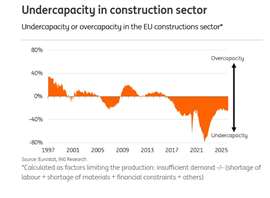 Undercapacity or overcapacity in EU construction. Image: ING
Across Europe and other developed construction markets, contractors increasingly report difficulty finding skilled workers. The sector’s ageing workforce, combined with relatively limited inflows of younger workers, has created persistent capacity constraints.
According to ING, around 27% of European construction companies say labour shortages are limiting their production.
The impact of these shortages is twofold: On the one hand, companies face higher wage costs as they compete for scarce workers. On the other, limited capacity means contractors can be more selective about the projects they pursue.
Rather than bidding aggressively for every available project, companies can prioritise contracts that offer better margins or more manageable risk profiles.
Full order books
Strong order books are another factor supporting the possibility of higher margins. Many contractors currently report healthy pipelines of work, particularly in areas such as infrastructure, energy transition projects and data centre construction.
With demand for construction services remaining robust in several segments, contractors are under less pressure to accept low-margin projects simply to keep their operations running.
This shift in market dynamics has begun to change bidding behaviour. Companies are increasingly focusing on profitability rather than purely on revenue growth.
In practical terms, this means some contractors are willing to walk away from projects where risk allocation is considered unfavourable or where margins appear insufficient. The result is a gradual strengthening of pricing discipline across parts of the sector.
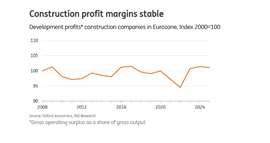 Development profits of construction companies in the Eurozone. Image: ING
Prices rising faster than volumes
Another trend highlighted in the report is the divergence between construction volumes and prices. In many markets, construction output has grown only modestly in recent years due to economic uncertainty, higher interest rates and slower residential development.
However, project prices have continued to rise. Construction cost inflation has forced contractors to increase prices. In some cases, these price increases have outpaced the slowdown in construction volumes.
As a result, contractors may be able to maintain or even improve profitability despite relatively subdued growth in the number of projects being delivered.
Better risk management
The report also points to improvements in how contractors manage project risk. The construction industry has experienced numerous high-profile contract losses over the past two decades, often linked to poorly priced projects or unrealistic risk assumptions.
In response, many large contractors have adopted stricter internal controls around bidding and risk assessment. Companies increasingly evaluate projects based not only on potential revenue but also on factors such as contractual risk allocation, complexity and supply chain exposure.
Digital tools and improved project management systems are also helping contractors monitor costs more closely and detect potential issues earlier in the delivery process. These changes may contribute to more stable financial performance over time.
Improvement possible - but margins remain low
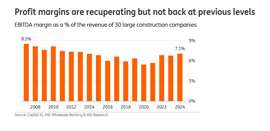 Profit margins of 30 largest European construction companies. Image: ING
Despite the potential for improvement, ING emphasises that construction is likely to remain a relatively low-margin industry.
Several structural characteristics continue to limit profitability. First, the sector remains highly fragmented, with many small and medium-sized contractors competing for work. This fragmentation creates ongoing pricing pressure in many markets. Second, construction projects are inherently complex and often exposed to external risks such as weather delays, supply chain disruption or design changes.
Finally, a large share of construction activity, particularly in infrastructure, is funded by governments or public authorities. These clients often operate within fixed budgets and procurement rules that constrain price increases. As a result, while margins may rise somewhat, they are unlikely to reach levels seen in sectors such as technology or manufacturing.



CONNECT WITH THE TEAM