




Read this article in 中文 Français Deutsch Italiano Português Español
Material recovery in an active industrial city

25 February 2026
Despite challenging logistics and space constraints, Sustainability Chain Contracting exceeded its 99%+ diversion rate target during a demolition project at Dammam Second Industrial City in Saudi Arabia.
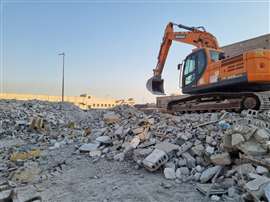 Over 6,000 tonnes of demolition waste was recovered for recycling (Image credit: SCC)
Demolition contractor Sustainability Chain Contracting Est., in Saudi Arabia, was founded in May 2024. It operates across Saudi Arabia and the GCC countries (Bahrain, Kuwait, Oman, Qatar, Saudi Arabia, and the United Arab Emirates).
The company has used a recent mechanical demolition project for the Saudi Authority for Industrial Cities and Technology Zones (MODON) at Dammam Second Industrial City to demonstrate that high landfill diversion rates can be achieved using conventional demolition methods on legacy residential buildings.
Honouring recycling commitments
The scope comprised the complete removal of two old residential buildings, including all reinforced concrete elements above and below ground. This had to be executed within an active industrial city environment with one of the buildings – a four-storey structure – situated less than 50 m from working factories and plants.
Sustainability Chain Contracting said that the biggest technical difficulty was managing the sheer volume of C&D waste generated from the reinforced concrete buildings, while honouring its commitment to achieving a minimum of 95% landfill diversion rate.
It also noted that this approach aligns with the Kingdom’s Waste Management Strategic Master Plan under the National Center for Waste Management (MWAN). Its aim is to: “Develop an integrated technical and economic plan to divert 90% of waste from landfills by 2040 and effectively implement the principles of circular economy.”
Mechanical demolition in action
The entire project at Dammam Second Industrial City, which took 45 days to complete, was carried out using standard mechanical demolition equipment only. No dismantling activities or manual deconstruction methods were deployed, the company stated.
Crawler excavators equipped with hydraulic rock hammers were used for breaking reinforced concrete, standard buckets for excavation and material handling, and hydraulic scrap shears for cutting and recovering steel reinforcement.
The fleet consisted of two CAT 320D2 L excavators and a Doosan DX 225LCA fitted with buckets and MSAS 30G hydraulic breakers rock hammers, and a Hitachi ZX210LC excavator with a Prodem PDS250R shear.
The total diesel consumption used to power this equipment during the project came to 14,412 litres.
Waste material management
The operation required tightly controlled debris sequencing, disciplined material handling and coordinated haulage to licenced recycling facilities to ensure continuous recovery performance.
Concrete was separated during the demolition and excavation activities, and steel reinforcement was recovered mechanically. In total, more than 6,000 tonnes of waste were sent to facilities 30-60 km away from the site for recycling. Within this number, almost 110 tonnes of rebar/carbon steel was recovered.
The works were carried out under live site constraints. This required Sustainability Chain Contracting to ensure tight control of safety and access, while also managing dust and noise, and handling material logistics.
All materials transported to approved recycling facilities were documented through weighbridge tickets and material receiving certificates, providing full traceability and verification.
Supporting the Saudi Vision 2030
According to Sustainability Chain Contracting, this project demonstrates that high material recovery is achievable through conventional mechanical demolition, even where complete removal of reinforced concrete structures is required.
By focusing on sequencing, material handling discipline and logistics control, the demolition scope was transformed from a disposal-driven activity into a material recovery operation.
The methodology is applicable across residential and industrial demolition scopes, including assets removed to enable infrastructure and large-scale redevelopment, particularly where speed, scale, operational control and cost efficiency are critical.
The company concluded by highlighting its pride in promoting the circular economy by maximising material recovery, reducing landfill dependency and lowering the carbon footprint of demolition activities. This also supports the sustainability and natural resource conservation objectives of the Saudi Vision 2030.
CONNECT WITH THE TEAM