




The World Demolition Awards (Explosives) winning project

11 December 2025
Precision Demolition Company Ltd (PDC) was recognised for its role in the decommissioning of the Sizewell A Nuclear Power Station on the Suffolk coast, one of the UK’s most technically demanding nuclear demolition environments.
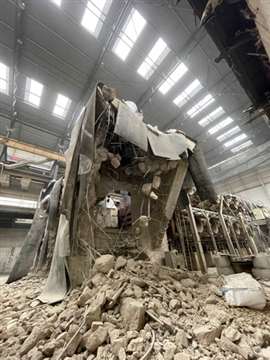 Photo: PDC
Working under contract to Erith Group, PDC was appointed to design and deliver the explosive strategy required to remove four large reinforced concrete turbine hall bases located within metres of the dormant Sizewell A reactor and the operational Sizewell B site.
Project scope and objectives
The four turbine bases, each approximately 92 metres long, 10.4 metres high, and 19.8 metres wide, previously supported the station’s main turbines, generators, condensers, and exciters.
PDC’s task was to develop a controlled explosive solution that would accelerate the removal process while maintaining the highest level of nuclear safety and regulatory compliance.
The project’s goals included reducing the overall demolition timeframe from an estimated six months to approximately two months (including preparation, blasting, and clean-up), controlling vibration and air overpressure to meet stringent ONR thresholds, and preventing any impact on critical Sizewell A and B infrastructure.
The work also aimed to demonstrate how explosive pre-weakening could support faster decommissioning across the UK’s nuclear estate.
Technical challenges
The project represented the most significant use of explosives on a UK nuclear-licensed site. PDC deployed 700kg of NG cartridge explosives and 1,350 electronic detonators, the largest single detonator deployment recorded in the UK.
The blast design required reprogramming of the electronic detonator software to extend its maximum shot duration, enabling a 14.5-second sequence in which every hole carried a unique delay.
Working adjacent to a 100-metre glazed elevation, an active Sizewell B reactor, public areas including a nearby beach, and multiple contractors operating on site added further complexity.
PDC also needed to control vibration to levels significantly below regulatory limits. Four seismographs were positioned at the turbine hall boundary; three did not register sufficient vibration to activate, demonstrating the effectiveness of the blast design.
A Hilti Ferroscanner was used to locate reinforcement prior to drilling, reducing aborted holes and minimising equipment breakage. The approach ensured accuracy and efficiency during the pre-weakening phase.
Innovative solution
PDC developed a pre-splitting and pre-weakening strategy informed by extensive trials, charge-weight testing, and validation of fly containment measures.
A 14.5-second electronic delay sequence enabled controlled internal fracturing of the concrete, reducing transmitted vibration and preventing uncontrolled debris projection.
A customised lifting platform was fabricated to allow a Brokk 300 fitted with a hydraulic drilling mast to be suspended from the overhead crane, enabling deep drilling into the turbine bases.
A comprehensive Quality Management Plan, cloud-based for real-time access by the client and regulator, documented all stages, including physical mark-outs and photographic verification. Environmental controls included advanced dust-suppression systems.
Regulation and stakeholder collaboration
Work was carried out under one of the UK’s strictest regulatory frameworks. PDC, Erith, the ONR, the Civil Nuclear Constabulary, Sizewell B management, local authorities, and community liaison groups worked in close alignment throughout the project.
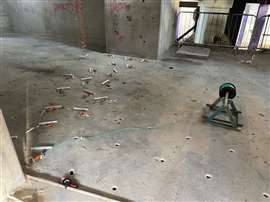 Photo: PDC
Engagement included test blasts, detailed programme planning, and ONR-released regulatory hold points.
The final demolition on 1 November 2024 was conducted under live regulatory oversight. All activity was staged to minimise disruption to site operations, the surrounding community, and the coastal environment.
Execution and performance
The detonation successfully fractured the turbine bases internally without disturbing surrounding structures, and no debris escaped the turbine hall.
The 100-metre glazed elevation remained intact, and vibration levels were low enough that three of four seismographs did not trigger.
The outcome included the processing of 2,600 tonnes of reinforced concrete within two days, significantly ahead of the original two-month expectation.
Mechanical demolition phases were reduced by approximately 75%, generating programme and cost efficiencies for Erith and the wider NRS decommissioning team.
Environmental impact
The explosive pre-weakening approach reduced the need for prolonged heavy-plant use and delivered measurable fuel and carbon savings.
Comparative data indicated that, for 1,000m³ of concrete, conventional mechanical demolition would require four weeks of excavator use and approximately 18,000 litres of fuel.
The explosive method required four days and 3,200 litres. This represented an estimated fuel saving of 14,800 litres and a carbon reduction of 36.5 tonnes CO₂e.
Across the full Sizewell A 2,148m³ scope the estimated savings were 31,790 litres of fuel and 78.4 tonnes CO₂e. All concrete arisings were processed and recycled on site.
Protection and site constraints
The blast zone sat approximately 10 metres from a major glazed elevation and within a highly active nuclear environment.
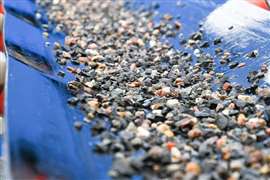
Protection measures included 70 wooden crane mats, 30 steel road plates, 280 one-tonne recycled-material bags, and more than 1,000 metres of rubber conveyor belt. These measures ensured all debris remained within the turbine hall structure.
The project required strict work-window management, coordination with multiple contractors, and rehearsed command structures.
The approach reduced programme impact to two clear weeks compared with multiple months for staged mechanical removal.
Programme and outcome
The work was completed on 1 November 2024. The accelerated removal of the turbine bases enabled Erith Group to advance the wider Turbine Hall decommissioning works and supported the NRS’s long-term site-clearance objectives.
PDC said the project demonstrated how explosive pre-weakening, when combined with stringent regulatory compliance and extensive collaboration, can deliver faster demolition, lower environmental impact, and high levels of safety.
CONNECT WITH THE TEAM