



The project that won DDM the Best of the Best Award

28 November 2025
Dutch firm DDM Demontage took home the Best of the Best Award at the World Demolition Awards in November. Lewis Tyler reports on the project that saw the company come out on top.
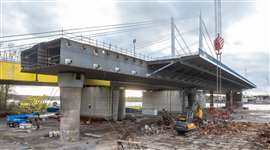 Photo: DDM Demontage
The dismantling of the original Rheinbrücke Neuenkamp in Duisburg, Germany, was a technically demanding project undertaken by Hochtief and Dutch demolition specialist DDM.
Originally designed for 30,000 vehicles per day but carrying more than 100,000, the bridge had exceeded its design life and required removal to make way for the second section of a new twin-structure replacement.
The project, completed over 20 months, has since been recognised with the Best of the Best Award at the World Demolition Awards (also taking home the Civils category).
A complex bridge and a challenging scope
The demolition had to be carried out while maintaining both the operation of the newly built adjacent bridge and uninterrupted shipping on the Rhine.
The structure was dismantled in reverse order of its original construction, requiring close structural analysis and controlled sequencing to maintain stability throughout.
During early works, asbestos was discovered in the asphalt. It was removed using ultra-high-pressure water jets, allowing the project to continue without exposing workers or the environment to risk.
Engineering precision amid strict constraints
Environmental restrictions meant that no demolition debris could enter the Rhine, a key transport route and sensitive ecological area.
To comply, the project team deployed containment systems and movable watertight platforms designed to intercept any falling material while keeping river traffic moving.
A critical step involved removing a 20-metre structural segment from within the bridge. Engineers predicted that if unnecessary loads were removed, the bridge would deflect only slightly—a forecast confirmed when the measured movement remained within the expected 1.5 cm.
The removal of the original stay cables required temporary support measures. A 25-tonne pylon cap, installed at a height of 50 metres, provided an anchor for stabilising cables that redistributed loads via hydraulically tensioned steel strands.
Oil-driven jacks were used to gradually transfer the load from the existing stays before cutting, avoiding sudden structural shocks. On the eastern side, where no pier supported the first stay cable, a temporary support structure was designed and installed for load absorption.
Environmental and logistical management
High water levels on the Rhine required repeated relocation of machinery and shielded work areas. All activities were planned to avoid impacts on the river and floodplain, and no work was carried out from the water itself.
Dismantled bridge sections were transported across the bridge deck to a designated zone for further processing and recycling. Throughout the works, the adjacent new bridge remained open to traffic, and river navigation continued without interruption.
Delivered to specification
The project was completed within the agreed 20-month schedule. According to the client, the demolition met all intended technical specifications, with final commercial settlement ongoing.
The judges described the project as “very complex, with imaginative engineering solutions, technically difficult planning, and well executed,” highlighting it as a standout example of engineering excellence and precision execution.
Key project highlights
Demolition of Rheinbrücke Neuenkamp: Completed safely within the planned 20-month schedule despite complex structural, logistical, and environmental challenges.
Asbestos management: Asbestos discovered in the asphalt was removed promptly using ultra-high-pressure water jet techniques, ensuring worker safety and environmental compliance.
Rhine River protection: Advanced containment systems were deployed to prevent any debris entering the Rhine, a major transport and ecological corridor.
Temporary pylon cap installation: A 25-tonne pylon cap was installed at 50 metres to enable the safe transfer of forces and controlled removal of the original stay cables.
Operational continuity: Throughout the demolition, the new adjacent bridge remained fully operational and river navigation continued without interruption.

CONNECT WITH THE TEAM