




Despe delivers environmentally controlled demolition

12 December 2025
The demolition of a waterfront building in the Port of Sanremo required a highly controlled approach from Despe due to its position in an environmentally sensitive marine area. Its completion saw the company take home a World Demolition Award in Nashville.
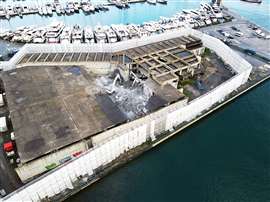 Photo: Despe
The structure sat directly on the marina with exposure to the sea on three sides and was built from lightweight concrete blocks containing polystyrene inserts, materials that, if dispersed, posed a pollution risk to the surrounding waters.
The project proceeded under strict environmental conditions set by the Ministry of Ecological Transition, covering emissions monitoring, ecological protection, hazardous-material verification and logistical management.
Challenges and constraints
The building’s location directly on the Sanremo marina imposed significant design and operational constraints, as the area is subject to environmental protection.
The lightweight concrete blocks with internal polystyrene required careful management to avoid dispersion, particularly in a marine ecosystem.
Before demolition could begin, the Ministry of Ecological Transition imposed five key requirements:
- preparation of a summary report documenting all environmental-mitigation activities;
- continuous monitoring of dust and noise;
- verification of the absence of hazardous materials, including asbestos;
- monitoring of marine biocenosis to detect potential ecological effects;
- and logistical planning to manage the movement of heavy vehicles within the port area.
Despe first secured the site by installing a perimeter scaffold approximately 400 metres long and 9 metres high. Designed to withstand strong sea winds, the scaffold was fully enclosed with double anti-dust sheeting to contain lightweight particles such as polystyrene.
All drains and manholes were hermetically sealed to prevent contaminated water from entering the sea.
These constraints, environmental, regulatory, structural and logistical, required meticulous planning, controlled sequencing and continuous site monitoring.
Equipment and approach
Following site-securing, demolition progressed under a strict, sequential plan designed to minimise dust and polystyrene release. Work began in the interior areas, using the building’s remaining envelope as a containment barrier.
A continuous misting system (“Dust Buster”), consisting of a concrete pump with a high-pressure lance, was employed throughout to suppress airborne dust.
Two specialist operators were dedicated to collecting, vacuuming and bagging polystyrene fragments, with comprehensive site cleaning carried out at the end of each day.
To reduce noise, Despe used hydraulic shears and crushers, avoiding pneumatic equipment and explosives.
The west wall - directly exposed to the sea - required a specialised approach. It was cut into 4-metre-wide sections using a diamond-tooth chainsaw, enabling controlled dismantling with minimal vibration, dust and noise, and without water.
All resulting materials were immediately transported to authorised recycling centres, avoiding temporary storage and supporting circular-economy objectives.
Collaboration and safety
Continuous monitoring of dust, noise and marine biocenosis was integrated into the project to comply with Ministry requirements.
Environmental protections - including double-sheeted scaffolding, sealed drainage, controlled dismantling, misting, and dedicated polystyrene-collection teams - formed part of a comprehensive strategy to prevent pollution and safeguard workers and the surrounding ecosystem.
Coordination among project teams, environmental specialists and regulatory bodies ensured full compliance at every stage.
Materials management and environmental performance
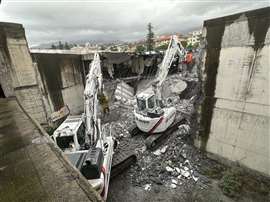 Photo: Despe
All waste produced during demolition was removed from the site immediately and taken to certified recycling centres. This eliminated onsite stockpiling, reduced the risk of accidental dispersion and supported efficient site logistics.
The use of low-impact tools, controlled sequencing and continuous environmental monitoring ensured that the marine ecosystem was protected and that regulatory limits were not exceeded.
Programme and outcome
The project complied with all conditions set by the Ministry of Ecological Transition. Demolition was completed without the release of polystyrene or other pollutants into the sea, and dust and noise remained within the required thresholds.

CONNECT WITH THE TEAM